
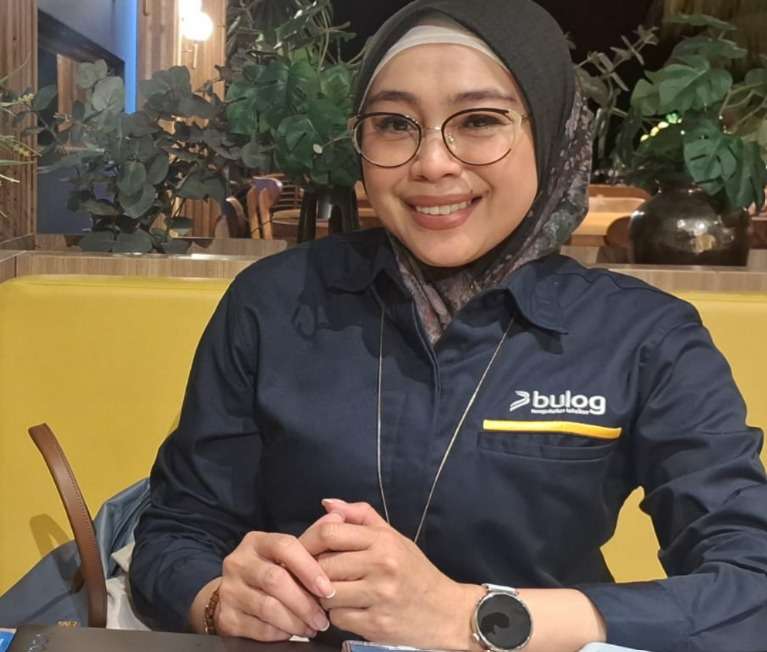
Building a career from a Bulog staff position through marketing, procurement, and business development to regional leadership, Karmila H. Marunta—a graduate of SMK Telkom, the National Institute of Public Administration (LAN), and Hasanuddin University’s Master of Management program, Class XXXI—now faces a different challenge: ensuring the availability of rice and other food commodities amid the geographical complexities and distribution constraints of East Nusa Tenggara.
MARITIMEPOSTS.COM — There is a responsibility in food management that cannot always be measured by the amount of rice stored in warehouses. In an archipelagic province such as East Nusa Tenggara (NTT), success is also determined by the ability to ensure that rice reaches the communities that need it, on time, in sufficient quantities, and at affordable prices.
It is against this backdrop that Karmila H. Marunta, a graduate of the Master of Management program at the Faculty of Economics and Business, Hasanuddin University, carries out her responsibilities as the Regional Head of Perum Bulog in East Nusa Tenggara. The position places her in a working environment that is far from straightforward.
She must manage the organization, ensure adequate stock availability, coordinate inter-island distribution, and build working relationships with local governments, suppliers, transportation companies, and various other stakeholders.
For Karmila, her assignment in NTT is not merely a transfer to another region or another step up the career ladder.
It is an opportunity to apply her extensive experience within Bulog, particularly her experience working in rice-producing regions such as South Sulawesi and West Sulawesi, to address food security challenges in a province that relies heavily on supplies from outside the region.
A long journey with Bulog
Karmila is no newcomer to the world of food management. Her professional journey with Bulog began when she was a graduate of SMK Telkom on Jalan Pettarani, Makassar, around 1997–1998. She took part in the recruitment process and was accepted into an institution that at the time was still part of the State Logistics Agency.
That decision marked the beginning of a career that would take her through various professional functions and assignments in different parts of Indonesia.
Interestingly, Karmila never allowed her professional responsibilities to become a reason to stop pursuing her education. Instead, she viewed education as an investment in herself, rather than simply a requirement for promotion or career advancement.
“I have always believed that if you want to develop yourself, it should not be merely to secure a promotion or advance your career. It should be for your own personal growth,” she said in the interview.
This principle was reflected in her decision to pursue higher education while continuing to work. She completed her undergraduate studies in approximately three and a half years. Following graduation, she was assigned to Kendari through an educational qualification adjustment. After graduating from SMK Telkom, she continued her studies at the National Institute of Public Administration (LAN), at an undergraduate-equivalent level.
Her academic journey continued at Hasanuddin University (Unhas), where she enrolled in the Master of Management program at the Baraya Campus in Makassar between 2009 and 2011. She pursued a master’s degree in Human Resource Economics through an executive program and completed her studies in 2011.
This academic experience provided her with a broader foundation for understanding organizations, not only from an operational perspective but also through the lenses of human resource management, economics, and institutional development.
From marketing to procurement management
Within Bulog, Karmila built her career across several functional areas, gaining a comprehensive understanding of both the company’s commercial activities and its public-service responsibilities.
During the early stages of her career, she served as Head of the Price and Market Analysis Section and was also involved in information technology. These roles introduced her to market intelligence, price monitoring, and data management—essential components of food logistics operations.
After completing her master’s degree, she was promoted to Regional Manager for Asset Optimization.
In 2017, Karmila was appointed Head of the Marketing Division. The position broadened her understanding of Bulog’s commercial operations, which extended beyond rice to other food products such as cooking oil, sugar, and meat.
Not long afterward, she was transferred to Bulog’s headquarters in Jakarta as Head of the Marketing Communication Subdivision.
“That assignment became an important phase in my career. I was involved in efforts to change public perceptions of Bulog, including strengthening product identity and expanding marketing approaches through an umbrella-brand strategy,” she said.
According to her, Bulog was then working to transform its public image so that its rice products would no longer be perceived merely as conventional “Bulog rice,” but could also be positioned as products with stronger quality credentials and a more competitive market identity.
After approximately three years at headquarters, she returned to a regional assignment.
In 2019, she was posted to West Java as Head of the Commercial and Business Development Division.
In 2020, she returned to South Sulawesi and was entrusted with business development responsibilities. Approximately eight months later, she was appointed Head of Procurement.
This role presented a different set of challenges. Rice procurement requires the ability to build relationships with farmers, rice millers, and business partners, while ensuring that procurement targets are achieved. Karmila noted that during this period, Bulog’s South Sulawesi and West Sulawesi operations succeeded in exceeding their procurement targets.
The experience demonstrated that a strong understanding of procurement processes and the ability to build networks are essential assets in managing an organization.
She was subsequently entrusted with leading the Bulog Makassar Branch, coordinating operations across five regencies and municipalities. After approximately two years, she was promoted to Deputy Regional Head of South Sulawesi and West Sulawesi.
After serving in that deputy position for around ten to eleven months, Karmila was appointed to lead Bulog’s East Nusa Tenggara Regional Office, the position she currently holds.
NTT: A different set of challenges
Her experience working in South Sulawesi and West Sulawesi gave her an interesting perspective when she began leading Bulog in NTT.
For Karmila, South Sulawesi is one of Indonesia’s major rice-producing centres, supporting food requirements across eastern Indonesia.
She compares the scale of stock management in her previous assignment with that of her new region.
She explained that Bulog’s managed rice stocks in South Sulawesi and West Sulawesi had once reached approximately 950,000 tonnes, while in NTT the volume under its management was around 20,000 tonnes.
“The difference reflects the distinct characteristics of these two regions. South Sulawesi has a relatively strong production base, whereas NTT is primarily a distribution and consumption region that depends on supplies from elsewhere,” she explained.
As a result, she said, stock management in NTT depends heavily on the smooth flow of interregional distribution.
Rice supplies are brought in from South Sulawesi, East Java, and Sumbawa. However, the movement of goods does not always proceed smoothly. Weather conditions, the availability of large vessels and shipping containers, as well as land transportation conditions in the supplying regions, can all affect delivery schedules.
“Our biggest challenge is the movement of goods. We are highly dependent on weather conditions and on the availability of containers and large vessels,” she said.
Distribution is therefore one of the most significant challenges facing her leadership.
In an archipelagic region, a shortage of stocks does not necessarily mean that rice is unavailable nationally. Rice may be readily available in producing regions but arrive late because of limited shipping capacity or transportation disruptions.
For this reason, Karmila emphasizes the importance of calculating stock requirements and resilience for the next three to six months. Such calculations are essential for anticipating demand and reducing the risk of supply disruptions.
It is worth noting that only a limited number of areas in NTT produce rice, including certain agricultural stretches on Rote Island and in Kupang Regency.
“There are not many, but there are some,” she said.
Managing 11 operational units with limited capacity
Another challenge is the geographical coverage of the region and the distribution of its operational units.
Bulog NTT has one regional office and ten branch offices spread across the province.
Its network covers Kupang, Atambua, Sumba, Labuan Bajo, Rote, and several other areas. Sumba itself has two branch offices.
With this organizational structure, coordination cannot rely solely on administrative communication from the regional office. Regular operational monitoring is essential, particularly regarding stock conditions, the needs of individual areas, and the smooth movement of supplies.
Karmila said that Bulog NTT has approximately 116 personnel managing the entire network.
This figure illustrates how the organization must operate with relatively limited human resources across an extensive service area. Some logistics activities also involve vendors and transportation partners.
On the other hand, Bulog NTT’s storage capacity, according to Karmila, is approximately 19,000 tonnes, distributed across eleven operational units. Improving existing warehouses and expanding storage capacity are important priorities, particularly in regencies and strategic locations with access to ports.
For Karmila, strengthening storage and transportation infrastructure must go hand in hand. Adequate warehouse facilities will have limited value if distribution to target destinations remains constrained.
Consolidation, food availability, and stronger networks
When asked about the key performance indicators guiding her leadership, Karmila identified two main priorities.
First, internal consolidation. Second, ensuring food availability.
Internal consolidation is essential because Bulog NTT manages an operational network spread across areas with different geographical characteristics.
“Every unit must understand its responsibilities, maintain coordination, and work within the same organizational objectives. At the same time, ensuring food availability is our core mandate, and it is non-negotiable,” she explained.
To achieve this, she is working to strengthen cooperation with production regions. Her experience in South Sulawesi and West Sulawesi provides a foundation for establishing communication with procurement partners and Bulog networks in those areas. She has already initiated discussions with partners in South Sulawesi, including those in Wajo, to support rice supplies for NTT.
This approach demonstrates that food management in NTT cannot be carried out in isolation. Strong interregional relationships are essential, particularly with areas that have greater production and procurement capacity.
At the local level, support from regional governments is also important. Karmila said that communication with the governor, deputy governor, and various stakeholders in NTT has been responsive and constructive.
She hopes this support can be further strengthened through greater involvement from the central government, particularly in identifying opportunities to develop logistics infrastructure and accelerate the availability of transportation fleets.
Strengthening logistics and digital monitoring
Discussions about the challenges of managing Bulog NTT reveal several priorities that are central to Karmila’s leadership agenda.
First, strengthening sea transportation capacity. Karmila hopes the central government can help identify and develop NTT’s logistics potential, particularly through the provision of shipping containers and large-capacity vessels.
Second, improving existing warehouses and expanding storage capacity. This is particularly important in strategic locations across regencies and municipalities with port access and the potential to serve as distribution hubs.
Third, strengthening coordination with producing regions. Relationships with South Sulawesi, East Java, and other supplying areas need to be maintained so that NTT’s food requirements can be anticipated well in advance.
Fourth, strengthening information systems and stock monitoring. During the interview, Karmila explained that she was still assessing the organization’s internal conditions before taking further steps. She also mentioned a plan to develop a more integrated monitoring system, including a dashboard that would provide a clearer picture of operational conditions.
The proposed dashboard is important because distribution problems cannot be monitored solely through reports on stocks that have already arrived at warehouses. The organization also needs information about supply movements, arrival schedules, shipping disruptions, and the needs of individual areas.
With an effective monitoring system, decisions can be made more quickly when distribution disruptions occur.
Fifth, maintaining the smooth distribution of rice for public-service needs, including the Food Supply and Price Stabilization Program (SPHP) and government food assistance.
Karmila explained that SPHP rice in NTT is expected to move through the distribution system without remaining in storage for too long, so that it can reach the public promptly. In its operations, Bulog also manages rice under its Public Service Obligation (PSO) mandate, as well as premium rice through its commercial activities.
These two functions must be managed in a balanced manner so that Bulog can fulfil its public-service mandate while continuing to develop its commercial business.
The motivation to lead: Experience, trust, and the opportunity to prove herself
There is an interesting dimension to Karmila’s journey toward regional leadership.
She acknowledged that before being entrusted with leading NTT, she had faced doubts because, at an earlier stage of her promotion within the regional structure, she had not yet held a branch leadership position. However, her experience in procurement, marketing, business development, communication, and organizational management gave her the foundation to take on greater responsibilities.
Her career reflects a gradual process of learning. She did not remain in a single functional area but moved from one division to another, from headquarters to regional assignments, and from a production region to a distribution-dependent region.
These transitions have helped her understand that Bulog’s challenges are not limited to rice procurement and storage. They also involve communication, human resource management, business development, transportation, and public services—all of which are interconnected.
Another source of motivation can be seen in the way she views personal development. As reflected in her stated principle, education should not have to wait for a promotion opportunity. People need to develop their capabilities because doing so is important for their own growth.
Leading Bulog in NTT involves challenges that extend far beyond stocks and distribution. They are closely linked to geographical conditions, infrastructure limitations, supply dependence, and the vulnerability of communities to logistics disruptions.
In areas that rely heavily on supplies from outside the region, disruptions to shipping services can directly affect food availability. Stock management must therefore be supported by effective information systems, warehouse infrastructure, transportation fleets, and interregional coordination.
Karmila brings with her extensive experience within Bulog and an understanding of how producing regions support consumption regions. Her challenge now is to translate that experience into an effective operational system in NTT.
Her success will not be measured solely by the amount of rice stored in warehouses, but also by how resilient the distribution network remains when weather conditions deteriorate, vessels are delayed, or supplies from producing regions are disrupted.
That is the deeper meaning of Bulog’s leadership in an archipelagic province: ensuring that geographical distance does not become a barrier between communities and their access to food.
For Karmila H. Marunta, the responsibility of leading Bulog NTT is an opportunity to demonstrate how experience, organizational capacity, and interregional collaboration can work together to safeguard the community’s food security.
Kupang, 17 November 2026
By Denun