
MARITIMEPOSTS.COM – For many coastal communities across the global south, economic survival relies entirely on the daily extraction of raw fish. This narrow dependence leaves local households exceptionally vulnerable to environmental shifts, seasonal catch fluctuations, and unpredictable market prices.
Without modern cold-chain infrastructure, value-added processing capabilities, or direct access to commercial distribution networks, traditional fishing villages frequently find themselves trapped in a cycle of immediate extraction without long-term value creation.
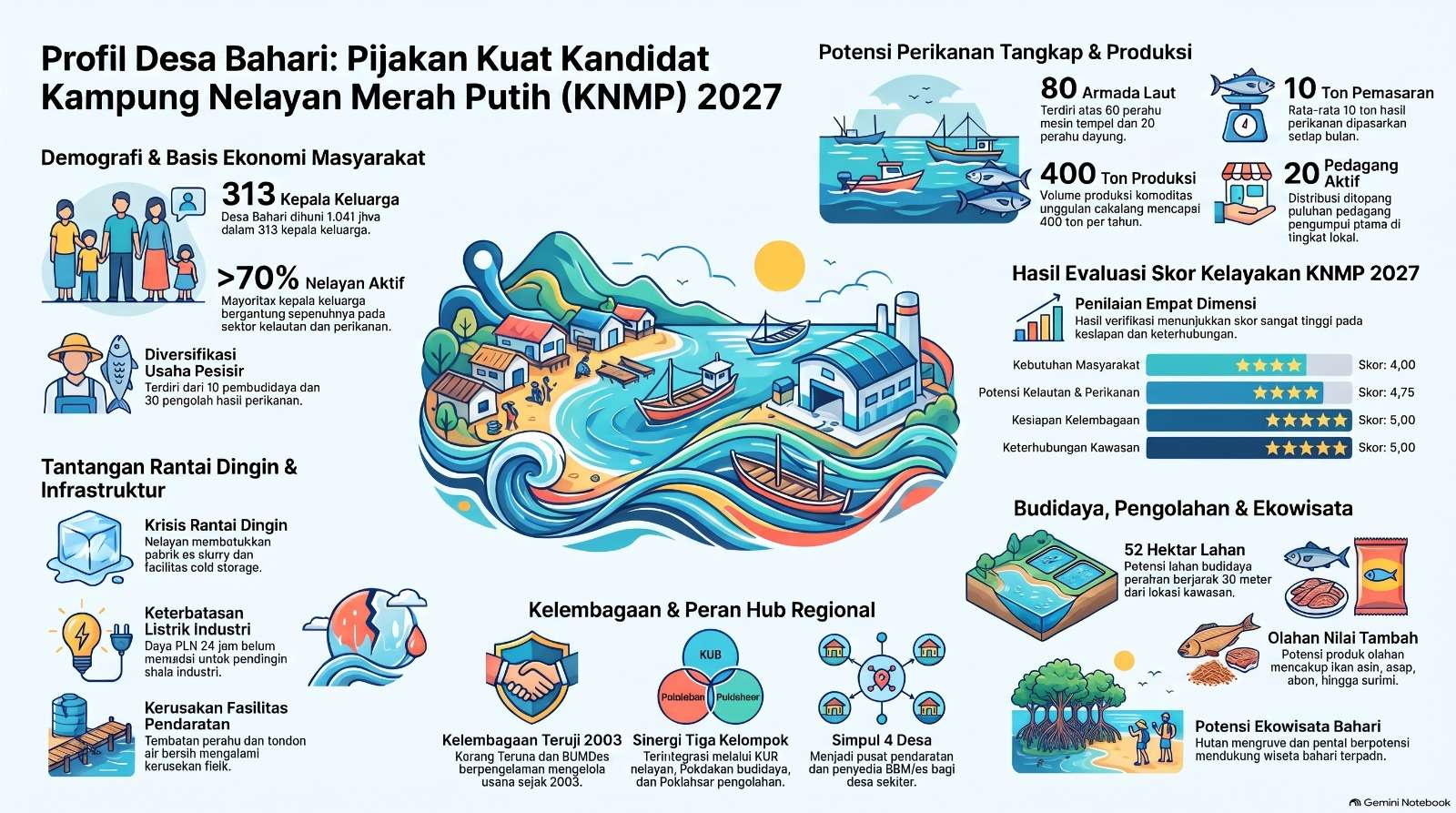
Desa Bahari, located in the Tojo Una Una Regency of Central Sulawesi, presents a compelling case study currently being vetted for Indonesia’s Kampung Nelayan Merah Putih (KNMP) 2027 program.
Home to 313 households and a population of 1,041 residents, over 70 percent of the village’s household heads rely directly on marine resources for their primary livelihood.
As development planners and marine economists assess the area’s potential, Desa Bahari offers an instructive look into a fundamental economic question: What does it take to transform a traditional fishing village into an integrated, self-sustaining maritime hub?
Fishery Isn’t Just an Occupation—It’s an Integrated Micro-Economy
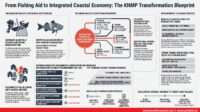
Desa Bahari’s economic structure demonstrates that a remote fishing village can operate as a multi-tiered micro-economy long before major industrial investments arrive. While the primary extraction phase is driven by a small-scale fleet—consisting of 60 outboard motorboats under 5 Gross Tons (GT) and 20 non-motorized or paddle boats utilizing handlines, longlines, bagan, and anco gear—the community’s capture profile is remarkably diverse. Beyond pelagic staples like skipjack tuna (cakalang), frigate tuna (tongkol), and yellowstripe scad (selar), local fishermen regularly harvest high-value reef species, including snapper (kakap), grouper (kerapu), anchovies (teri), and coral trout (sunu).
                  [ Desa Bahari Micro-Economy ]
                               |
       +-----------------------+-----------------------+
       |                                               |
[ Capture Fleet ]                          [ Diversified Workforce ]
 • 60 Motorboats (<5 GT)                    • ~10 in Aquaculture / Seaweed
 • 20 Non-motorized Boats                   • ~30 in Fish Processing
 • Handlines, Bagan, Anco                   • 20 Primary Collectors / Buyers
 • Species: Cakalang, Tongkol,              • Direct Local & Restaurant Supply
   Selar, Kakap, Kerapu, Sunu, Teri
Crucially, the workforce is already organically organized beyond direct sea-going extraction. The local economy supports approximately 10 individuals dedicated to fish and seaweed aquaculture, alongside 30 workers focused specifically on post-harvest fish processing.
Rather than sending raw catches through lengthy intermediary channels, the village benefits from a surprisingly short supply chain. Fresh catches flow directly from local fishermen to household consumers, local culinary outlets, or through 20 primary collectors and key buyers active in the area, such as Ismail Dg Marawa, Burhanudin, and Mila.
Because structural integration between capture, processing, and distribution already exists at the grassroots level, Desa Bahari provides an established operational baseline. Rather than constructing socio-economic systems from scratch, public and private interventions can directly build upon a pre-existing network of local producers, processors, and traders.
The Cold Chain Gap is the Only Barrier to 500 Tons of Potential
The primary constraint on Desa Bahari’s economic growth is not a resource deficit, but a severe physical infrastructure bottleneck. The village yields significant annual capture volumes: its primary commodity, skipjack tuna (cakalang), reaches an estimated 400 tons per year, while secondary commodities such as frigate tuna (tongkol) and yellowstripe scad (selar) add another 100 tons annually. However, official verification data shows that average marketed volumes hover around only 10 tons per month—or 120 tons per year.
+-----------------------------------------------------------------------+
|                       ANNUAL PRODUCTION METRICS                       |
+----------------------------------------------------+------------------+
| Primary Commodity: Skipjack Tuna (Cakalang)        | 400 Tons / Year  |
| Secondary Commodities: Frigate Tuna & Scad         | 100 Tons / Year  |
| Total Combined Capture Potential                   | 500 Tons / Year  |
+----------------------------------------------------+------------------+
| Currently Marketed Volume (10 Tons / Month)        | 120 Tons / Year  |
| ANNUAL MARKET LEAKAGE (Post-Harvest Loss/Distress) | 380 Tons (76%)   |
+----------------------------------------------------+------------------+
This quantitative discrepancy reveals a stark economic reality: an estimated 380 tons per year—roughly 76 percent of the village’s total catch potential—is lost to rapid post-harvest degradation, distress selling, or unmonitored subsistence consumption. Due to preservation limits at sea and onshore, ex-vessel fish prices experience severe volatility.
Under normal conditions, baseline market prices at the fisherman level rest at Rp 40,000 per kilogram, but routinely plummet to Rp 25,000 per kilogram during peak landings due to a lack of cold-chain preservation facilities.
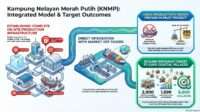
Overcoming this price degradation requires targeted cold-chain infrastructure, including slurry ice production, dedicated onshore cold storage units, commercial-grade coolboxes, hygienic fish landing sites, and streamlined distribution of subsidized vessel fuel (BBM).
“Developing the coastal economy requires more than isolated physical construction; it demands reinforcing the entire business chain—from sea-going supplies and hygienic landing facilities to quality preservation, cold storage, and formal off-taker partnerships.”
52 Hectares of Untapped Potential Sitting 30 Meters Away
Beyond wild capture fisheries, Desa Bahari possesses substantial physical capacity for economic expansion through structured aquaculture and value-added processing. Official site verifications have identified 52 hectares of potential marine and brackish cultivation waters situated just 30 meters from the candidate KNMP site. Existing, unutilized pond areas present immediate opportunities for productive revitalization.
The technical cultivation opportunities spans three distinct ecosystems:
- Marine Finfish (Floating Net Cages / Keramba Jaring Apung): High-value species including grouper (kerapu), snapper (kakap), and pompano (bawal bintang).
- Brackish Ponds & Shellfish (Revitalisasi Tambak & Specialized Gear): Vaname shrimp, tiger shrimp (udang windu), lobster, swimming crab (rajungan), pearl oysters (tiram mutiara), and mud crab (kepiting bakau) utilizing vertical crab bucket recirculation systems.
- Freshwater & Inland Systems: Tilapia (nila), patin, and catfish (lele) adjusted to local water characteristics.
[ Raw Supply Inputs ]     [ Production & Processing ]      [ Market Channels ]
 • Skipjack & Tuna         • Joint Production Houses        • Local Markets
 • Reef Fish & Scad        • Hygienic Processing & Packaging• Regional Hubs
 • Cultivated Finfish      • Sanitation Infrastructure      • National Networks
 • Crabs & Shellfish       • Output Products: Salted/Dried, • Export Channels
                             Smoked, Anchovies (Teri), Abon,
                             Fish Meatballs, Surimi Paste
With an abundant, year-round raw fish supply, value-added processing offers a clear pathway to eliminate post-harvest waste. Establishing communal processing centers, packaging facilities, and sanitary production spaces will allow the village to process fresh fish into shelf-stable goods such as dried/salted fish, dried anchovies (teri), smoked or grilled fish, fish floss (abon), fish meatballs, nuggets, and minced fish paste (surimi). Converting highly perishable raw fish into high-margin, shelf-stable goods positions the community to supply regional, national, and international export markets.
Grassroots Institutions Are Already Battle-Tested
Infrastructure investments in remote coastal regions frequently fail if local operational capacity is absent. In Desa Bahari, social capital and institutional governance are already well-established. Community management bodies, including the local Village-Owned Enterprise (BUMDes) and Karang Taruna, are legally incorporated and hold over five years of active management experience, with institutional foundations tracing back to 2003.
                     [ Village Administration ]
                   (Led by Headman Samsir Beto)
                                |
        +-----------------------+-----------------------+
        |                                               |
[ Formal Management ]                        [ Targeted Producer Groups ]
 • BUMDes                                     • Capture: KUB
 • Karang Taruna                              • Aquaculture: Pokdakan
 • Track Record: Landing piers, ice machines, • Processing/Marketing: Poklahsar
   gear kiosks, culinary/processing ventures
Crucially, these entities possess a documented operational track record. Historically, local management has operated landing piers and docks, managed small-scale ice-making machinery, run production input and fishing gear kiosks, and overseen community culinary and processing ventures. They are supported by specialized producer groups:
- Capture Fisheries: Kelompok Usaha Bersama (KUB)
- Aquaculture: Kelompok Pembudidaya Ikan (Pokdakan)
- Processing & Marketing: Kelompok Pengolah dan Pemasar Hasil Perikanan (Poklahsar)
Village Head Samsir Beto actively coordinates community readiness, while these organized groups have formally committed to managing planned landing piers, cold storage facilities, ice plants, fuel distribution kiosks, gear stores, and culinary hubs under the KNMP framework.
“Long-term sustainability cannot be achieved through physical construction alone. It depends fundamentally on the capacity of local management and community ownership to run, maintain, and commercially grow those facilities over time.”
The “Regional Hub” Strategy—Serving Four Villages at Once
Desa Bahari’s strategic value extends beyond its immediate administrative boundaries. The village is geographically positioned to function as a central commercial and service hub for at least four surrounding coastal communities. By centralizing core assets—such as joint fish landings, auctions, ice production, fresh water supply, and dedicated vessel fuel stations—it can act as a regional economic engine for the entire sub-district.
+-----------------------------------------------------------------------+
|                    OFFICIAL KNMP EVALUATION SCORES                    |
+----------------------------------------------------+------------------+
| Dimension                                          | Score            |
+----------------------------------------------------+------------------+
| Community Needs (Kebutuhan Masyarakat)             | 4.00 / 5.00      |
| Marine & Fisheries Potential (Potensi Perikanan)   | 4.75 / 5.00      |
| Local Readiness (Kesiapan Kelembagaan)             | 5.00 / 5.00      |
| Regional Connectivity (Konektivitas Kawasan)       | 5.00 / 5.00      |
+----------------------------------------------------+------------------+
Official government evaluations reflect this strategic potential, granting Desa Bahari high marks across four core dimensions: 4.00 for Community Needs, 4.75 for Marine & Fisheries Potential, 5.00 for Local Readiness, and 5.00 for Regional Connectivity.
However, an economic analysis reveals a notable infrastructure paradox when contrasting these high scores against ground-level constraints:
Power vs. Industrial Load: The village possesses 24-hour PLN grid electricity and stable 4G telecommunications. However, the current electrical grid capacity is scaled strictly for domestic household use and requires industrial upgrading to power commercial ice plants and deep-freeze cold storage facilities.
Water Supply Continuity: Fresh water is sourced from clear, odorless dug wells (sumur gali) and drilled wells (sumur bor). Yet, supply continuity is unreliable, forcing residents to ration water—a critical bottleneck for processing plants that demand continuous, hygienic fresh water.
Physical Assets in Disrepair: While basic structures exist—such as boat moorings, landing shelters, and water reservoirs—key assets are currently damaged or dilapidated, requiring systematic revitalization alongside new construction.
Logistical Access Realities: Despite a 5.00/5.00 score in Regional Connectivity, overland access is restricted to narrow concrete footpaths (rabat beton) accessible only to two-wheeled vehicles and handcarts. Meanwhile, maritime transport relies on unscheduled, chartered boats rather than regular commercial routes.
Conclusion: Beyond the Scorecard
Desa Bahari’s status as a top-tier candidate for the KNMP 2027 initiative is justified by its strong baseline data, active institutional framework, and high official evaluation scores.
Yet, moving from raw potential to a thriving blue economy requires resolving concrete operational bottlenecks. Unlocking the village’s full potential depends on upgrading grid power, securing continuous fresh water, deploying reliable cold-chain systems, and connecting local producers directly to formal market off-takers.
If public infrastructure investments can successfully resolve these operational gaps in remote locations like Desa Bahari, this small village could serve as a national blueprint for sustainable marine development—proving that targeted capital, combined with strong local governance, can transform isolated fishing settlements into vital nodes of the global blue economy ahead of the KNMP 2027 deployment.