
Discussing the resource curse, China’s dominance, low-carbon concrete from nickel slag and the path to green industrialisation
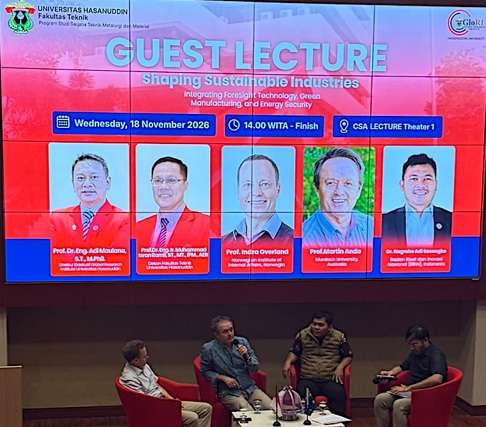
MARITIMEPOSTS.COM – MAKASSAR — The Global Research Institute (GloRI) of Universitas Hasanuddin (Unhas), together with the Undergraduate Program in Metallurgical and Materials Engineering, Faculty of Engineering, held a guest lecture titled Shaping Sustainable Industries: Integrating Foresight Technology, Green Manufacturing, and Energy Security on Wednesday, 18 November 2026.
Held at CSA Lecture Theater 1 from 14.00 WITA, the lecture brought together experts from Norway, Australia and Indonesia’s National Research and Innovation Agency (BRIN) to discuss how industry, particularly the minerals and metallurgy sector, can grow without sacrificing the environment.
The three speakers were Prof. Indra Overland of the Norwegian Institute of International Affairs (NUPI), Associate Professor Martin Anda of Murdoch University, Australia, and Dr. Ir. Nugroho Adi Sasongko, S.T., M.Sc., MBA, IPU, of BRIN. GloRI Executive Director Prof. Dr. Eng. Adi Maulana, S.T., M.Phil., was unable to attend and was represented by GloRI Secretary Andi Imam Arundhana Thahir, S.Gz., MPH, Ph.D.
The Dean of the Faculty of Engineering, Prof. Dr. Eng. Ir. Muhammad Isran Ramli, S.T., M.T., IPM., AER., was represented by Vice Dean Prof. M. Bachtiar Nappu, S.T., M.T., M.Phil., Ph.D.
Around 200 participants attended, including students and lecturers of the Metallurgical and Materials Engineering program, among them Head of Program Dr. Hairul Arsyad, S.T., M.T., and Dr. Eng. Lukmanul Hakim Arma, S.T., M.T., Chair of the Thematic Research Group (TRG) on Critical and Rare Earth Metals.
In his opening remarks, Prof. M. Bachtiar Nappu welcomed the speakers from various institutions and thanked them for sharing their expertise with the faculty’s students. He also expressed hope that BRIN would act as a catalyst for the development of science and technology in Indonesia and support the research ecosystem in universities.
Critical minerals are not “the new oil”
In his talk, Critical materials: a realistic take, Indra Overland, who is also a Research Associate at the Oxford Institute for Energy Studies, urged a more measured view of critical minerals. Demand will rise sharply by 2050, and that horizon is closer than it seems, since a new mine can take 10 to 20 years to open.
Overland rejected the assumption that critical minerals inevitably bring a “resource curse”. The Democratic Republic of the Congo, often cited as proof, is a poor example: its problems stem largely from its colonial legacy, large post-independence wars and weak infrastructure, not from cobalt mining itself.
He pointed to nickel in Indonesia and aluminium in Kalimantan as cases where resource extraction need not lead to a curse.
The resource curse was real in the 1960s to 1980s, Overland acknowledged, affecting countries including Norway and Indonesia, when oil revenue flowed straight into state budgets and swung with oil prices.
Today the landscape is different. Sovereign wealth funds have proven able to buffer volatile revenue, ESG frameworks and organisations such as EITI strengthen accountability, and countries can draw on established templates for licensing, revenue management and environmental standards.
China’s edge lies in processing
Overland argued that geopolitics and reserves are overrated, while industrial policy, trade and manufacturing are underrated. China’s advantage lies in processing, not extraction; its share of global reserves is actually shrinking as more countries discover and develop deposits. Its processing dominance rests on generally well-targeted subsidies, economies of scale, vertical integration and a complete industrial ecosystem.
He warned that clean-energy technology moves fast and unpredictably. Norway learned this the hard way: Morrow Batteries, backed by government-guaranteed loans, went bankrupt after China moved through two technology cycles, from lithium-ion to LFP to sodium-ion, in the time it took to plan and build a single Norwegian factory.
He also identified hydrogen and carbon capture and storage (CCS) as overrated, warning that public money channelled into them risks being wasted.
He closed with what he called the “China dilemma”. On one hand, China’s dominance makes it hard for developing countries to build their own industries; Indonesia’s nickel success, he said, is often overstated, as the technology remains largely Chinese-controlled and most profits flow to Chinese firms.
On the other hand, China is making the largest contribution of any country to global climate mitigation. Its clean-technology exports in 2026 alone are estimated to offset emissions equivalent to Brazil’s entire fossil-fuel CO₂ emissions.
Nickel waste for low-carbon concrete
Martin Anda presented Mine & Refinery Waste Characterisation for Low-Carbon Concrete, drawing on a research project with PATREC and DTMI in Western Australia.
Cement production accounts for around 8 per cent of global CO₂ emissions, and about 60 per cent of those emissions come from the chemistry of making clinker rather than from fuel. Switching fuels alone is therefore not enough; less clinker must be used.
Mining and refinery residues such as nickel slag, he explained, can partly replace cement, serve as a geopolymer precursor, or substitute for sand and stone as aggregate, turning a storage liability into a useful product.
Each residue must be tested in stages, from material characterisation and reactivity screening to strength and durability tests on the finished concrete.
Safety is a gate, not a footnote: leaching tests must confirm that hazardous metals are not released into the environment. He also referred to the Bantaeng Industrial Estate as a source of nickel slag, the UNHAS RISE project, and New Colombo Plan students working on solar-powered seawater desalination.
Reading the direction of technology
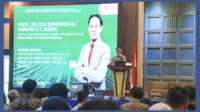
Nugroho Adi Sasongko of BRIN presented Technology Foresight and Sustainable Industrialisation, highlighting the importance of anticipating technological change early so that Indonesia’s industrialisation moves in a sustainable direction.
Nugroho posed a central question: can Indonesia become a developed country by 2045? The answer, he argued, lies in manufacturing.
Comparing income per capita with the share of manufacturing in national economies, he presented projections of Indonesia’s position to 2041 under four growth scenarios towards 2045. Countries that have moved up the income ladder generally have a larger manufacturing share in their economies.
He also traced the development of Indonesia’s science, technology and human resources over three decades. Patent applications in Indonesia have risen steadily, reaching 10,902 in 2024, ranking Indonesia second among the nine ASEAN countries compared, behind Singapore.
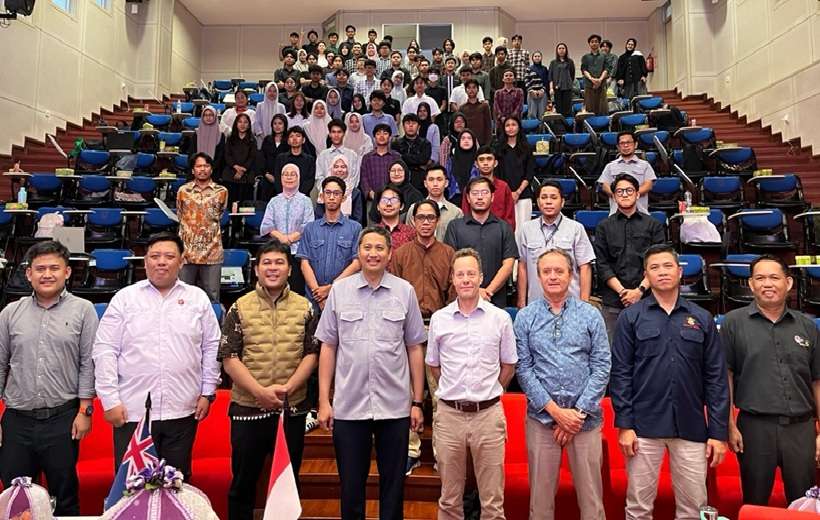
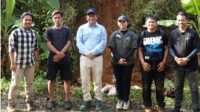
Speakers, leaders of the Faculty of Engineering and the Global Research Institute (GloRI) Unhas, lecturers and students of the Metallurgical and Materials Engineering program pose for a group photo after the guest lecture Shaping Sustainable Industries at Universitas Hasanuddin.
The lecture is especially relevant to Sulawesi, now one of Indonesia’s main hubs for nickel downstreaming. Downstreaming that pursues not only added value, but also lower emissions and productive use of its waste is in line with the Sustainable Development Goals (SDGs), particularly Goal 9 on industry, innovation and infrastructure, Goal 12 on responsible consumption and production, and Goal 13 on climate action.
Through events like this, GloRI Unhas aims to strengthen international research networks in metallurgy, critical minerals and energy, and to open opportunities for research collaboration and student exchange with partners in Norway and Australia for the Unhas academic community, particularly the Faculty of Engineering.