
MARITIMEPOSTS.COM – The diving industry needs more than people who are skilled at exploring the underwater world.
More importantly, developing human resources in the marine sector requires instructors who are committed to sharing knowledge, establishing safety standards, and preparing a new generation of divers capable of supporting marine education and research.
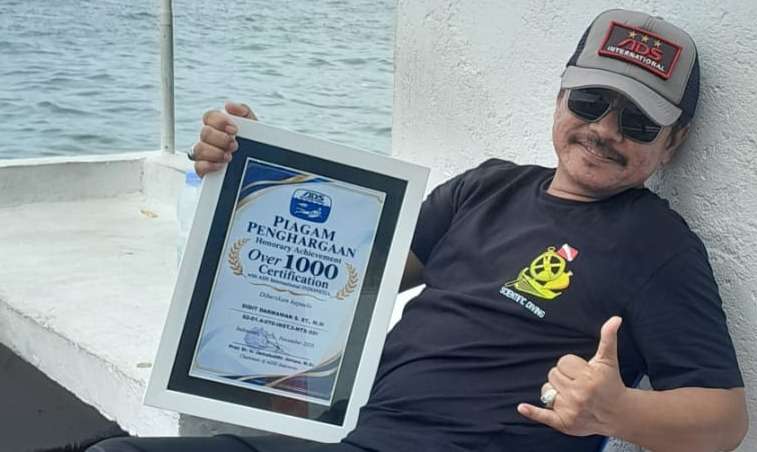
A longstanding dedication to this field has earned Didit Darmawan S., S.T., M.Si., popularly known as Didot, an honorary award titled Honorary Achievement: Over 1000 Certification with ADS International INDONESIA in November 2026.
The award recognizes his contribution to delivering more than one thousand certifications through the Association of Diving School International (ADS International Indonesia). The certificate bears registration number 62-01.4-070-INST.3-NTX-SDI and is signed by Prof. Dr. Ir. Jamaluddin Jompa, M.Sc., Chairman of ADSI Indonesia.
Achieving more than one thousand certifications is not merely an administrative milestone. Behind this number lies a long process of mentoring, knowledge transfer, skills training, and professional guidance for individuals seeking to develop their competencies in diving.
From Diving Skills to Marine Education
Based in Makassar, South Sulawesi, Didit Darmawan is an experienced marine professional and diving instructor. His professional credentials include several instructor licenses, among them those issued by ADS International, POSSI, which is affiliated with CMAS, as well as a First Aid Instructor qualification from NAUI.
This combination of competencies demonstrates that diving requires a broader range of expertise than simply mastering breathing equipment, buoyancy control, or underwater exploration.
Safety, knowledge of marine ecosystems, emergency procedures, and the ability to conduct observations and collect data are all essential components of a diver’s professional development.
Through various educational and training activities, Didit has contributed to expanding this understanding. His work extends across universities, vocational education institutions, and capacity-building initiatives in marine tourism.
At Khairun University (Unkhair) in Ternate, for example, Didit has participated in educational activities and the development of diving competencies. He has also served as a resource person and instructor in scientific diving certification programs at Unkhair’s Faculty of Fisheries and Marine Science (FPIK), involving Marine Science students and faculty members.
This involvement is particularly relevant to the need for universities to strengthen human resource capacity in underwater research. Marine science students and researchers cannot rely solely on classroom-based knowledge of oceanography, marine ecology, or research methodologies. They also need the technical skills required to conduct direct observations of underwater ecosystems.
Beyond higher education, Didit’s experience also extends to marine tourism and vocational training. He has participated in dive tour guide training programs organized in collaboration with the South Sulawesi Office of Culture and Tourism and has taught introductory diving equipment courses at Makassar Tourism Polytechnic.
These activities illustrate how diving competencies can serve a wide range of purposes, from education and research to occupational safety and marine tourism development.
Strengthening the Tradition of Scientific Diving
One important area for the advancement of diving in Indonesia is scientific diving.
The importance of this field continues to grow alongside increasing research activities in coastal and marine ecosystems. These include coral reef monitoring, marine biodiversity inventories, underwater habitat assessments, and data collection to support the management of marine conservation areas.
Scientific diving differs from recreational diving in both purpose and practice. Its objective goes beyond the experience of exploring the underwater environment. Instead, it supports research activities through established safety procedures, observation methods, documentation standards, and accountable data collection protocols.
Experienced instructors therefore play a strategic role in connecting diving skills with academic and research requirements. They help ensure that divers are not only capable of working underwater but also understand their scientific responsibilities and the importance of safety throughout their activities.
For Indonesia, an archipelagic nation with extraordinary marine ecosystem diversity, strengthening these capabilities represents an important investment. This need is particularly evident in eastern Indonesia, a region with significant marine biodiversity that requires more skilled personnel to support research and sustainable coastal resource management.
More Than an Award: A Record of Dedication
The Honorary Achievement: Over 1000 Certification award received by Didit Darmawan can be seen as recognition of his consistent efforts to develop human resources in the diving sector.
More than one thousand certifications represent a considerable number of individuals who have undergone education and training. Each carries competencies that can potentially be applied in professional activities, education, research, and the broader development of Indonesia’s marine sector.
The next challenge is certainly not just to increase the number of certified divers, but also to ensure that their competencies continue to grow and generate tangible benefits for communities and marine resource management.
Indonesia needs a diving ecosystem that goes beyond certification numbers. It must also uphold safety, ethics, methodological proficiency, and responsibility toward the marine environment.
In this context, Didit Darmawan’s professional journey deserves recognition. The award is not merely a marker of personal achievement; it is also a reminder that strengthening marine sector capacity requires the sustained efforts of instructors, educators, and practitioners willing to pass on their knowledge to the next generation.
Beyond one thousand certifications, the more meaningful contribution lies in how many people have gained the skills, confidence, and sense of responsibility to work and contribute to the future of Indonesia’s oceans.
Editor: Denun