
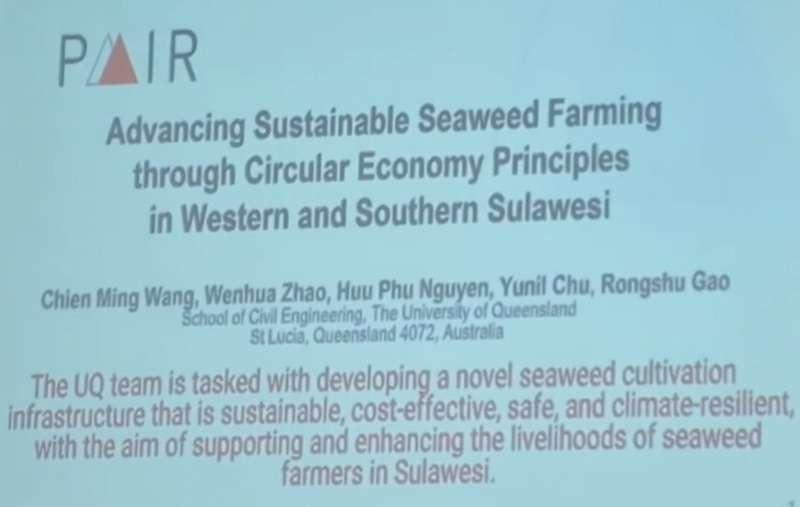
MARITIMEPOSTS.COM – MAKASSAR – A research team from the University of Queensland (UQ), Australia, has introduced an innovative semi-submersible seaweed cultivation raft designed to improve the resilience of seaweed farming against extreme weather while enhancing productivity and supporting the livelihoods of seaweed farmers in Indonesia.
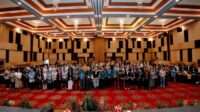
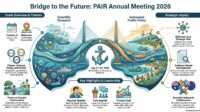
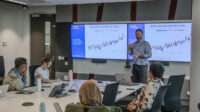
The innovation was presented virtually by Prof. Wang during the PAIR Annual Meeting 2026, held at the Unhas Hotel and Convention, Makassar, on Wednesday (22 July 2026).
Although he was unable to attend in person due to medical reasons, Prof. Wang shared the latest progress of the research being conducted by the University of Queensland team.
Together, they are developing a seaweed cultivation infrastructure that is sustainable, safe, cost-effective, and highly resilient to dynamic marine conditions.
“We are developing a new seaweed cultivation infrastructure that is sustainable, cost-effective, safe, and highly resilient, with the aim of supporting and improving the livelihoods of seaweed farmers in Sulawesi,” Prof. Wang said.
One of the project’s key achievements is the design of a semi-submersible cultivation raft capable of lowering itself several metres below the sea surface during periods of high waves or storms. By submerging beneath surface turbulence, the system is expected to protect cultivated seaweed from wave damage, one of the primary causes of infrastructure losses in conventional seaweed farming.
The pilot trial is scheduled to take place in September or October 2026 through a collaboration involving three key partners. The University of Queensland is responsible for the engineering design, structural analysis, and technical support throughout the demonstration.
Dow Agro, the project’s industry partner, will provide financial support for the procurement of materials, fabrication, and deployment of the pilot raft. Hasanuddin University will oversee farming operations, including seeding, maintenance, monitoring, harvesting, and evaluating seaweed growth performance.
The pilot site has been selected off the coast of Kolaka, where the water depth is approximately 15 metres, with average wave heights of one metre, a wave period of four seconds, and current speeds of around 0.3 metres per second. These conditions are considered representative of seaweed farming areas that require infrastructure capable of withstanding dynamic ocean conditions.
The raft design incorporates four buoyancy units positioned at each corner to support a square cultivation platform. A mechanical system mounted on the buoys enables the cultivation ropes and raft to be lowered several metres below the water surface whenever severe weather conditions arise. The entire structure is secured by concrete anchor blocks placed on the seabed to ensure stability.
Prof. Wang explained that each buoy incorporates several engineering features to maintain structural balance, including aluminium bridge frames, rope guide rollers, and adjustable counterweight systems using concrete weights and water ballast.
These components allow the buoyancy system to remain level while operating under varying environmental loads.
To enhance safety, the interior of each buoy is filled with polystyrene foam, ensuring that it remains afloat even if the buoy shell is punctured. The research team has also conducted comprehensive hydrodynamic and hydroelastic simulations to evaluate structural deformation, rope tension, and mooring performance under wave and current loading, ensuring that every component remains strong and safe under extreme sea conditions.
According to Prof. Wang, every component of the pilot raft has been designed according to detailed engineering specifications, including material selection, dimensions, component lengths, and required quantities.
Looking ahead, the research team is developing a larger semi-submersible platform featuring an octagonal layout. The octagonal configuration offers more load distribution points, allowing wave and mooring forces to be spread more evenly than in the current square design, thereby improving structural performance.
The next-generation system will also incorporate automation through movable buoys powered by solar panels. Electric motors installed inside the buoys will enable them to move along the mooring lines, automatically raising or lowering the cultivation platform with minimal manual intervention.
“We are very excited about this design and will continue conducting rigorous analysis to ensure it performs optimally in seaweed farming environments, including in Takalar,” Prof. Wang said.
The development of the semi-submersible seaweed cultivation raft is expected to become an important innovation in strengthening the resilience of Indonesia’s seaweed farming sector against climate change and increasingly extreme ocean conditions. Through collaboration among universities, industry partners, and Indonesian research institutions, the technology is expected to enhance productivity while promoting a more sustainable and climate-resilient seaweed farming industry across coastal communities.