
By Kamaruddin Azis
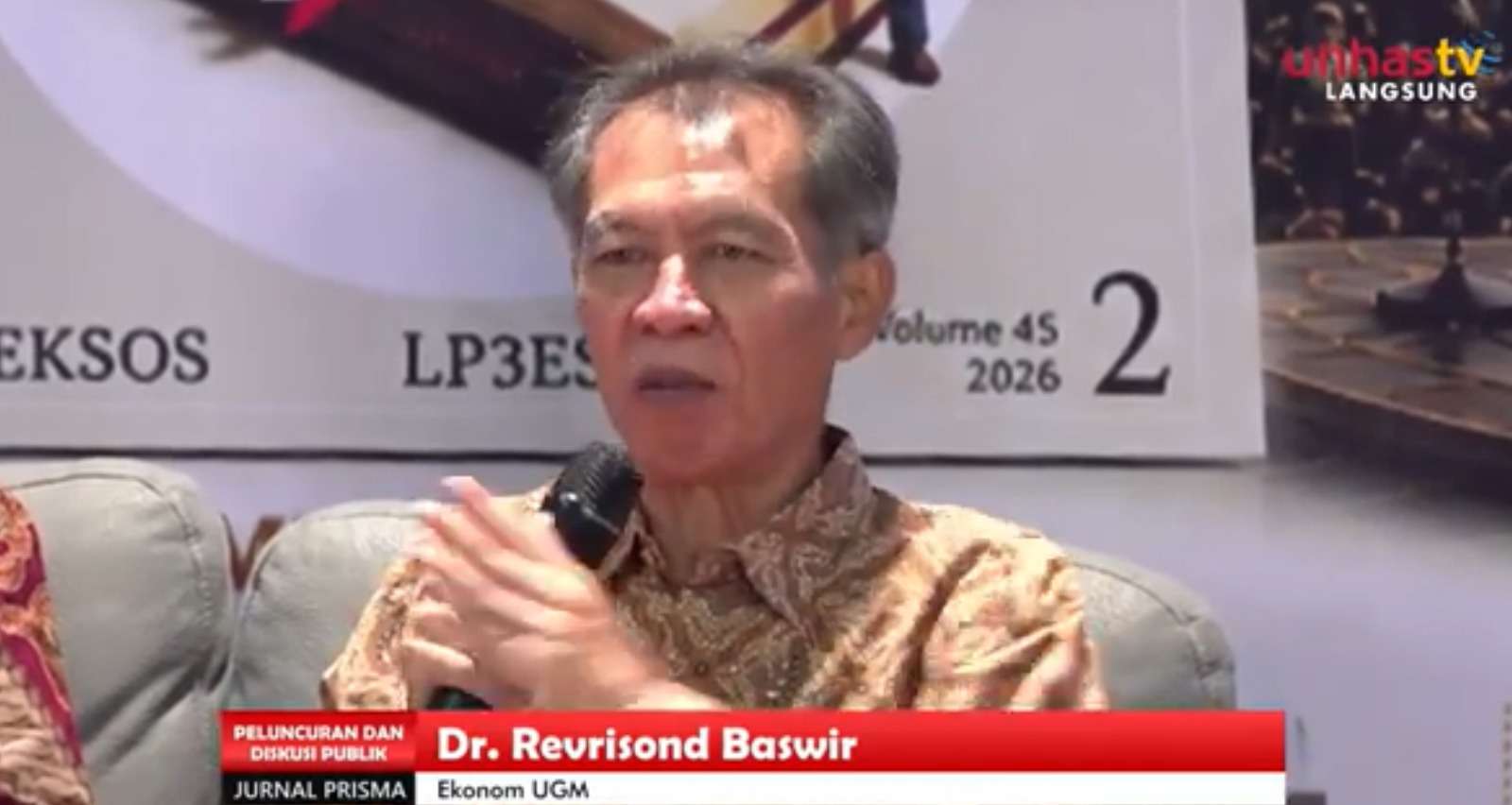
Based on a Conversation with Dr. Revrisond Baswir at the Unhas TV Studio
MARITIMEPOSTS.COM – There is an intriguing story behind the name Revrisond Baswir. When he was born, his father named him “Revrisound”—a combination of two English words: revolution and sound. Over time, school administrators and official documents simplified it into “Revrisond.”
Yet one thing never changed: he remains one of Indonesia’s most persistent voices reminding the nation not to lose its direction in economic development.
For decades, the economist from Gadjah Mada University has dedicated his intellectual life to defending the ideas of Pancasila Economics, people-centered economics, and constitutional economics. Amid the powerful currents of liberalization and market-oriented development, Baswir continues to ask a simple but fundamental question:
Who is Indonesia’s economic development actually for?
During a recent conversation at the Unhas TV Studio, that question resurfaced with remarkable urgency. What followed was a thoughtful yet piercing critique of Indonesia’s post-Reformasi economic journey.
Thirty Years of Returning to Zero
Baswir describes Indonesia’s current condition through a simple but unsettling metaphor.
“We have been spinning around from zero for thirty years.”
According to him, every new administration arrives with fresh slogans, new priorities, and ambitious programs. Yet the discussions always seem to return to the same themes: investment targets, economic growth rates, debt ratios, and various technocratic indicators.
What is missing is a serious conversation about the ultimate purpose of the state.
Indonesia remains busy discussing economic instruments while neglecting the broader destination. As a result, development appears highly active but lacks a clear trajectory. Infrastructure expands, economic figures improve, yet the fundamental challenges faced by ordinary citizens remain largely unchanged.
For Baswir, this is why Indonesia often feels as though it is endlessly rereading the first chapter of a book without ever reaching the next.
When the Language of the Constitution Disappears
Baswir’s concern extends beyond economic policy itself. He points to something even more fundamental: the disappearance of constitutional language from Indonesia’s development discourse.
He recalls reviewing regional development plans and searching for a single word: cooperative.
It was almost nowhere to be found.
The same absence applies to terms such as economic democracy, the principle of familyhood (asas kekeluargaan), and other concepts explicitly embedded in Article 33 of the 1945 Constitution.
To Baswir, this is not merely a linguistic issue.
When constitutional vocabulary disappears, what actually vanishes is a particular worldview. The nation gradually abandons the economic vision of its founders and replaces it with language imported from global markets, consulting firms, and investment-driven development frameworks.
The result is subtle but profound: public policy begins to prioritize investor confidence over citizen sovereignty.
Cooperatives as Schools of Democracy
In contemporary Indonesia, cooperatives are often perceived as outdated institutions—small, inefficient, and suitable only for those left behind by modern capitalism.
Baswir rejects this perception entirely.
Drawing from his observations in the Czech Republic, he explains that children there are introduced to cooperative principles from an early age. Cooperatives are not viewed as economic shelters for the poor but as institutions for learning democratic citizenship.
Why?
Because within a cooperative, an individual is not merely a worker or a consumer. They are also an owner. They possess voting rights and participate in determining the organization’s direction.
In conventional corporations, people often function primarily as economic instruments. In cooperatives, they become active subjects.
According to Baswir, a healthy political democracy cannot thrive without economic democracy.
Cooperatives therefore should not be regarded merely as business entities. They are schools where citizens learn responsibility, participation, and collective decision-making.
The Myth of Economic Transformation
Indonesia is frequently praised for its successful transition from an agrarian economy to a service-based economy.
Baswir urges us to examine this narrative more carefully.
Has genuine transformation actually occurred?
He offers a familiar example: a farmer who cultivates crops during the planting season but drives a motorcycle taxi in the city when agricultural work dries up.
In economic statistics, this individual may be recorded as evidence of structural transformation toward the service sector.
In reality, however, he is simply struggling to survive.
What is occurring is not necessarily movement toward higher productivity and prosperity. Rather, it is movement from one form of vulnerability to another.
Classical development theory suggests that successful transformation occurs when labor shifts from agriculture to industry and eventually into high-value service sectors.
Indonesia, Baswir argues, largely skipped the industrial stage.
Many workers left agriculture without ever entering a strong manufacturing sector. Instead, they moved directly into low-productivity informal services.
The result is a service economy that often masks persistent insecurity.
Inequality Is About More Than Income
When discussing inequality, Baswir does not immediately refer to Gini coefficients or poverty statistics.
Instead, he shares a childhood memory.
Growing up in a mining company settlement, there was a movie theater reserved exclusively for elite staff. Children from ordinary workers’ families were not allowed inside.
To watch the films, he and his friends would sneak through dark drainage culverts.
The memory remains vivid.
For Baswir, inequality is not simply about income. It is about access, recognition, and dignity.
That drainage tunnel symbolizes something deeper: the existence of spaces from which certain citizens are excluded.
In many ways, he believes this reality persists today.
Skyscrapers rise. Exclusive districts expand. Economic growth is celebrated.
Yet millions remain outside the gates.
Development cannot be measured solely by financial indicators. It must also be measured by whether people possess the dignity and freedom to participate fully in society.
Bringing the People Back to the Center
Toward the end of our conversation, Baswir returned to the principle that has animated his intellectual journey for decades.
A nation is not a corporation.
Citizens are not merely human resources.
And development is not a competition for higher growth statistics.
Standing within the intellectual tradition of Mohammad Hatta, Mubyarto, and Dawam Rahardjo, Baswir insists that economics must ultimately serve social justice.
Article 33 of the Indonesian Constitution never positioned the market as the ultimate goal. The ultimate goal was—and remains—the prosperity of the people.
This is why the most important question facing Indonesia today is not how fast the economy will grow next year.
The more important question is whether that growth makes citizens more sovereign.
If the economy expands while ordinary people become increasingly marginalized; if investment rises while farmers and fishermen remain vulnerable; if development becomes more impressive while citizens lose control over their own lives, then the concerns voiced by Revrisond Baswir deserve serious attention.
Perhaps what Indonesia is building is no longer the promise envisioned by its founders, but merely an economic machine that has forgotten the people it was meant to serve.
And if that is true, then the nation may need to pause, revisit its constitutional foundations, and ask itself one honest question:
If the economy grows but the people are forgotten, who exactly are we building this nation for?