
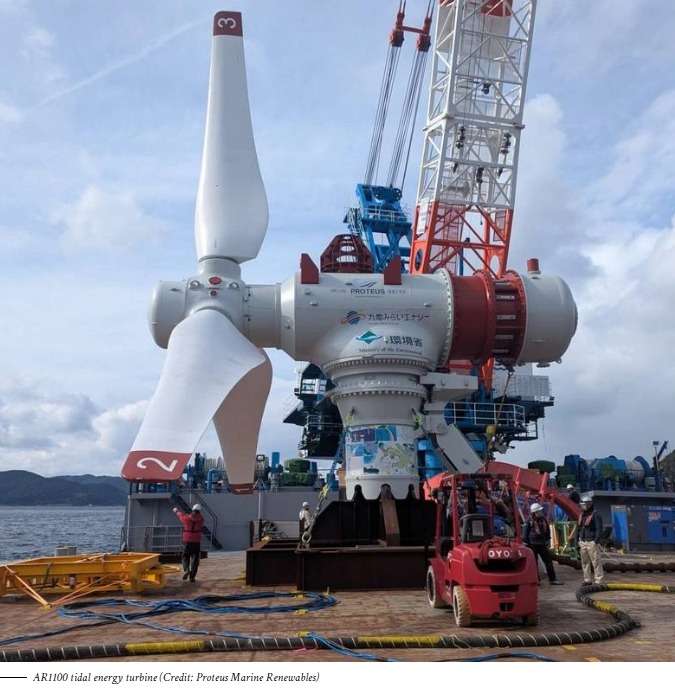
- Japan’s transition toward renewable energy through the installation of its first megawatt-scale tidal turbine. Developed by Proteus Marine Renewables, the AR1100 turbine is situated in the Naru Strait and is capable of providing 1.1 MW of clean power to the national grid.
- This project scales up previous successful trials to offer a predictable and sustainable alternative to fossil fuels by capturing energy from ocean currents. Beyond this primary focus, the source also lists various global advancements in artificial intelligence, electric transportation, and biotechnology.
- The leap from the 500-kilowatt (kW) AR500 pilot to the 1.1-megawatt (MW) AR1100 is more than just a doubling of capacity; it is a signal that tidal energy has reached a commercial inflection point.
MARITIMEPOSTS.COM – Japan faces a stark energy paradox: an island nation defined by its vast coastlines, yet one historically tethered to the volatility of imported fossil fuels.
For a country prioritizing energy security, the Naru Strait has become a high-stakes laboratory for a transition toward grid-stabilizing assets.
The successful deployment of the AR1100 tidal turbine marks a decisive move from experimental pilots to utility-scale marine power, proving that the ocean’s kinetic energy is ready to serve as a cornerstone of Japan’s renewable mix.
Takeaway 1: Scaling the “Megawatt” Milestone
The leap from the 500-kilowatt (kW) AR500 pilot to the 1.1-megawatt (MW) AR1100 is more than just a doubling of capacity; it is a signal that tidal energy has reached a commercial inflection point.
This milestone was solidified in November 2022 when Proteus signed a pivotal contract with Kyuden Mirai Energy (KME) to develop this upgraded system.
From an analyst’s perspective, this scaling is critical because it pushes the technology toward the threshold where the Levelized Cost of Energy (LCOE) becomes competitive with traditional offshore wind, transforming tidal from a niche demonstration into a viable utility-scale contender.
“The AR1100 deployment marks a major milestone for Proteus and the marine energy industry. With operational turbines in both the United Kingdom and Japan, we are proving the scalability of tidal energy as a viable power source for coastal communities.” — Drew Blaxland, CEO of Proteus.
Takeaway 2: The “97% Factor” — Reliability That Challenges Wind and Solar
In the world of renewables, availability is the metric that separates intermittent sources from true grid-stabilizing assets.
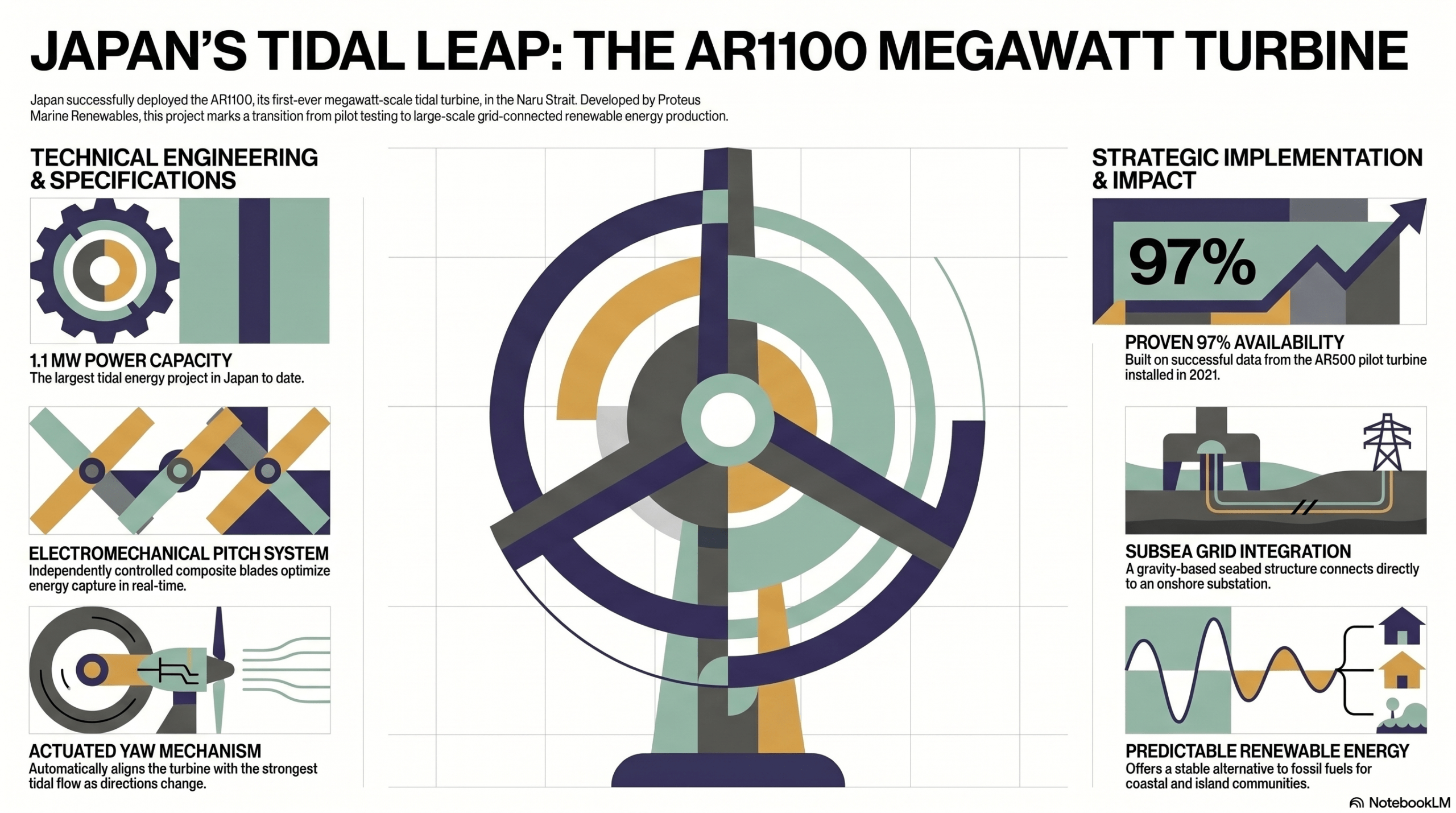
The AR500 pilot in the Naru Strait achieved a staggering 97% availability rate—a figure that far outpaces the typical capacity factors of wind or solar installations.
The fundamental difference lies in the physics of the energy source: while wind and solar are weather-dependent, tidal energy is orbital-dependent.
This high availability allows grid operators to treat tidal power as a predictable, baseload-style renewable, providing a dependable foundation for real-time load balancing that more volatile sources cannot match.
Takeaway 3: Intelligent Design Under Pressure
Operating in the high-flow environment of the Naru Strait requires a sophisticated mechanical architecture designed to survive and thrive under immense hydrodynamic pressure.
The AR1100 features a drivetrain that transfers mechanical energy from a three-bladed, high-tech composite rotor to a permanent magnet generator, ensuring high-efficiency conversion of ocean kinetic energy into electricity.
To manage the extreme forces at play, the system utilizes an electromechanical pitch system that independently adjusts blade angles in real time.
This minimizes mechanical stress during peak flow while maximizing energy capture. Furthermore, an electrically actuated yaw mechanism ensures the turbine remains perfectly oriented toward the strongest tidal flow as the tides change direction multiple times each day.
Takeaway 4: Predictability is the New Green Gold
While the intermittent nature of wind and solar requires grid operators to rely on short 24-48 hour forecasting windows, tidal energy offers a degree of certainty that simplifies long-term grid management.
Because tidal cycles are dictated by the lunar cycle, energy production can be accurately scheduled years in advance.
The AR1100’s stability is further enhanced by its gravity-based structure, which anchors the turbine to the seabed without the need for complex drilling, ensuring a fixed and reliable performance profile.
This infrastructure, connected via subsea cables to an onshore substation, allows Japan to integrate a “dependable renewable source” that acts as a hedge against the unpredictability of other green technologies.
“The result reinforces tidal energy’s potential as a dependable renewable source in Japan. Our next immediate focus is the commissioning of the turbine, Japan’s first ever MW-scale grid-connected tidal system, and the subsequent testing and accreditation phase.” — Philip Archer, Managing Director of Proteus Operations Japan.
The successful installation of the AR1100 is a masterclass in domestic and international collaboration. Supervised by Proteus Offshore Services, the deployment leveraged local Japanese vessels and resources, a strategic choice that not only bolstered local industry but also reduced the carbon footprint associated with the installation process itself.
By combining international technical expertise with local infrastructure, the project has established a clear blueprint for Japan’s path toward becoming a global leader in marine energy.
As Japan continues to diversify its energy portfolio, the focus moves from simply “generating power” to “generating predictability.” Tapping into the ocean’s rhythm provides a rare opportunity to align the national grid with the most reliable clock in existence.
How might our relationship with the power grid change when our primary energy source is as predictable and constant as the pull of the moon?
Source: from HERE!
Editorial Team