

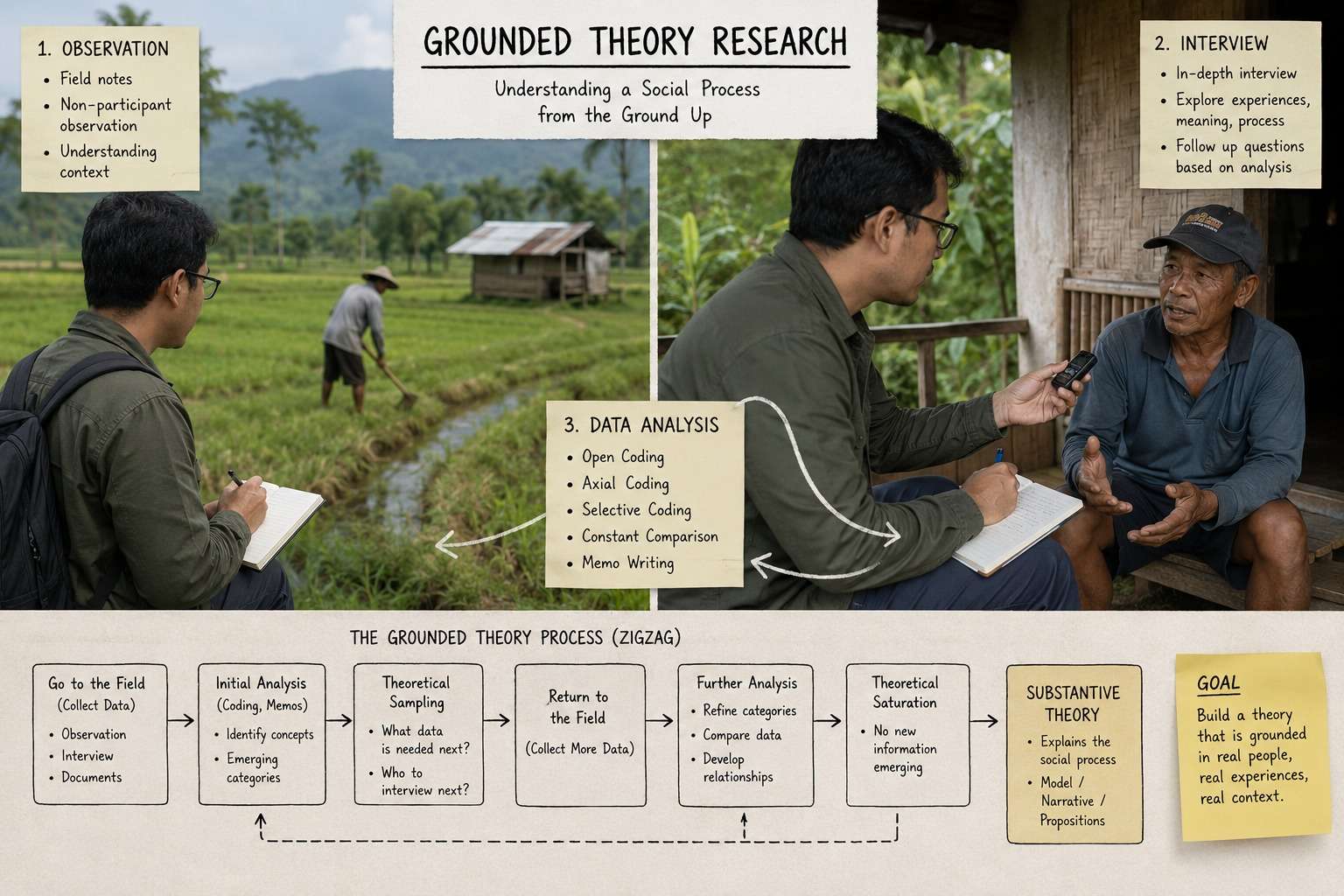
MARITIMEPOSTS.COM – Grounded Theory Research (GTR) is one of the most influential qualitative research methodologies in the social sciences. Unlike many research approaches that begin with an existing theory and seek to test it, Grounded Theory starts with empirical reality.
The researcher enters the field with an open mind, gathers rich data from participants, and gradually develops concepts, categories, and eventually a theory that is firmly grounded in the lived experiences of people.
Originally introduced by Barney Glaser and Anselm Strauss in 1967 through their landmark book The Discovery of Grounded Theory, this methodology emerged as a response to the dominance of positivist research traditions.
Their goal was to demonstrate that rigorous theory could be generated directly from field data rather than merely tested through quantitative methods.
Today, Grounded Theory has evolved into several traditions, including the classic Glaserian approach, the systematic approach of Juliet Corbin and Strauss, and the constructivist perspective developed by Kathy Charmaz. Despite these variations, all Grounded Theory approaches share a common objective: explaining social processes through theories that emerge inductively from data.
Philosophical Foundation of Grounded Theory
At its core, Grounded Theory seeks to answer a fundamental question:
“How does a social process occur?”
Rather than describing a phenomenon, Grounded Theory aims to explain:
- How a process begins
- What triggers it
- How people respond to it
- What factors influence it
- What consequences emerge
This emphasis distinguishes Grounded Theory from other qualitative methodologies.
Grounded Theory vs Other Qualitative Approaches
| Methodology | Primary Focus |
|---|---|
| Phenomenology | Lived experiences and meanings |
| Ethnography | Culture and social groups |
| Case Study | In-depth examination of a case |
| Narrative Research | Personal stories and life histories |
| Grounded Theory | Social processes and theory development |
For example, if studying climate adaptation among farmers:
- A phenomenologist asks: “What is it like to experience drought?”
- An ethnographer asks: “How does farming culture shape responses to drought?”
- A Grounded Theory researcher asks: “How do farmers adapt to drought, and what social process explains their adaptation?”
Historical Evolution of Grounded Theory
1. Classic Grounded Theory (Glaser & Strauss)
The original model emphasized:
- Theory emerging directly from data
- Minimal influence from existing theories
- Constant comparison
- Theoretical sensitivity
- Inductive reasoning
Researchers were encouraged to avoid imposing preconceived frameworks onto participants’ experiences.
2. Systematic Grounded Theory (Strauss & Corbin)
During the 1990s, Strauss and Corbin developed a more structured approach.
This version introduced:
- Open Coding
- Axial Coding
- Selective Coding
- Coding Paradigm
- Explicit analytical procedures
The goal was to increase transparency and methodological rigor.
3. Constructivist Grounded Theory (Charmaz)
Charmaz argued that theories are not “discovered” but rather co-created through interactions between researcher and participants.
Key assumptions include:
- Reality is socially constructed
- Researcher perspectives matter
- Reflexivity is essential
- Multiple interpretations are possible
This approach emphasizes meaning-making rather than theory discovery.
Core Characteristics of Grounded Theory
Several features distinguish Grounded Theory from other methodologies.
1. Inductive Logic
Theory emerges from observations rather than being imposed beforehand.
2. Simultaneous Data Collection and Analysis
Researchers do not wait until all interviews are completed before analyzing data.
Instead:
Data Collection → Analysis → Further Data Collection → Further Analysis
This iterative movement is often described as a zigzag process.
3. Theoretical Sampling
Participants are selected based on analytical needs rather than demographic representativeness.
Researchers continually ask:
“Who should I interview next to strengthen or challenge my emerging theory?”
4. Constant Comparison
Every piece of new information is compared with previous data.
Researchers compare:
- Incident with incident
- Incident with category
- Category with category
This process refines concepts and strengthens theory development.
The Grounded Theory Research Cycle
Grounded Theory follows a recursive rather than linear process.
Stage 1: Initial Data Collection
Researchers begin with:
- In-depth interviews
- Participant observation
- Field notes
- Documents
- Archival materials
Interviews are typically semi-structured and exploratory.
Stage 2: Initial Coding
The first interviews are coded immediately.
Researchers identify:
- Actions
- Events
- Interactions
- Meanings
At this stage, coding remains open and exploratory.
Stage 3: Emerging Categories
Repeated concepts become categories.
For example:
| Initial Statements | Emerging Category |
|---|---|
| Borrowing money from relatives | Kinship support |
| Receiving seeds from neighbors | Community solidarity |
| Sharing irrigation water | Mutual assistance |
Stage 4: Theoretical Sampling
Researchers identify gaps in understanding and seek participants who can fill those gaps.
For instance:
If drought adaptation appears important, researchers may intentionally interview:
- Farmers experiencing severe drought
- Farmers who successfully adapted
- Farmers who failed to adapt
Stage 5: Further Analysis
New interviews refine categories.
Researchers examine:
- Similarities
- Differences
- Conditions
- Interactions
- Consequences
Stage 6: Theoretical Saturation
Data collection ends when:
- No new categories emerge
- Existing categories are fully developed
- Relationships are well understood
This point is called theoretical saturation.
Importantly, saturation—not sample size—determines when data collection stops.
Many studies reach saturation after approximately 20–30 interviews, although complex studies may require considerably more.
Coding in Grounded Theory
Coding is the analytical engine of Grounded Theory.
Open Coding
Open coding involves breaking data into smaller units of meaning.
Example:
Interview statement:
“When the drought comes, I work as a carpenter in town.”
Possible codes:
- Seeking alternative income
- Climate adaptation
- Labor migration
- Livelihood diversification
The objective is to identify as many meaningful concepts as possible.
Axial Coding
Axial coding reconnects categories by identifying relationships.
Researchers ask:
- What caused this?
- Under what conditions?
- What strategies were used?
- What happened afterward?
Strauss and Corbin introduced a coding paradigm consisting of:
Core Phenomenon
The central process being studied.
Causal Conditions
Events triggering the phenomenon.
Context and Intervening Conditions
Factors influencing actions.
Strategies
Responses adopted by participants.
Consequences
Outcomes resulting from those responses.
Example: Climate Adaptation Among Farmers
| Component | Example |
|---|---|
| Causal Condition | Drought |
| Core Phenomenon | Livelihood adaptation |
| Context | Limited irrigation |
| Strategy | Working outside village |
| Consequence | Reduced household vulnerability |
This transforms scattered themes into an explanatory framework.
Selective Coding
Selective coding integrates all categories into a coherent theory.
Researchers identify:
- The central storyline
- Key relationships
- Overall explanatory model
The outcome is a substantive theory explaining how the process works.
Memoing: The Heart of Analysis
Grounded Theory researchers write memos continuously throughout the study.
A memo records:
- Emerging ideas
- Category relationships
- Analytical insights
- Questions for future investigation
- Theoretical reflections
Memoing acts as a bridge between raw data and theory.
Without memoing, Grounded Theory risks becoming merely descriptive.
Constant Comparison Method
Constant comparison is perhaps the most distinctive analytical technique in Grounded Theory.
Researchers continuously compare:
- Data with data
- Data with codes
- Codes with categories
- Categories with theory
This process helps:
- Refine categories
- Identify gaps
- Test relationships
- Increase theoretical precision
Constant comparison continues until saturation is achieved.
Theoretical Sampling
Traditional sampling seeks representativeness.
Grounded Theory seeks theoretical relevance.
Participants are selected because they can help explain emerging categories.
For example:
If early findings suggest younger farmers interpret climate change differently from older farmers, researchers intentionally recruit additional younger and older farmers to deepen the analysis.
Sampling decisions are therefore driven by theory development.
The Concept of Theoretical Saturation
Theoretical saturation occurs when:
- New interviews provide no new insights
- Categories are richly developed
- Relationships are stable
- The theory adequately explains the process
Saturation is not merely repetition of data.
It is the point where additional information no longer contributes meaningful theoretical advancement.
Quality Standards in Grounded Theory
Rigorous Grounded Theory requires more than coding.
Researchers must demonstrate:
Credibility
Ensuring findings accurately represent participants’ experiences.
Methods include:
- Member checking
- Peer debriefing
- Prolonged engagement
Reflexivity
Researchers critically examine:
- Personal assumptions
- Biases
- Values
- Influence on interpretation
Reflexivity is especially important in Charmaz’s constructivist approach.
Audit Trail
Researchers maintain detailed records of:
- Sampling decisions
- Coding procedures
- Memo development
- Model revisions
An audit trail allows others to understand how theory emerged.
Triangulation
Using multiple sources such as:
- Interviews
- Observations
- Documents
Triangulation strengthens confidence in findings.
Ethical Standards
Researchers must ensure:
- Informed consent
- Confidentiality
- Anonymity
- Participant protection
- Responsible data storage
Final Outputs of Grounded Theory
Grounded Theory findings are usually presented in three forms:
1. Theoretical Narrative
A detailed explanation of how the process unfolds.
2. Visual Model
A diagram showing relationships among categories.
3. Propositions or Hypotheses
Statements explaining connections between concepts.
For example:
Prolonged drought increases livelihood diversification among downstream farmers through labor migration and social support networks.
Such propositions emerge from data rather than being predetermined.
Substantive Theory: The Ultimate Goal
The final product of Grounded Theory is a substantive theory.
A substantive theory:
- Explains a specific social process
- Is grounded in empirical evidence
- Reflects participants’ realities
- Has explanatory power
Unlike broad grand theories, substantive theories are context-specific and highly relevant to practical social issues.
For example, a Grounded Theory study of climate adaptation in Bulukumba may generate a substantive theory explaining how upstream and downstream rice farmers combine local ecological knowledge, social capital, and livelihood diversification to maintain resilience under increasing climate uncertainty.
Conclusion
Grounded Theory Research is far more than a coding technique. It is a systematic methodology for discovering how social processes operate in real-world settings. Through theoretical sampling, constant comparison, memoing, coding, and iterative field engagement, researchers move from raw observations to explanatory theory.
Its greatest strength lies in its ability to generate new knowledge directly from lived experiences. Rather than forcing reality to fit existing theories, Grounded Theory allows theory to emerge from reality itself. This makes it especially valuable for studying complex social phenomena, emerging issues, and contexts where existing explanations remain inadequate.
In an era characterized by rapid social, environmental, and technological change, Grounded Theory remains one of the most powerful approaches for understanding not merely what happens, but how and why it happens.