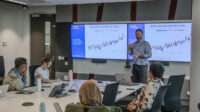

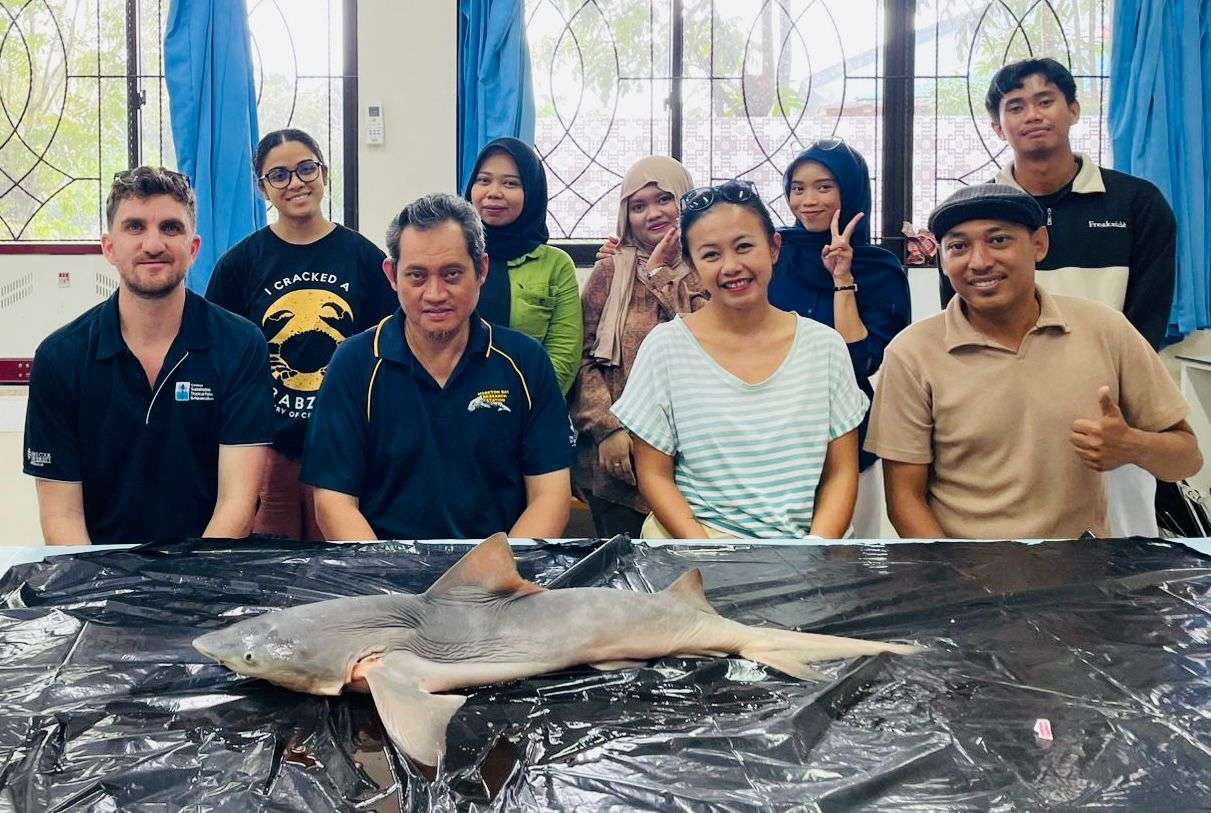
That commitment was highlighted during the Workshop on Conservation Planning for the Ganges Shark (Glyphis gangeticus) held at Universitas Borneo Tarakan on Tuesday (13/05).
MARITIMEPOSTS.COM – In the midst of growing global concern over marine species extinction, a rare sign of hope has emerged from the waters of the Sesayap River in Tana Tidung Regency, North Kalimantan.
In this calm river system flowing into the northern coast of Borneo, a team of researchers from Hasanuddin University, James Cook University, and Universitas Borneo Tarakan has rediscovered a population of the Ganges Shark (Glyphis gangeticus), a freshwater shark species long believed to be on the brink of extinction.
The discovery marks a significant milestone for the international conservation community. Since 2000, sightings of the Ganges Shark have been recorded fewer than ten times across its historical range, stretching from Pakistan to Myanmar.
The International Union for Conservation of Nature (IUCN) has classified the species as Critically Endangered, making it one of the rarest sharks in the world.
However, field research conducted in 2023 by the international collaboration team revealed a surprising reality. In less than three weeks, researchers documented 43 Ganges Shark specimens in the Sesayap River.
The finding positions the river as one of the most important remaining habitats for the survival of a species that had become almost invisible to science.
More than just a scientific breakthrough, the rediscovery demonstrates how collaborative research can reopen pathways of hope for biodiversity conservation in Indonesia.
For Hasanuddin University, the research also reflects the growing role of universities in advancing science that directly addresses global environmental challenges.
That commitment was highlighted during the Workshop on Conservation Planning for the Ganges Shark (Glyphis gangeticus) held at Universitas Borneo Tarakan on Tuesday (13/05).
The forum brought together researchers, government representatives, fishing organizations, and conservation advocates to discuss protection strategies that are not only science-based, but also socially realistic for coastal communities.
Representing the Rector of Hasanuddin University, Prof. Rohani Ambo Rappe emphasized that the university’s involvement in the research is part of its long-term commitment to strengthening international collaboration and sustainable marine research.
According to her, the partnership between Hasanuddin University and James Cook University, which began in 2022, is not solely focused on scientific data collection, but also on building conservation models that actively involve local communities as part of the solution.
“This discovery is not only about saving a rare species, but also about building a conservation model that is fair, collaborative, and accepted by society. That is why we encourage the establishment of a shark and ray research consortium in Kalimantan, so scientific data and policy development can move forward together,” Prof. Rohani explained.
Meanwhile, researcher Dr. Michael Grant from James Cook University revealed that the Sesayap River was officially designated as an Important Shark and Ray Area (ISRA) in 2024. This international recognition underscores the river’s significance as a nursery ground for critically rare river sharks.
Yet discussions during the workshop extended beyond species and habitat protection. Strong attention was also directed toward the livelihoods of coastal communities that have long coexisted with the river and estuarine ecosystem.
One important finding presented during the forum showed that the Ganges Shark is not a primary fishing target. Instead, the species is typically caught accidentally as bycatch when fishers deploy nets in estuarine areas. Its low economic value means local communities do not intentionally hunt the shark.
This reality has become a crucial foundation for designing a more balanced conservation approach. Stakeholders agreed that protection efforts should not rely on total fishing bans, but rather on limited conservation measures such as releasing juvenile sharks, regulating catch sizes, and restricting certain fishing gear. This approach is considered more realistic while also safeguarding the economic sustainability of coastal communities.
As a follow-up step, the research team plans to conduct socio-economic studies in eight villages along the Sesayap River. The studies aim to map community relationships with sharks and rays while identifying suitable conservation incentive schemes.
Public awareness campaigns will also be strengthened through illustrated identification cards, educational posters, and community meetings to improve public understanding of the importance of protecting this rare species.
With the rediscovery of the Ganges Shark in North Kalimantan, Hasanuddin University has not only contributed to saving one of the world’s rarest shark species, but has also reinforced its role as a university actively producing impactful research for environmental sustainability and coastal communities.
The Ganges Shark is a tropical river shark species inhabiting river mouths, estuaries, and coastal waters at depths of up to 50 meters. It is characterized by a short, rounded snout and can grow to a maximum length of 275 centimeters. Juvenile sharks are generally found in freshwater and estuarine environments, while adults tend to inhabit coastal waters.
The global population of the Ganges Shark is estimated to consist of fewer than 250 mature individuals, with each subpopulation containing fewer than 50 adults, making it one of the rarest shark species on Earth. Its population is believed to have declined by more than 80 percent over the last 54 years.
The species faces major threats from accidental capture in gillnet and hook fisheries operating in rivers and estuaries. Habitat degradation caused by agricultural land clearing, which increases sedimentation, as well as dam construction that disrupts river flows, further intensifies the risk of extinction.
The rediscovery of the Ganges Shark in the Sesayap River in 2023 is especially significant considering that the last recorded sighting of the species in the Borneo region occurred in the Kinabatangan River, Malaysia, in 2003.
Through strengthened international collaboration, science-based research, and inclusive conservation approaches, Hasanuddin University continues to promote environmental governance models that not only prioritize biodiversity protection, but also support the socio-economic well-being of local communities.
From the Sesayap River, this small step has become a powerful message about how science, collaboration, and collective care can work together to safeguard the future of Indonesia’s ecosystems.