
- Through an introduction to the National Fishers Center Indonesia (NFC-I), participants learned about fundamental labor rights, indicators of forced labor, grievance mechanisms, and support services available to fisheries workers.
- This information was particularly relevant given that many participants were employed under short-term contracts, making them vulnerable to labor rights violations.
- The benefits extend beyond workers themselves. Companies and markets also gain from improved product quality, greater production efficiency, and enhanced competitiveness of Indonesia’s fisheries industry as a whole.
MARITIMEPOSTS.COM – Indonesia’s fisheries industry, particularly the tuna sector, plays a strategic role in the national economy and global trade. Over the past five years, fisheries exports have shown steady growth, increasing from USD 4.56 billion in 2021 to USD 6.27 billion in 2025.
This average annual growth of approximately 8.3 percent has been driven by rising international demand and Indonesia’s position as one of the world’s leading tuna producers.
Benoa, Bali, serves as one of the industry’s key hubs, functioning as Indonesia’s second-largest center for fish landing, processing, distribution, and export after Muara Baru in Jakarta.
These activities make significant contributions to state revenue, regional economic growth, and large-scale employment opportunities.
As a national fisheries industry center, Benoa attracts workers from various regions across Indonesia, including East Java, Central Java, West Nusa Tenggara, East Nusa Tenggara, Maluku, and North Sulawesi. This reflects the fisheries sector’s heavy reliance on a skilled and competent workforce.
Amid growing global attention to social and labor issues within sustainable seafood supply chains, the industry is expected not only to meet product quality and environmental sustainability standards but also to ensure the protection of workers’ rights, safety, and welfare.
However, fish processing workers, particularly those engaged in tuna freezing operations, continue to face numerous challenges.
Limited access to standardized training, uneven implementation of Occupational Health and Safety (OHS) practices, and inadequate understanding of labor rights remain common issues. In addition, most workers still lack competency certification relevant to their occupation.
This is despite the existence of regulations governing competency standards and certification in tuna freezing, including Minister of Manpower Decree No. 78 of 2016 and Minister of Marine Affairs and Fisheries Regulation No. 2 of 2019.
Minister of Manpower Decree No. 78 of 2016 establishes national competency standards for tuna freezing operations, covering the knowledge, skills, and work attitudes required of workers.
Meanwhile, Ministerial Regulation No. 2 of 2019 governs the implementation of the Indonesian National Qualifications Framework (KKNI) for tuna processing to ensure workforce competency standardization. Nevertheless, implementation of these regulations remains limited and has yet to become mandatory for workers or companies.
As a result, a gap persists between workforce competencies and the quality standards demanded by the industry. Even by the end of 2024, the Level 1 Occupational Certification Scheme for Tuna Freezing Operators proposed by the Fisheries Professional Certification Institute (LSP KP) had not yet been approved by the National Professional Certification Board (BNSP).
This situation has also created difficulties for companies in recruiting qualified workers, establishing career pathways, setting wage standards, and maintaining product quality.
To address these challenges, Destructive Fishing Watch (DFW) Indonesia, in collaboration with the Marine and Fisheries Training Center (Puslat KP) under the Ministry of Marine Affairs and Fisheries, launched a capacity-building and certification program for workers in Tuna Fish Processing Units (UPI).
The program was designed to support the issuance of a tuna freezing certification scheme while enhancing workforce competencies through training needs assessments, curriculum and module development, awareness campaigns on certification, and the implementation of training and competency assessments.
The initiative began with the socialization of Ministerial Regulation No. 2 of 2019 among companies affiliated with the Indonesian Tuna Longline Association (ATLI).
Subsequently, training needs assessments were conducted at PT Hatindo Makmur and PT Sari Segar Laut in Benoa, Bali, through surveys and interviews with workers and company management.
The findings served as the foundation for developing five key training modules: Sanitation and Hygiene in Frozen Tuna Production; Occupational Health and Safety (OHS) in Tuna Freezing Operations; Handling of Tuna Raw Materials; Tuna Freezing Production Processes; and Packaging of Frozen Tuna Products.
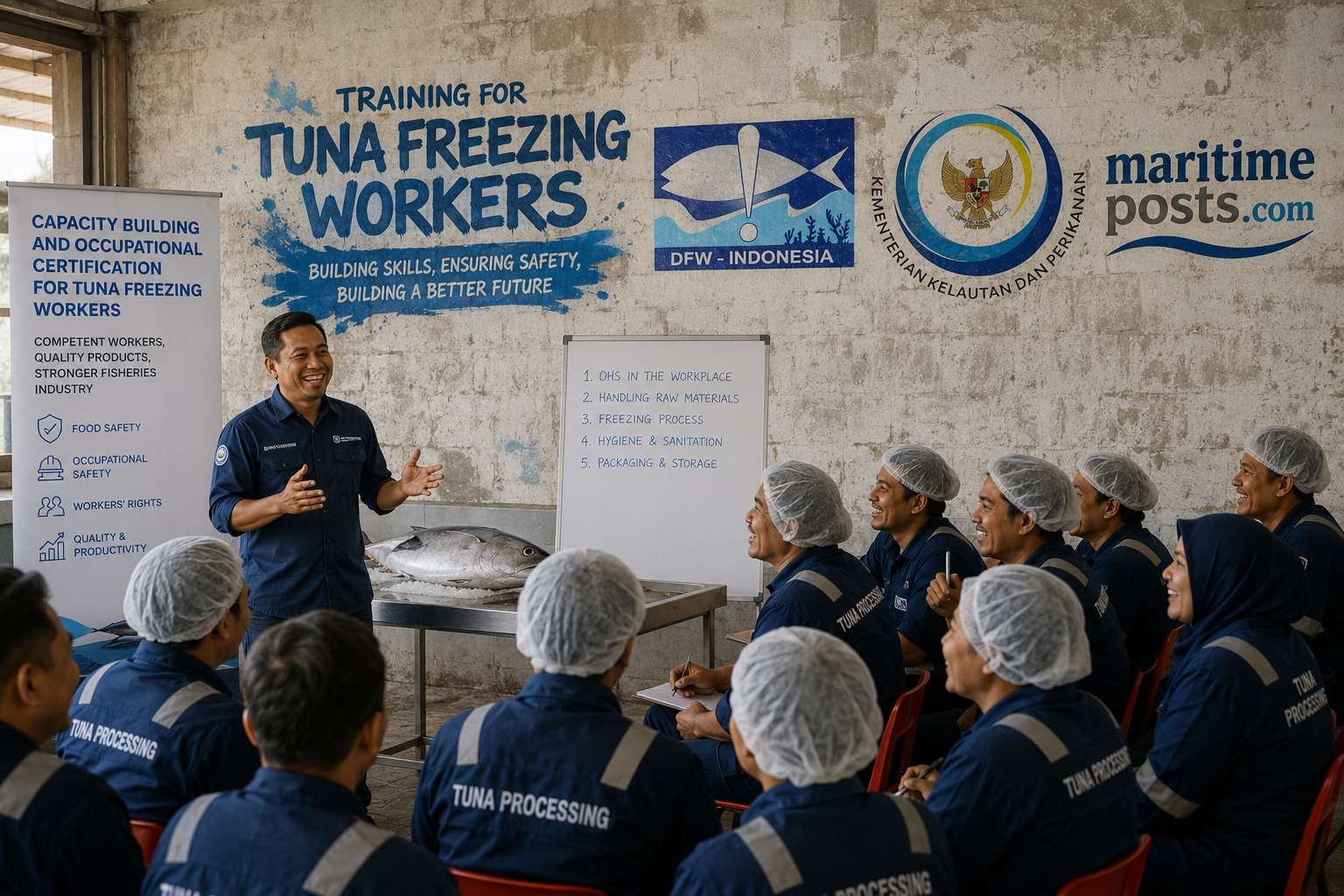
In December 2025, DFW Indonesia, together with Puslat KP and the Banyuwangi Fisheries Training and Extension Center (BPPP Banyuwangi), organized a Capacity Building Training Program for Tuna Freezing Workers as a pilot implementation of the developed modules.
The training involved 29 participants from 13 tuna processing companies in Benoa, Bali, including former fish processing workers. Participants comprised 18 men and 11 women, highlighting the significant role of women in the tuna freezing industry.
Coming from diverse educational and professional backgrounds, participants enriched the learning process through discussions and exchanges of experience related to workplace standards, sanitation practices, personal protective equipment (PPE), and workload management in low-temperature environments.
Beyond improving technical skills, the training also strengthened participants’ understanding of workers’ rights and labor protection mechanisms.
Through an introduction to the National Fishers Center Indonesia (NFC-I), participants learned about fundamental labor rights, indicators of forced labor, grievance mechanisms, and support services available to fisheries workers. This information was particularly relevant given that many participants were employed under short-term contracts, making them vulnerable to labor rights violations.
Participants showed strong interest, especially during discussions on safe and confidential complaint mechanisms. Ultimately, the training contributed not only to individual capacity building but also to strengthening solidarity and social networks among tuna processing workers in Benoa. Those who completed the program received training certificates from the Agency for Marine and Fisheries Human Resources Development (BPPSDM KP), a prerequisite for competency certification assessments.
Another significant development occurred in April 2025 when the Ministry of Marine Affairs and Fisheries restructured its organization through Ministerial Regulation No. 2 of 2025.
The regulation established the Center for Marine and Fisheries Human Resources Standardization and Certification (Pusat SS SDM KP), which was mandated to oversee workforce competency standardization and certification within the marine and fisheries sector.
Consequently, supervision of the tuna freezing certification scheme submission process was transferred from Puslat KP to Pusat SS SDM KP.
Despite this progress, challenges remained. By mid-June 2026, the certification scheme proposed by LSP Banyuwangi had still not been approved by BNSP, creating a significant gap between training completion and competency assessment.
This delay risked reducing the number of eligible participants, as some workers had already changed jobs or left their companies.
After a lengthy process, BNSP finally approved and issued the Occupational Certification Scheme for Tuna Freezing Operators in late June 2026. Of the 27 eligible participants, 25 successfully took part in the competency assessment conducted in August 2026.
The competency assessment covered eight core units: implementation of Occupational Health and Safety (OHS); receiving fresh tuna raw materials; washing raw materials; temporary chilling storage; butchering operations; storage of products in chilling rooms; freezing processes; and product packaging.
Assessment methods included written examinations, interviews, and practical evaluations conducted through direct observation in processing facilities or simulations supported by Observation Support Questions (PMO). As a result, all participants were declared competent by the assessors.
The issuance of occupational certificates for tuna freezing workers marks an important milestone in strengthening human resources within Indonesia’s fisheries sector.
The certificates provide formal recognition of workers’ competencies and expertise while ensuring that personnel involved in tuna freezing operations possess skills that meet industry standards.
The benefits extend beyond workers themselves. Companies and markets also gain from improved product quality, greater production efficiency, and enhanced competitiveness of Indonesia’s fisheries industry as a whole.
Moving forward, stronger commitment and collective awareness are needed from government agencies, training institutions, companies, industry associations, and workers to continuously promote workforce capacity development and certification.
Such efforts are essential to creating added value, strengthening the competitiveness of Indonesian fisheries products, and ensuring the long-term sustainability of the national tuna industry amid increasingly intense global market competition.
___
Edited by Kamaruddin Azis