
A systematic reading of the Qur’anic sea through the lens of contemporary marine science
MARITIMEPOSTS.COM – The sea occupies a distinctive place in the Qur’an. It is not presented merely as a vast body of water separating one landmass from another.
Across its many references, the sea appears as a source of food, a livelihood, a highway for ships, a space of human vulnerability, a boundary between water masses, a setting for historical events, a metaphor for immeasurable knowledge, and a domain in which humanity is reminded of its dependence upon the Creator.
A linguistic examination of the Qur’anic Arabic reveals 41 occurrences of the noun baḥr (بَحْر) and its grammatical forms referring to the sea or seas, appearing in 39 verses. The broader triliteral root ب-ح-ر occurs 42 times, but one occurrence—baḥīrah—refers to a pre-Islamic category of animal and is not a marine reference.
This distinction matters. If the question is specifically about the Qur’an’s references to the sea as a marine environment, 41 occurrences of baḥr provide the more meaningful starting point.
But counting the word is only the beginning.
The more interesting question is: What does the Qur’an say about the sea?
When the references are examined systematically, they reveal several interconnected dimensions of the marine world: ecology, food, fisheries, livelihood, transportation, navigation, maritime hazards, water systems, coastal interfaces, environmental degradation and spirituality.
The sea as part of the human environment
One of the earliest and most comprehensive references appears in Al-Baqarah 2:164, where the Qur’an mentions ships sailing through the sea carrying things beneficial to humanity.
وَالْفُلْكِ الَّتِي تَجْرِي فِي الْبَحْرِ بِمَا يَنفَعُ النَّاسَ
“And the ships that sail through the sea with what benefits people…”
The verse is striking because the sea is immediately associated with human benefit.
The image is not of an isolated wilderness. It is a functioning space through which people move, exchange goods and obtain livelihoods.
The same idea appears repeatedly. In 14:32, 17:66, 22:65, 31:31, 45:12 and 55:24, ships are described as sailing through the sea.
Viewed from contemporary marine studies, the Qur’anic sea is therefore also a transportation system and economic space.
Today we might describe this through the language of maritime transport, shipping, ports, logistics, fisheries, tourism and the blue economy.
The Qur’anic language is simpler, but the fundamental relationship is recognizable: the sea supports human civilization.
The sea as a source of food
The marine environment also appears as a source of nourishment.
In Al-Ma’idah 5:96, the Qur’an states:
أُحِلَّ لَكُمْ صَيْدُ الْبَحْرِ وَطَعَامُهُ
“Lawful for you is the game of the sea and its food…”
This is an important verse for anyone interested in fisheries and food security.
The sea is not simply admired. It is recognized as a productive ecosystem capable of sustaining human communities.
The same theme appears more explicitly in An-Nahl 16:14:
لِتَأْكُلُوا مِنْهُ لَحْمًا طَرِيًّا
“So that you may eat fresh meat from it…”
The verse then mentions extracting ornaments and observing ships moving through the sea.
In a single passage, the sea therefore provides:
food + resources + transportation + livelihood.
That combination is remarkably close to the contemporary concept of marine ecosystem services.
Marine ecosystems provide provisioning services such as food and materials, regulating services that support environmental stability, cultural services connected to identity and recreation, and supporting functions essential to life.
The Qur’an does not use this modern terminology, of course. But it clearly recognizes the sea as something that provides benefits to human beings.
The sea and coastal livelihoods
Perhaps one of the most socially significant marine references occurs in Al-Kahf 18:79.
فَكَانَتْ لِمَسَاكِينَ يَعْمَلُونَ فِي الْبَحْرِ
“It belonged to poor people working at sea.”
The verse describes a vessel belonging to economically vulnerable people whose livelihoods depended on the sea.
This is more than a reference to a ship.
It introduces a social dimension of marine dependence.
The sea provides livelihood, but livelihood dependence also creates vulnerability. Damage to a boat is not simply damage to property. For a poor coastal household, it can mean loss of income, food security and social resilience.
This resonates strongly with contemporary coastal development studies.
Millions of people around the world remain dependent upon fisheries, small-scale fishing, coastal tourism, aquaculture, shipping and other marine activities.
The Qur’anic narrative in Al-Kahf therefore offers an intriguing perspective on what we now call coastal livelihood vulnerability.
The sea as a navigational space
Several verses associate the sea with darkness, stars and wind.
In Al-An’am 6:97, the Qur’an says:
لِتَهْتَدُوا بِهَا فِي ظُلُمَاتِ الْبَرِّ وَالْبَحْرِ
“So that you may be guided by them through the darknesses of land and sea.”
The “them” refers to the stars.
From the history of navigation, this is highly significant.
Before GPS, satellites and electronic navigation systems, sailors relied on the stars to determine direction and position.
The Qur’an therefore connects the marine environment with celestial navigation.
Another verse, An-Naml 27:63, connects navigation with winds:
وَمَن يُرْسِلُ الرِّيَاحَ بُشْرًا
“And who sends the winds as good tidings…”
Similarly, Yunus 10:22 describes ships sailing with favorable winds before encountering dangerous conditions.
The sea here becomes a dynamic environment governed by forces beyond human control.
The sea as a space of risk
The Qur’an does not romanticize the sea.
It repeatedly acknowledges its danger.
In Al-Isra 17:67:
وَإِذَا مَسَّكُمُ الضُّرُّ فِي الْبَحْرِ
“And when hardship touches you at sea…”
In Al-An’am 6:63, darknesses of land and sea are mentioned.
In Yunus 10:22, people aboard ships initially experience favorable winds, only to find themselves confronted by threatening conditions.
These passages correspond closely with the historical experience of seafaring societies.
The sea offers opportunity, but it also demands respect.
This duality remains true today.
Modern vessels have sophisticated navigation, satellite communication and weather forecasting, yet storms, currents, waves, equipment failure and human error continue to make the ocean one of Earth’s most challenging environments.
The Qur’anic sea is therefore simultaneously a resource and a risk.
The meeting of two seas
One of the most frequently discussed marine themes in the Qur’an concerns the meeting of two bodies of water.
In Al-Kahf 18:60, Moses seeks:
مَجْمَعَ الْبَحْرَيْنِ
“the junction of the two seas.”
Later, Al-Furqan 25:53 states:
مَرَجَ الْبَحْرَيْنِ هَٰذَا عَذْبٌ فُرَاتٌ وَهَٰذَا مِلْحٌ أُجَاجٌ
“He released the two seas, one fresh and sweet and the other salty and bitter.”
And in An-Naml 27:61, we find:
وَجَعَلَ بَيْنَ الْبَحْرَيْنِ حَاجِزًا
“And He placed a barrier between the two seas.”
The theme appears again in Fatir 35:12.
These verses are particularly interesting from a marine-science perspective because modern oceanography recognizes numerous situations in which different water masses meet while maintaining distinct physical and chemical characteristics.
Estuaries provide an obvious example: freshwater from rivers encounters seawater, creating gradients in salinity, temperature and density.
Ocean fronts provide another: different water masses converge while maintaining distinctive properties.
However, a scientifically responsible interpretation should avoid claiming that barzakh means a permanent physical wall preventing all mixing.
Marine waters do mix.
The more defensible observation is that marine and freshwater systems can meet while maintaining identifiable gradients and differentiated water masses through physical processes.
The Qur’anic language invites reflection; oceanography provides the contemporary scientific vocabulary for examining such phenomena.
The deep sea and darkness
Perhaps the most famous marine passage is An-Nur 24:40:
أَوْ كَظُلُمَاتٍ فِي بَحْرٍ لُّجِّيٍّ
“Or like darknesses within a deep sea…”
The verse continues with waves above waves and clouds, describing layers of darkness.
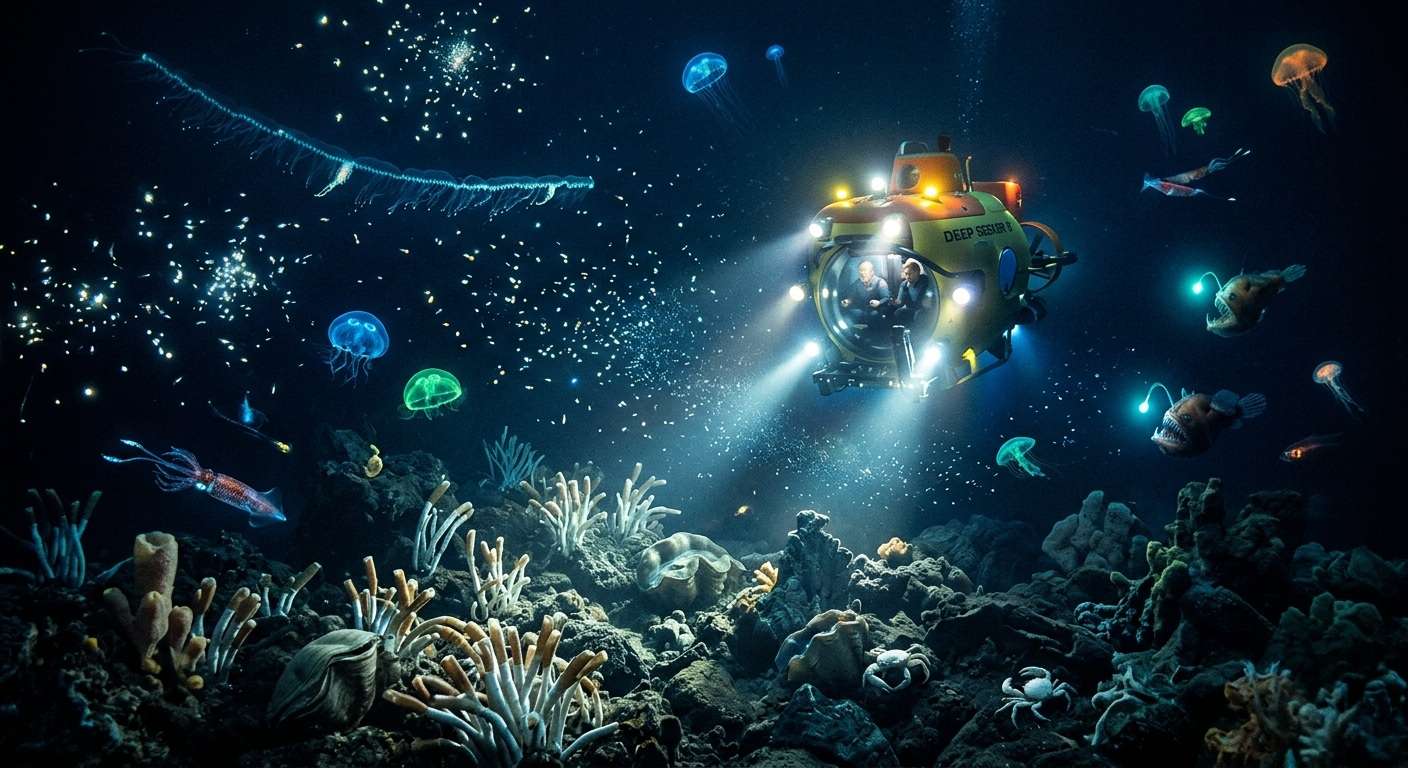
Modern marine science tells us that light decreases rapidly with increasing depth. Beyond the photic zone, sunlight becomes increasingly limited, eventually creating the darkness characteristic of the deep ocean.
The verse has therefore attracted considerable interest among writers discussing the relationship between the Qur’an and oceanography.
Yet academic caution is important.
The verse is explicitly a parable. Its primary purpose is spiritual and theological, not to provide a technical explanation of underwater optics.
Nevertheless, its imagery is remarkably compatible with the experience of a deep marine environment: depth, darkness, waves and layered conditions.
That makes it an especially productive verse for interdisciplinary discussion between Qur’anic studies and marine science.
The freshwater–saltwater continuum
The Qur’an repeatedly distinguishes freshwater and saltwater.
In Al-Furqan 25:53:
هَٰذَا عَذْبٌ فُرَاتٌ وَهَٰذَا مِلْحٌ أُجَاجٌ
“One is fresh and sweet, and the other is salty and bitter.”
And in Fatir 35:12:
وَمَا يَسْتَوِي الْبَحْرَانِ
“The two seas are not alike.”
This is highly relevant to contemporary coastal science.
Freshwater and seawater have different salinity, density and chemical properties. Where rivers meet the ocean, these differences generate complex physical processes that influence sediment transport, nutrient dynamics, biological productivity and fisheries.
Estuaries are among the world’s most productive ecosystems.
Thus, the Qur’anic distinction between fresh and salty waters provides an interesting conceptual entry point into coastal hydrology and estuarine ecology.
The sea as an ecological system
If the different verses are read together, the Qur’an does not portray the sea as merely a physical container of water.
It contains organisms.
It produces food.
It supports livelihoods.
It carries ships.
It interacts with rivers.
It contains different water conditions.
It has waves, winds and darkness.
It can sustain communities but can also threaten them.
In contemporary ecological language, the sea is therefore a complex socio-ecological system.
This is important because modern marine science increasingly recognizes that ecosystems cannot be separated completely from the people who depend upon them.
Fisheries are connected to households.
Coastal habitats are connected to food security.
Mangroves are connected to shoreline protection.
Coral reefs are connected to tourism and fisheries.
Seagrass ecosystems are connected to carbon storage, biodiversity and coastal productivity.
The Qur’anic perspective, although expressed in a different conceptual language, repeatedly places the marine environment within a larger relationship between creation and human life.
The most important environmental verse: Ar-Rum 30:41
Among all the marine references, one verse deserves particular attention in contemporary environmental discussions.
ظَهَرَ الْفَسَادُ فِي الْبَرِّ وَالْبَحْرِ بِمَا كَسَبَتْ أَيْدِي النَّاسِ
“Corruption has appeared throughout the land and sea because of what people’s hands have earned…”
This is arguably the Qur’an’s strongest statement linking human behavior with environmental deterioration.
The word fasād has a broad semantic range and should not simply be translated as “pollution.” It can refer to disorder, corruption, deterioration and disruption.
That broader meaning actually makes the verse more relevant to contemporary environmental ethics.
Consider the range of human pressures on marine ecosystems:
- overfishing;
- destructive fishing;
- plastic and chemical pollution;
- coastal reclamation;
- habitat destruction;
- mangrove loss;
- coral reef degradation;
- unsustainable extraction;
- sedimentation;
- biodiversity loss;
- greenhouse-gas-driven ocean warming and acidification.
Not all of these are explicitly named in the Qur’an.
But the ethical proposition is clear:
human actions can produce deterioration in the natural world.
That principle has enormous relevance for modern marine governance.
The sea and the concept of stewardship
This brings us to an important conceptual question.
If the Qur’an repeatedly describes the sea as a source of food, transportation and livelihood, while simultaneously warning about the consequences of human actions, what kind of relationship between humans and nature does this suggest?
Perhaps the answer is neither absolute exploitation nor complete separation.
Instead, it suggests responsible use.
The sea can be used.
Fish can be harvested.
Ships can sail.
Resources can support human life.
But human benefit exists within a larger moral order.
This is especially relevant to contemporary debates about the blue economy.
A blue economy cannot simply mean extracting more value from the ocean.
It must also ask:
How much can ecosystems sustain?
Who benefits?
Who bears the environmental cost?
What happens to coastal communities?
How do we preserve marine biodiversity for future generations?
The Qur’anic marine references can therefore contribute to a broader ethical discussion about sustainable marine development.
The sea as a metaphor for knowledge
Not every reference to the sea should be forced into marine science.
In Al-Kahf 18:109, the sea becomes a metaphor:
لَوْ كَانَ الْبَحْرُ مِدَادًا لِّكَلِمَاتِ رَبِّي
“If the sea were ink for the words of my Lord…”
The sea represents extraordinary magnitude.
Even an ocean of ink would be insufficient to exhaust divine knowledge.
Likewise, Luqman 31:27 speaks of the sea being supplemented by seven additional seas as ink.
The point is not oceanography.
It is limitlessness.
The Qur’an draws upon the human perception of the ocean as something enormous and seemingly inexhaustible to communicate the incomparably greater vastness of divine knowledge.
In this sense, the sea becomes both a physical environment and a philosophical metaphor.
From Baḥr to a Qur’anic marine vocabulary
The study becomes even richer when we move beyond the word baḥr itself.
The Qur’an contains a broader vocabulary associated with marine environments, including:
- بَحْر — baḥr: sea
- بَحْرَيْن — baḥrayn: two seas
- أَبْحُر — abḥur: seas
- بِحَار — biḥār: seas
- الْيَمّ — al-yamm: sea/large body of water
- مَوْج — mawj: wave
- حُوت — ḥūt: fish/large fish
- لُؤْلُؤ — lu’lu’: pearl
- مَرْجَان — marjān: coral
- فُلْك — fulk: vessel/ship
- سَفِينَة — safīnah: ship
- عَذْب — ‘adhb: fresh/sweet water
- مِلْح — milḥ: salty water
- بَرْزَخ — barzakh: barrier/separation
- صَيْدُ الْبَحْر — ṣayd al-baḥr: sea catch/marine game
This vocabulary suggests that a full Qur’anic marine study should not stop with frequency counting.
It should examine concepts, relationships and values.
A Qur’anic marine framework
When the verses are organized systematically, at least eight major marine dimensions emerge:
| Dimension | Qur’anic examples |
|---|---|
| Marine food | 5:96; 16:14; 35:12 |
| Livelihood | 7:163; 18:79 |
| Shipping & transport | 2:164; 14:32; 17:66; 45:12 |
| Navigation | 6:97; 27:63 |
| Maritime risk | 6:63; 10:22; 17:67 |
| Water interfaces | 25:53; 27:61; 35:12; 55:19–20 |
| Marine depth & waves | 24:40 |
| Environmental ethics | 30:41 |
This classification may actually be more meaningful than simply asking how many times “sea” appears.
The frequency tells us how often.
The thematic analysis tells us why it matters.
Beyond counting: a Qur’anic marine worldview
Taken together, the 41 occurrences of baḥr present a fascinating worldview.
The sea is productive, because it provides food and resources.
The sea is economic, because people work and trade through it.
The sea is technological, because ships depend upon it.
The sea is navigational, because people use stars and winds to cross it.
The sea is dangerous, because darkness, storms and uncertainty threaten human life.
The sea is ecological, because it contains living organisms and interacts with freshwater systems.
The sea is social, because communities depend upon it.
The sea is moral, because human actions can produce fasād in the sea.
And the sea is spiritual, because its vastness repeatedly becomes a sign of the greatness of Allah.
This is perhaps the most compelling finding.
The Qur’an does not isolate nature from human life.
The sea exists within a network of relationships:
water → life → food → livelihood → transport → society → responsibility → gratitude.
That sequence is remarkably relevant to contemporary marine science and policy.
Toward a Qur’anic marine ethic
For a marine scientist, the Qur’an should not be treated as an oceanography textbook.
It does not contain equations for salinity, descriptions of thermohaline circulation or quantitative models of wave dynamics.
But it does something different.
It provides a moral and philosophical framework for thinking about humanity’s relationship with the sea.
The sea provides.
Therefore, humans should be grateful.
The sea supports livelihoods.
Therefore, vulnerable communities matter.
The sea carries ships.
Therefore, maritime activity has social value.
The sea contains living resources.
Therefore, those resources should not simply be viewed as commodities.
Human actions can produce fasād.
Therefore, environmental responsibility matters.
And the sea is vast beyond ordinary human comprehension.
Therefore, humility is necessary.
In this sense, Qur’anic marine thought can complement—not replace—marine science.
Science tells us how marine systems function.
Ethics asks how humans should behave within those systems.
Policy determines how society organizes its relationship with those systems.
And spirituality asks what that relationship means.
Together, these perspectives can create a richer approach to marine sustainability.
Conclusion: 41 references, one vast ocean of meaning
The question may begin simply:
How many times does the Qur’an mention the sea?
The answer, when restricted to the marine noun baḥr, is 41 occurrences in 39 verses.
But the number itself is less important than what those references collectively reveal.
The Qur’anic sea is not an empty blue space.
It is a source of food, livelihood and resources.
It is a highway for ships and human civilization.
It is a place of navigation and danger.
It is a meeting place of different waters.
It is a home for marine life.
It is a vulnerable environment affected by human action.
And ultimately, it is an āyah—a sign, inviting human beings to observe, reflect and become grateful.
For contemporary marine science, perhaps the most productive approach is therefore not to ask whether the Qur’an “contains modern oceanography.”
A better question is:
What kind of relationship with the sea does the Qur’an invite humanity to develop?
That question moves us from counting words to understanding values.
And perhaps that is where the Qur’anic sea becomes most relevant to the twenty-first century.
At a time when humanity faces overfishing, marine pollution, coastal degradation, biodiversity loss, climate change and increasing pressure to extract economic value from the ocean, the Qur’anic reminder is simple but profound:
The sea is a gift, a livelihood, a responsibility and a sign.
To benefit from it is human.
To understand it is scientific.
To govern it wisely is political.
But to protect it for the generations that follow may also be understood as an ethical obligation.
Key Qur’anic marine references
For a systematic research version, the core baḥr passages include:
2:50; 2:164; 5:96; 6:59; 6:63; 6:97; 7:138; 7:163; 10:22; 10:90; 14:32; 16:14; 17:66; 17:67; 17:70; 18:60; 18:61; 18:63; 18:79; 18:109; 20:77; 22:65; 24:40; 25:53; 26:63; 27:61; 27:63; 30:41; 31:27; 31:31; 35:12; 42:32; 44:24; 45:12; 52:6; 55:19–20; 55:24; 81:6; 82:3.
Note: For publication, I recommend verifying each Arabic verse and translation against an authoritative Qur’an edition before print, and keeping the distinction clear between Qur’anic meaning and modern marine-science interpretation. That distinction will make the article much stronger academically.
Note: I recommend verifying each Arabic verse and translation against an authoritative Qur’an edition before print, and keeping the distinction clear between Qur’anic meaning and modern marine-science interpretation. That distinction will make the article much stronger academically.