

Indonesia’s coral-based fisheries continue to produce approximately 7.3 million metric tons annually, illustrating both the productivity of reef ecosystems and the enormous dependency of coastal populations upon them. Yet this productivity cannot be sustained if reef degradation continues unchecked.
MARITIMEPOSTS.COM – Indonesia is often celebrated as the world’s largest archipelagic nation, blessed with unparalleled marine biodiversity.
Beneath its turquoise waters lies one of Earth’s most valuable ecological treasures—the Coral Triangle, home to the richest coral reef ecosystem on the planet. Yet this extraordinary natural heritage is facing unprecedented threats from climate change, pollution, and unsustainable human activities.
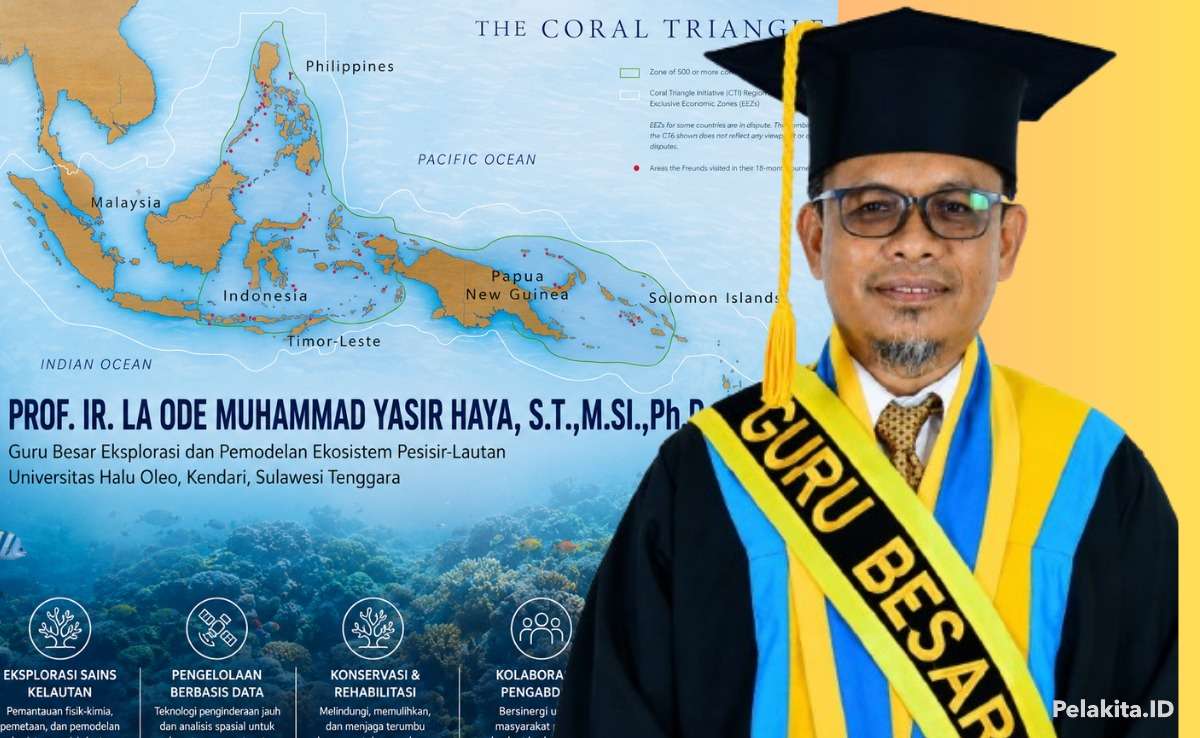
Standing at the forefront of efforts to understand and protect this ecosystem is Prof. Ir. La Ode Muhammad Yasir Haya, S.T., M.Si., Ph.D., Professor of Coastal-Marine Ecosystem Exploration and Modeling at Universitas Halu Oleo.
Through decades of research, technological innovation, and policy-oriented science, he has emerged as one of Indonesia’s leading marine scientists dedicated to safeguarding the nation’s coral reefs.
His scientific vision was eloquently presented during his professorial inaugural lecture, where he outlined not only the alarming state of Indonesia’s coral reefs but also a comprehensive scientific roadmap for ensuring their resilience in an era of accelerating climate change.
Indonesia: The Global Center of Coral Biodiversity
Indonesia occupies a unique position within the Coral Triangle, often referred to as the “Amazon of the Seas.” The country manages approximately 50,875 square kilometers of coral reefs, representing nearly 18 percent of the world’s total coral reef area.
Despite covering a relatively small portion of the Earth’s oceans, Indonesian reefs harbor extraordinary biodiversity. They are home to approximately 480 species of reef-building corals, representing nearly 60 percent of all known hard coral species, and support around 1,650 species of reef fish.
These ecosystems perform functions far beyond their ecological beauty. Coral reefs are among the planet’s most productive ecosystems, sustaining fisheries, protecting coastlines from erosion and storm surges, supporting marine tourism, and providing opportunities for pharmaceutical discoveries.
For millions of Indonesians living in coastal communities, healthy coral reefs are directly linked to food security, livelihoods, and economic prosperity.
“Coral reefs are not merely underwater landscapes,” Prof. Yasir emphasizes. “They are the biological foundation of Indonesia’s marine economy and an essential pillar of national resilience.”
A Marine Treasure Under Siege
Despite their immense ecological and economic value, Indonesia’s coral reefs are experiencing severe degradation.
According to Prof. Yasir’s research synthesis, more than 85 percent of Indonesia’s coral reefs are classified as facing high to very high levels of threat, while approximately 70.21 percent are currently in fair to poor condition.
The causes are multifaceted.
Climate change has increased sea surface temperatures, triggering widespread coral bleaching events and reducing reef resilience. Simultaneously, anthropogenic pressures—including destructive fishing practices, coastal development, sedimentation, pollution, and nutrient enrichment—have accelerated ecosystem decline.
Indonesia’s coral-based fisheries continue to produce approximately 7.3 million metric tons annually, illustrating both the productivity of reef ecosystems and the enormous dependency of coastal populations upon them. Yet this productivity cannot be sustained if reef degradation continues unchecked.
“The challenge is no longer whether coral reefs are changing,” Prof. Yasir argues. “The challenge is whether science and policy can respond quickly enough.”
Integrating Science and Technology for Marine Conservation
One distinguishing feature of Prof. Yasir’s work is his integration of marine science, remote sensing technology, environmental monitoring, and socio-economic analysis into a unified framework for coastal management.
His research is built upon four interconnected scientific pillars.
Mapping Reef Dynamics
Using satellite imagery integrated with long-term field observations collected between 1994 and 2024, Prof. Yasir has documented spatial and temporal changes in coral reef cover across numerous Indonesian coastal regions.
Remote sensing enables scientists to monitor reef health over extensive areas, detect degradation patterns, and evaluate restoration outcomes more efficiently than conventional field surveys alone.
Economic Valuation of Coral Ecosystems
Recognizing that conservation decisions often require economic justification, Prof. Yasir’s research quantifies the financial value of ecosystem services provided by coral reefs while estimating future economic losses associated with environmental degradation.
By translating ecological damage into economic terms, his work strengthens the evidence base for investment in marine conservation and sustainable coastal management.
Sustainability Assessment
Employing analytical tools such as Rapfish and the Analytic Hierarchy Process (AHP), his studies evaluate sustainability across ecological, economic, institutional, and social dimensions.
This multidimensional approach enables policymakers to identify critical weaknesses within marine governance systems while prioritizing interventions that generate the greatest long-term impact.
Adaptive Management Strategies
Finally, his research synthesizes scientific evidence into practical management recommendations, emphasizing community engagement, stronger law enforcement, habitat restoration, and sustainable fisheries management.
Rather than treating coral conservation solely as an environmental issue, Prof. Yasir frames it as an integrated socio-ecological challenge requiring collaboration among scientists, governments, coastal communities, and industry.
Climate Change Is Already Reshaping Indonesia’s Reefs
Among the most concerning findings presented in Prof. Yasir’s research is the rapid deterioration of water quality associated with climate change.
Environmental monitoring conducted between 2022 and 2024 recorded average Sea Surface Temperatures (SST) reaching 30.69°C—well above the threshold known to induce thermal stress in reef-building corals.
Persistent exposure to temperatures exceeding 30°C significantly increases the likelihood of mass coral bleaching.
Chemical indicators further reveal deteriorating environmental conditions.
Measured nitrate concentrations ranged from 0.107 to 0.120 mg/L, while phosphate concentrations reached 0.026 to 0.182 mg/L—both exceeding Indonesian marine water quality standards.
These elevated nutrient levels promote eutrophication, stimulate excessive algal growth, and intensify competition that suppresses coral recruitment and recovery.
Together, thermal stress and nutrient pollution create conditions that leave coral reefs increasingly vulnerable to disease outbreaks and ecosystem collapse.
Evidence from the Field
Prof. Yasir’s research spans multiple regions across Indonesia, documenting alarming patterns of ecosystem degradation.
In Pangkep Regency, coral cover declined by approximately 174 hectares annually between 1994 and 2014, with sustainability assessments categorizing the ecosystem as less sustainable.
In the Tiworo Strait, combined anthropogenic and environmental pressures produced a sustainability index indicative of high ecological risk.
Around Mandeike Island, coral reef cover declined by nearly 90 percent, shrinking from 78.3 hectares to only 8.01 hectares.
Meanwhile, across Southeast Sulawesi, the prevalence of coral diseases—including White Band Disease (WBD) and Black Band Disease (BBD)—has increased substantially, reflecting declining ecosystem health.
These ecological losses also carry profound economic consequences.
Research estimates the ecosystem value of coral reefs in Pangkep at approximately USD 2.8 million per hectare, while projecting cumulative economic losses approaching USD 1 billion over the next two decades if degradation continues.
Similar projections indicate future losses of approximately IDR 2.47 billion in North Konawe Regency and IDR 1.7 billion around Bawean Island over a ten-year period.
Closing the Management Gap
Based on the Analytic Hierarchy Process, Prof. Yasir proposes four strategic priorities for coral reef conservation.
The highest priority is public education and awareness campaigns, emphasizing behavioral change and community participation.
The second priority is strengthening environmental law enforcement to combat illegal and destructive marine activities.
Third is improving fishing gear selectivity, reducing ecological damage caused by unsustainable fishing practices.
Finally, he advocates expanding coral reef rehabilitation programs to restore degraded habitats and enhance ecosystem resilience.
These priorities demonstrate that effective conservation requires more than scientific knowledge; it demands governance systems capable of translating evidence into action.
A Scientific Roadmap Toward Climate-Adaptive Coral Reefs
Looking ahead, Prof. Yasir has developed a long-term research roadmap extending through 2030, designed to build climate-resilient reef ecosystems.
The roadmap begins with molecular identification and characterization of coral diseases using DNA and biochemical analyses, establishing comprehensive coral health databases.
The next phase focuses on developing climate-adaptive coral strains through selective propagation and resilience testing.
Subsequent research explores the role of coral ecosystems in Blue Carbon dynamics, contributing to global climate mitigation strategies.
Advanced spatial-temporal modeling will then predict future ecosystem dynamics under different climate scenarios.
Ultimately, the program aims to establish an integrated Climate-Adaptive Coral Database for the Coral Triangle region, providing policymakers with robust scientific information to guide conservation planning.
Science as the Foundation for Indonesia’s Blue Future
Prof. La Ode Muhammad Yasir Haya’s work reflects a broader vision of marine science—one in which research extends beyond academic publication to become a catalyst for policy innovation and sustainable development.
His interdisciplinary approach demonstrates that protecting coral reefs requires combining remote sensing, ecological monitoring, molecular biology, economics, spatial modeling, and community engagement within a unified framework.
As climate change continues to reshape marine ecosystems worldwide, Indonesia’s ability to safeguard the Coral Triangle will depend increasingly on science-driven decision-making.
For Prof. Yasir, coral reefs represent far more than biodiversity hotspots. They are living infrastructure that supports food security, coastal resilience, economic prosperity, and national sovereignty.
Protecting them is not simply an environmental responsibility—it is an investment in Indonesia’s future.
“Science must become the foundation of marine policy. Only by understanding ecosystem dynamics through rigorous research can we safeguard the future of Indonesia’s oceans and the millions of people whose lives depend upon them.”