
Journalists must remember the profession’s original DNA: serving the public, not merely feeding algorithms or emotional outrage.
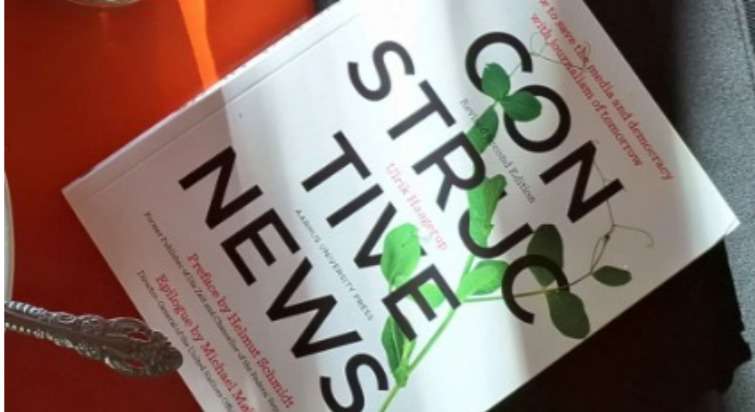
MARITIMEPOSTS.COM – In an era when headlines are dominated by fear, outrage, conflict, and endless pessimism, Constructive News by Ulrik Haagerup arrives not merely as a journalism book, but as a manifesto for rebuilding public trust in the media.
Published by Aarhus University Press and first released in 2017, this influential work challenges one of the deepest assumptions in modern journalism: that bad news is the only news people will pay attention to.
Through experience, criticism, and practical solutions, Haagerup argues that journalism has become trapped inside a culture of negativity that distorts reality, weakens democracy, and exhausts society psychologically.
The book is both a critique and a roadmap.
A Journalist Who Knows the System from the Inside
Haagerup writes with authority earned over decades inside elite newsrooms.
Before founding the independent Constructive Institute in Aarhus, Denmark, in 2017, he served for ten years as Executive Director of News at the Danish Broadcasting Corporation (DR). Earlier, he worked as editor-in-chief at major Danish newspapers including Jyllands-Posten and Nordjyske.
His academic and executive training at institutions such as Stanford University, INSEAD, IMD, the Stanford Research Institute, and the Wharton Business School adds intellectual depth to his arguments.
Yet what makes the book powerful is not academic theory alone, but Haagerup’s direct confrontation with journalism’s internal culture.
This is a veteran editor speaking honestly about the failures of the profession he loves.
The Core Argument: Journalism Has Become Addicted to Negativity
The opening chapters — What’s Wrong? and Why Are You So Negative? — immediately establish the central crisis. Haagerup dissects the newsroom mindset that prioritizes scandal, fear, outrage, and conflict because “if it bleeds, it leads.”
He argues that modern media increasingly creates a distorted perception of reality. While journalism claims to reflect society truthfully, it often magnifies society’s worst moments while ignoring solutions, resilience, cooperation, and progress.
One of the book’s strongest concepts is what Haagerup describes as a “global mental obesity pandemic.” Just as unhealthy food damages the body, unhealthy information diets damage public thinking and emotional wellbeing. Constant exposure to negativity creates cynicism, fear, polarization, and hopelessness.
The critique is sharp:
- journalism acts as a mouthpiece instead of a watchdog,
- speculation replaces verification through “hypothesis journalism,”
- outrage becomes more profitable than understanding,
- and superficial content overwhelms meaningful reporting.
Haagerup does not argue for “positive news” or naïve optimism.
Instead, he advocates for what he calls constructive journalism — reporting that remains critical and truthful while also exploring solutions, context, consequences, and possibilities.
The Powerful Preface: A Warning from Helmut Schmidt
One of the most remarkable sections of the book is the preface written by Helmut Schmidt, the former Chancellor of Germany and publisher of Die Zeit.
Schmidt’s reflections elevate the book from a media critique into a civilizational warning.
He argues that Western societies have evolved into “media-democracies,” where media influence often surpasses political leadership itself.
According to Schmidt, the media’s obsession with negativity and superficiality produces distorted public realities and encourages the rise of populist leaders.
His comparison between modern politics and historical leadership is striking. Ancient Greeks, Romans, and later leaders like Winston Churchill and Charles de Gaulle emerged before today’s hyper-mediated political culture.
Modern politicians, Schmidt argues, are forced to chase exposure, simplify complex issues, and survive within an endless cycle of media attention.
The preface also criticizes the culture of short-form communication — reducing complicated policies into tweet-sized slogans and emotional reactions.
Schmidt warns that such superficiality weakens democratic leadership itself.
At nearly 95 years old when writing the preface in October 2014, Schmidt describes himself as a realist, while presenting Haagerup as the optimist attempting to rescue journalism from its destructive habits.
It is an extraordinary endorsement.
From Criticism to Solutions
What distinguishes Constructive News from many media critiques is that Haagerup does not stop at diagnosis. The second half of the book becomes intensely practical.
In chapters such as A Good Story, Best Practice, and How to Do It?, Haagerup presents examples from Denmark and international media organizations attempting to rebuild audience trust through more meaningful journalism.
He explains how newsroom culture can evolve:
- asking better questions,
- focusing on solutions rather than only failures,
- improving audience engagement,
- reducing cynical reporting habits,
- and strengthening journalism’s democratic purpose.
Particularly compelling is his emphasis on leadership.
In Constructive Leadership, Haagerup argues that media transformation requires editors and newsroom leaders willing to change entrenched habits.
Journalists must remember the profession’s original DNA: serving the public, not merely feeding algorithms or emotional outrage.
The later chapters — Mind Your Step, Now What?, and Join the Global Movement — expand the discussion into a broader international movement for media reform. Haagerup calls for journalism that empowers citizens rather than emotionally exhausting them.
Why This Book Matters Today
Nearly a decade after its publication, Constructive News feels even more relevant.
The rise of social media outrage cycles, disinformation, clickbait economies, algorithmic polarization, and political distrust has intensified many of the problems Haagerup identified. Around the world, audiences increasingly avoid news altogether because they associate it with anxiety, anger, helplessness, and manipulation.
Haagerup’s argument is not that journalism should become soft. It is that journalism should become smarter, deeper, and more responsible.
Constructive journalism does not ignore corruption, injustice, war, or crisis. Instead, it asks an additional question:
What now?
That question may be the most important contribution of this book.
Final Assessment
Constructive News is one of the most important contemporary books about the future of journalism and democracy.
It combines newsroom experience, philosophical reflection, political critique, and practical innovation into a persuasive argument for reform.
For journalists, editors, media scholars, communication students, and anyone concerned about the emotional and political impact of modern news culture, this book is essential reading.
Ulrik Haagerup does not offer easy optimism. What he offers is something more valuable: the possibility that journalism can still recover its public mission before cynicism completely consumes it.
In a contemporary media landscape frequently defined by outrage, systemic pessimism, and a relentless focus on societal friction, Ulrik Haagerup’s Constructive News serves as a critical manifesto for structural reform rather than just another academic critique.
Haagerup and the book
First published by Aarhus University Press in 2017, the book confronts a foundational premise of the modern press: the belief that audience engagement is strictly dependent on negative framing.
Drawing on extensive industry experience, Haagerup argues that a pervasive culture of negativity actively distorts public perception, erodes democratic institutions, and contributes to widespread psychological fatigue.
Haagerup’s arguments carry the weight of decades spent at the highest levels of European journalism.
Before establishing the independent Constructive Institute in Aarhus, Denmark, in 2017, he spent ten years as the Executive Director of News at the Danish Broadcasting Corporation (DR).
His career also includes tenures as editor-in-chief at prominent Danish newspapers, including Jyllands-Posten and Nordjyske.
___
Editor K. Azis