

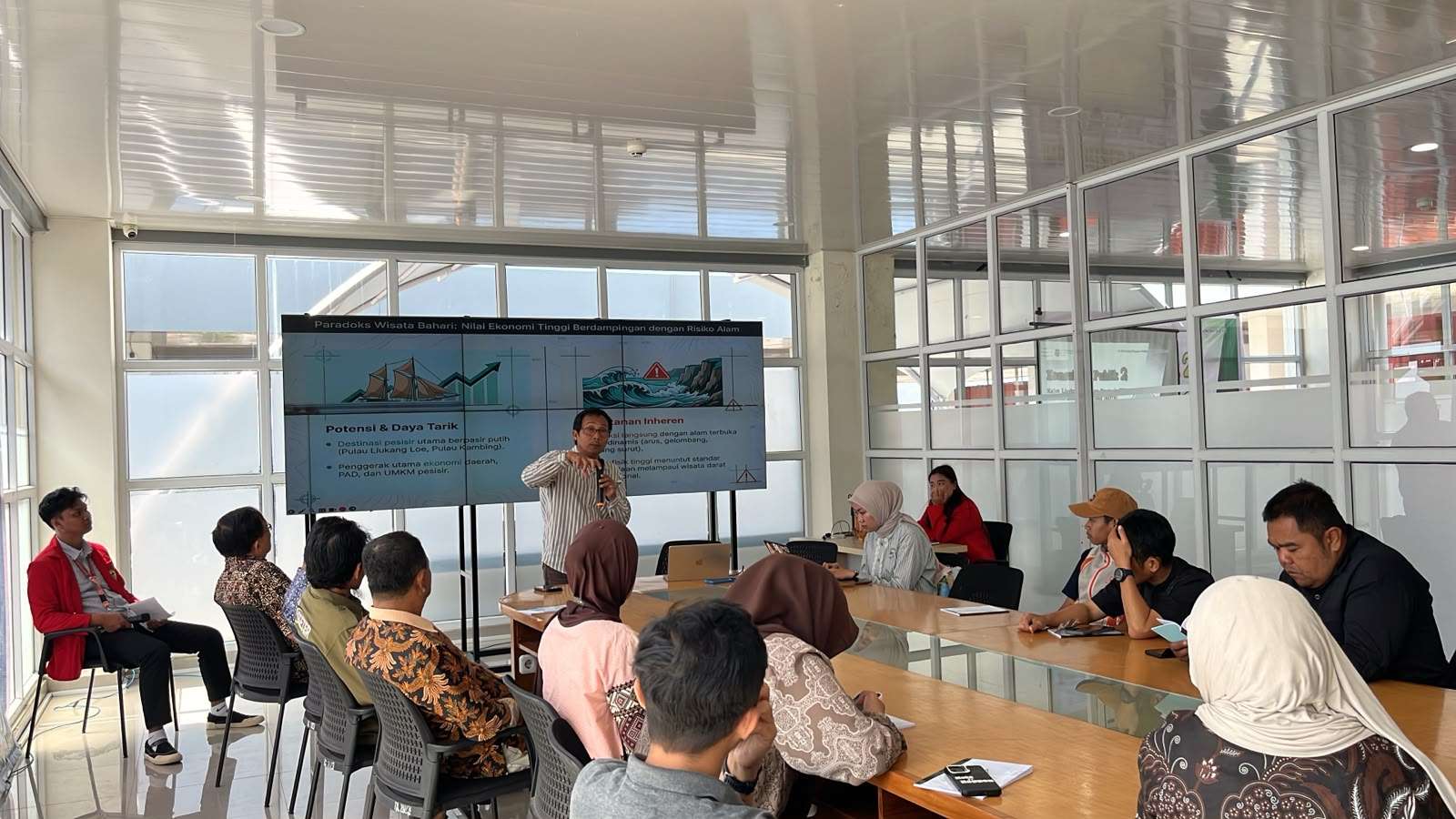
MARITIMEPOSTS.COM — The Center for Climate Change Studies at the Institute for Research and Community Service of Hasanuddin University (PSPI LPPM-Unhas), in collaboration with the Bulukumba Regency Tourism, Youth and Sports Office, held a training session on occupational safety procedures for operators and managers of marine tourism destinations on Thursday (Aug. 20, 2026).
The activity was part of Hasanuddin University’s Community Service Program through the 2026 Community Partnership Program (PPMU-PK-M). The training was held at the Bira Meeting Room, fourth floor of the Phinisi Building, Bulukumba Regency Government Public Service Mall.
The training was attended by representatives of operators and managers from a number of marine tourism destinations across Bulukumba Regency.
Head of the Unhas Center for Climate Change Studies, Dr. Rijal Idrus, M.Sc., who served as the person in charge of the program, said the community service activity was initially designed for the Beach Tourism Operators Group in Bira Village, Bonto Bahari District, Bulukumba Regency.
The partner group consists of community members directly involved in marine tourism management. However, they continue to face challenges related to limited awareness and capacity in implementing safety, security, and environmental ethics standards in tourism activities.

“This condition has the potential to reduce the quality of tourism services, increase the risk of accidents, and contribute to coastal environmental degradation. The main problems faced by the partners include a lack of optimal understanding of marine tourism safety and security standards, low awareness of environmentally friendly tourism practices, and the absence of simple guidelines or systems that can serve as a reference for managing tourism activities safely and sustainably,” Rijal explained.
According to Rijal, these challenges are consistent with findings from previous studies showing that marine tourism management in coastal areas has yet to be fully integrated with safety and environmental sustainability considerations.
As a solution, the program adopts a participatory educational approach combined with community-based action.
The program will be implemented through several stages, beginning with further identification of problems and a pre-test to measure the partners’ initial level of knowledge.
“Second, we will conduct education and training on safety, security, and environmental ethics standards in beach tourism management; jointly develop a simple community-based guideline as an operational reference for the partners; and conduct an evaluation through a post-test to measure improvements in understanding and changes in behavior,” he added.
Through the program, the organizers hope to promote safer, more comfortable, and environmentally friendly tourism management in Bira Village. This, in turn, is expected to improve tourists’ experiences while supporting the sustainability of coastal ecosystems and the welfare of local communities.
Rijal explained that the training was initially planned specifically for participants from Bira following several incidents that highlighted safety risks in marine tourism, including the drowning of a high school student at Apparalang and a fire at Hotel Padduppa.
“These incidents raised concerns about hazards in marine tourism and highlighted the need to increase awareness among tourism operators as an initial step toward implementing safety standards and improving service quality,” he said.
However, Rijal said the Bulukumba Tourism, Youth and Sports Office, through its head, Hj. Hamrina Andi Muri, S.Pd., M.Si., recognized that the training was important for all tourism operators in the regency.
“The Head of the Office took the initiative to invite 20 participants from various destinations and tourism activities,” he said.
“As a result, 20 representatives of tourism operators from different parts of Bulukumba attended the training, including operators of mountain bathing facilities and other tourism activities that are not limited to marine tourism,” Rijal explained.
Safety Procedures for Tourism Destinations
The training was designed to improve participants’ understanding of occupational safety procedures in tourism area management, particularly at destinations involving activities and risks associated with coastal and marine environments.
One of the speakers was Prof. Dr. Ir. Abd. Rasyid Jalil, M.Si., a lecturer and researcher at the Faculty of Marine Science and Fisheries, Hasanuddin University. He discussed the concept of Safety Navigation for Marine Tourism.
Prof. Rasyid Jalil, popularly known as Prof. Cido, specializes in ecology, oceanography, and fisheries.
In his presentation, Rasyid Jalil emphasized that safety must be an integral part of marine tourism destination management rather than merely an operational complement.
“Safety in marine tourism areas must be part of destination governance. Managers need to understand the characteristics of the marine environment, identify potential risks, and ensure that every tourism activity is carried out using safe procedures.”
He explained that an understanding of coastal and marine environmental conditions is essential because marine tourism activities directly interact with dynamic natural factors.
Tourism managers therefore need to be prepared to anticipate changes in water conditions and various potential hazards that could endanger both visitors and workers.
Prof. Cido has an extensive research track record in marine science. Data from SINTA records several of his research activities, including studies on the physicochemical conditions of marine waters, blue carbon, and coastal ecosystems.
The training was expected not only to provide theoretical knowledge but also to encourage tourism managers to apply safety procedures in their daily activities.
These include emergency preparedness, monitoring tourist activities, and identifying potential hazards within marine tourism areas.
The second speaker, Rahmah Dini Irhamna Paradita, S.K.M., presented material on First Aid and Emergency Response at Tourism Destinations. The session was followed by a question-and-answer discussion and a post-test.
The training brought together representatives of tourism managers from various destinations in Bulukumba, including Tebing Mattoanging, Dego Degona Bira, Bira Beach, Bara Beach, Titik Nol, Merpati Beach, Pussahelu Beach, Panrang Luhu Beach, and Kapu Beach.
Other participants represented Balabalayya Beach, Lembang Beach, Babana Beach, Paranyalling Beach, Batu Batang Beach, Marumasa Beach, Panaikang Birayya Beach, Kasuso Beach, Solleng Beach, and Apparalang Beach.
By K. Azis