
How Upstream and Downstream Farmers in Bulukumba Are Learning to Live with Climate Change
- The insights presented in this article are based on research conducted by Arifah (Pangkep State Polytechnic of Agriculture) together with Darmawan Salman, Amir Yassi, and Eymal Bahsar Demmallino from Hasanuddin University.
- Their study on climate change adaptation among lowland rice farmers in Bulukumba explores how knowledge flows between farmers, communities, agricultural extension officers, and scientific institutions.
- The research offers a rare look into how farmers at different points of the irrigation system experience climate change differently and how they combine generations of local wisdom with modern agricultural knowledge to protect their livelihoods amid increasingly unpredictable weather patterns.
MARITIMEPOSTS.COM – Climate change does not arrive equally for everyone. Even within the same irrigation system, people can experience entirely different realities.
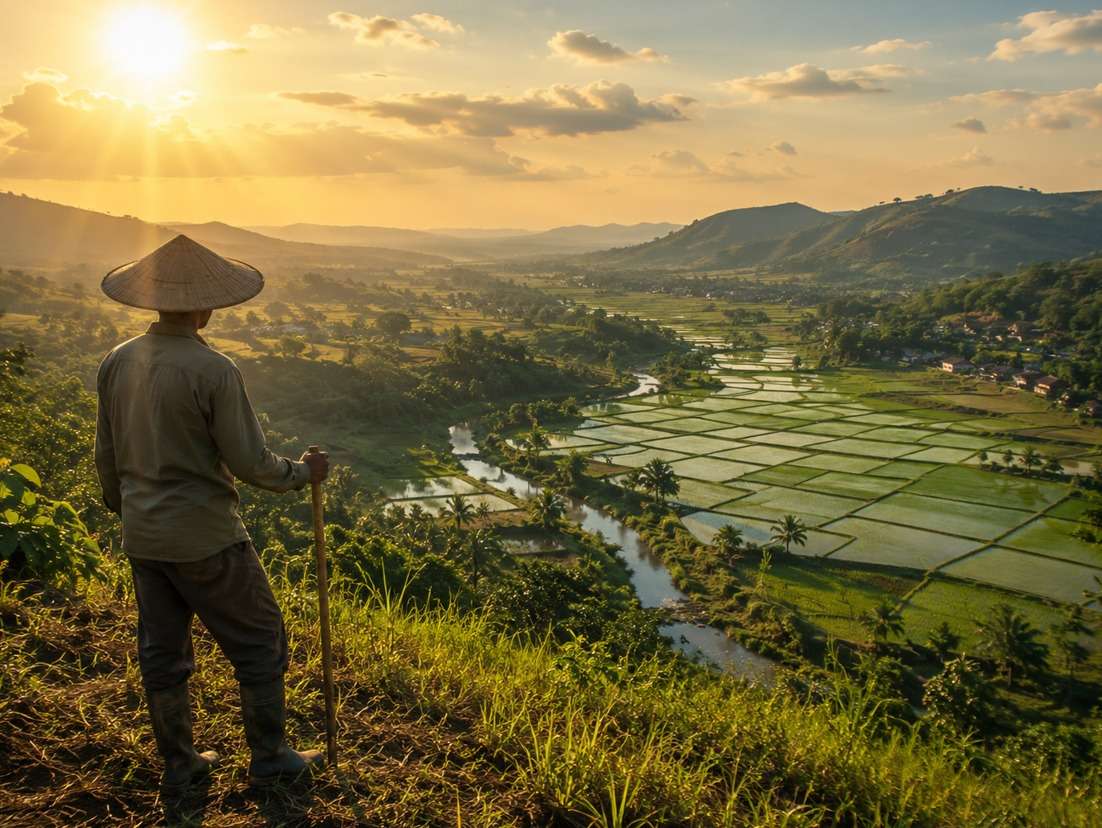
In Bulukumba Regency, South Sulawesi, rice farmers living in upstream and downstream irrigation areas are facing the same changing climate, but they are fighting very different battles.
For farmers near the headwaters and irrigation sources, the challenge comes in the form of increasingly aggressive pests and plant diseases. For those at the tail end of the irrigation network, climate change means something more fundamental: the struggle to secure water itself.
A recent study on climate adaptation among rice farmers in Bulukumba reveals how communities are responding to environmental uncertainty by combining ancestral knowledge, social solidarity, and modern agricultural innovations.
Their experiences offer a glimpse into how rural Indonesia may confront one of the greatest challenges of the twenty-first century.
Two Landscapes, Two Climate Realities
The distinction between upstream and downstream farmers begins with geography.
Upstream farmers are located closer to irrigation sources. Water generally remains available even during dry periods. As a result, they do not perceive water scarcity as the most serious consequence of climate change. Instead, they point to rising temperatures and shifting seasons that trigger outbreaks of pests and diseases.
Many describe increasing attacks from rats, brown planthoppers, blast disease, and a local pest known as mate mappong ase. This pest causes rice leaves to turn yellow, shoots to wither, and grains to remain empty, ultimately reducing harvest yields.
For these farmers, climate change is visible not through dry canals but through damaged crops.
Downstream farmers face a starkly different reality.
Situated farther from irrigation sources, they are often the first to suffer when rainfall declines or river flows weaken. Water shortages, reduced irrigation discharge, and prolonged droughts have become defining features of their agricultural lives.
Unlike their upstream counterparts, downstream farmers frequently experience crop failures and substantial declines in rice production. Climate change is not merely an environmental issue for them—it is a direct threat to household survival.
The contrast illustrates an important lesson: climate change impacts are shaped not only by weather but also by access to resources.
Understanding Climate Through Culture and Experience
The study reveals that farmers’ perceptions of climate change are deeply influenced by culture, religion, age, and personal experience.
Among older upstream farmers, climate change is often understood through a moral and spiritual lens. Many believe that environmental disturbances occur because people have strayed from religious teachings and traditional values.
Failed harvests, unusual weather, and pest outbreaks are sometimes interpreted as signs that communities have violated social and religious norms. In this worldview, restoring environmental balance requires not only practical action but also moral reflection and prayer.
Many farmers describe climate change simply as “God’s will.”
Yet another perspective is emerging among younger generations.
Younger downstream farmers increasingly explain climate change through environmental degradation. They point to deforestation, forest conversion, and unchecked land development as major drivers of changing rainfall patterns and declining water availability.
Having witnessed repeated droughts, these younger farmers often express concern that the loss of forests has reduced nature’s ability to store and regulate water.
This generational shift reflects the growing influence of education, digital technology, and scientific information in rural communities.
Reading Nature’s Signals
Long before weather forecasts became available on smartphones, Bulukumba farmers relied on nature itself as a forecasting system.
Many continue to observe environmental signs that have been passed down through generations.
One unusual indicator involves dogs.
Farmers believe that when dog droppings appear frequently in rice fields, heavy rains are approaching. Rat behavior also serves as a forecasting tool. If rats begin attacking young rice plants at the beginning of the planting season, farmers interpret this as a sign that the rainy season will last longer than usual.
Plants also provide important clues.
The growth of bamboo shoots and banana plants is closely monitored. When bamboo shoots fail to grow properly, farmers see it as a warning that a prolonged dry season may be coming. Such signals encourage them to plant earlier to avoid future water shortages.
These observations form part of a sophisticated local knowledge system developed through decades of interaction with the landscape.
While scientific validation of these indicators may vary, they continue to play a practical role in decision-making because they are grounded in generations of accumulated experience.
The Traditional Calendar Under Pressure
Another important adaptation tool is the traditional Bugis-Makassar agricultural calendar.
For generations, this calendar has helped farmers determine when to plant and harvest. It incorporates observations of lunar cycles, seasonal patterns, and ecological indicators.
Some farmers avoid planting during a full moon because traditional teachings suggest that pests emerge more actively during that period. Others time critical crop growth stages to coincide with specific lunar phases believed to reduce pest risks.
These decisions are often discussed collectively through community meetings known as Tudang Sipulung, where farmers, local leaders, government representatives, and agricultural stakeholders gather to coordinate planting schedules.
However, climate change is challenging the reliability of traditional calendars.
Many farmers report that weather patterns no longer align with historical expectations. Seasons arrive later, rainfall becomes less predictable, and drought periods extend beyond normal cycles.
As a result, farmers increasingly combine traditional knowledge with scientific forecasts and advice from agricultural extension officers.
Rather than abandoning local wisdom, they are adapting it.
Innovation from the Rice Fields: The Salibu System
One of the most promising examples of scientific adaptation is the adoption of the Salibu system.
Used by a growing number of younger and more educated farmers, the method allows rice plants to regenerate from existing stubble after harvest rather than requiring complete replanting.
The benefits are substantial.
Farmers report water savings of up to 50 percent compared to conventional rice cultivation. The system also reduces labor requirements and improves resistance to pest attacks.
One farmer explained that after four years of using the Salibu method, he had not needed chemical pesticides.
Another advantage is strategic timing. By adjusting planting and harvesting schedules through the Salibu system, farmers can avoid periods when rat populations typically reach their peak.
Despite these benefits, adoption remains limited.
Many traditional farmers remain cautious because of concerns about rat infestations and uncertainty regarding the system’s long-term performance.
The challenge highlights a common issue in climate adaptation: effective innovations do not automatically spread unless farmers trust them and see evidence from their peers.
Climate Change and Household Food Security
Perhaps the most alarming finding from the study concerns household food security among downstream communities.
When drought causes harvest failures, families often face difficult choices.
Many report reducing food consumption, purchasing cheaper foods, or relying heavily on instant noodles. Others must sell productive assets such as livestock, jewelry, or gold to meet daily expenses.
In severe cases, family members leave the village temporarily to seek employment elsewhere.
Men commonly work as construction laborers, masons, or carpenters in urban areas while maintaining ties to their farming households.
Climate change therefore extends far beyond agricultural production. It affects nutrition, income stability, education opportunities, and overall household well-being.
The vulnerability of downstream farmers demonstrates how environmental shocks can quickly become social and economic crises.
The Hidden Strength of Social Capital
Yet the study also reveals an important source of resilience.
As climate pressures intensify, kinship networks and community solidarity become increasingly valuable.
When crops fail, neighbors frequently lend seeds, provide food, or offer small loans. Families often borrow money from relatives under informal trust-based arrangements that allow repayment whenever circumstances improve.
Migrant workers who leave the village for temporary employment continue supporting their households and communities.
Rather than weakening social ties, climate hardship often strengthens them.
Researchers describe this as “bonding social capital”—a network of trust, reciprocity, and mutual assistance that helps households absorb shocks.
These relationships serve as an informal safety net when formal support systems are absent or insufficient.
For many downstream farmers, social solidarity is as important as irrigation infrastructure.
Lessons for Climate Policy
The experiences of Bulukumba’s farmers suggest that climate adaptation cannot rely solely on technological solutions.
Water infrastructure, drought-resistant seeds, and climate forecasting systems remain essential. However, successful adaptation also depends on understanding local realities, cultural beliefs, social relationships, and traditional knowledge.
The study recommends a participatory approach that brings farmers directly into climate planning processes.
Such an approach would recognize that adaptation strategies are already emerging from the ground up. Farmers are not passive victims of climate change. They are active innovators, observers, and problem-solvers.
Their experiences show that effective climate policy should combine scientific expertise with local knowledge systems, support social resilience alongside technological innovation, and address the differing needs of upstream and downstream communities.
A Shared Future
The story of Bulukumba is ultimately a story about adaptation under unequal conditions.
Upstream farmers battle pests and disease. Downstream farmers fight for water. Older generations seek explanations in cultural and spiritual traditions, while younger farmers increasingly turn to science and environmental awareness. Some rely on traditional calendars; others experiment with new cultivation systems like Salibu.
Yet all share a common challenge: learning how to farm in a climate that is becoming increasingly unpredictable.
As Indonesia confronts rising temperatures, changing rainfall patterns, and growing climate risks, the lessons emerging from Bulukumba’s rice fields may prove valuable far beyond South Sulawesi.
They remind us that resilience is not found only in technology or infrastructure. It is also found in memory, knowledge, cooperation, and the enduring determination of farming communities to adapt and survive.