
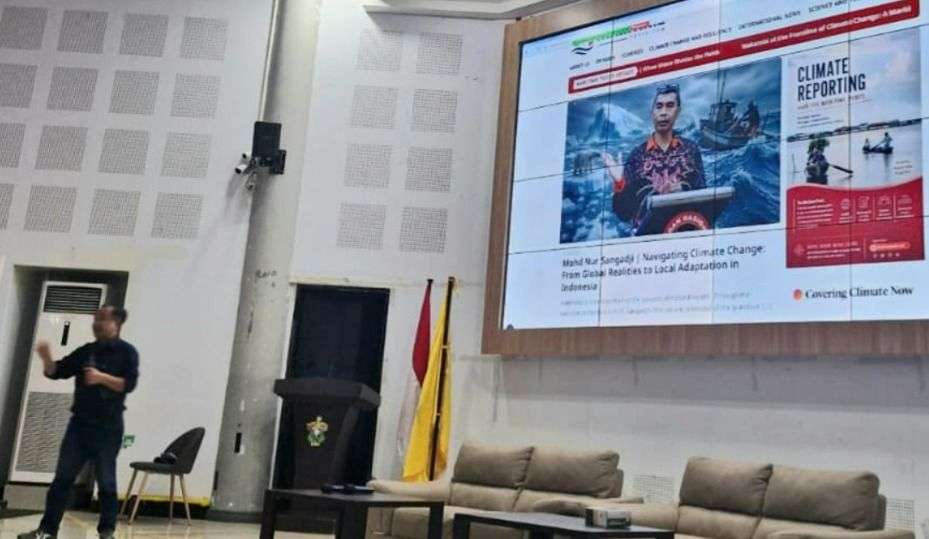
Drawing on experiences from the Climate Reporting Workshop for Indonesian Journalists, organized by The Australian-Indonesia Centre (AIC) and Monash Climate Communication, I shared insights into the evolving role of journalism in addressing climate change.
MARITIMEPOSTS.COM – Makassar, Indonesia — More than a thousand students from Hasanuddin University are preparing to spend the next month living and working in villages across five districts in South Sulawesi as part of Indonesia’s Climate Village Program (Program Kampung Iklim or ProKlim), a community-based initiative aimed at strengthening local climate resilience.
Ahead of their deployment, the students participated in a Climate Dialogue titled “Youth Action for Climate Protection: Towards a Green and Sustainable Indonesia,” an event supported by Indonesia’s Ministry of Environment in collaboration with the Hans Seidel Foundation and Hasanuddin University.
The forum brought together academics, climate experts, government representatives, and practitioners to discuss the growing importance of climate action and the role of young people in supporting climate adaptation and mitigation efforts at the local level.
During the session, participants were encouraged to view climate change not merely as an environmental issue, but as a social, economic, and development challenge that directly affects communities.
The discussion emphasized the need for informed public engagement and effective communication to help bridge the gap between scientific knowledge and everyday experiences.
Drawing on experiences from the Climate Reporting Workshop for Indonesian Journalists, organized by The Australian-Indonesia Centre (AIC) and Monash Climate Communication, I shared insights into the evolving role of journalism in addressing climate change.
The workshop highlighted the urgency of improving climate coverage in Indonesia by promoting reporting that is factual, evidence-based, constructive, and solution-oriented.
As climate impacts become increasingly visible across the country—from coastal erosion and extreme weather events to changing agricultural patterns—journalists and communicators have a critical responsibility to help the public understand both the risks and the available solutions.
For students preparing to work closely with rural communities, I emphasized three essential skills that can help them better understand and document climate realities at the local level.
The first is factual observation, the ability to carefully observe environmental and social changes occurring within communities.
The second is evidence-based interviewing, which involves gathering information through meaningful conversations supported by data and local knowledge.
The third is comprehensive analysis, enabling students to connect local experiences with broader climate trends and policy discussions.
These skills, while fundamental to journalism, are equally valuable for students engaged in community service and climate action programs. They can help ensure that local voices, experiences, and innovations are accurately documented and shared with wider audiences.
Students were also encouraged to transform their field experiences into stories that highlight community resilience, local adaptation practices, and environmental stewardship. Such stories can play an important role in inspiring public awareness and supporting climate action beyond the communities where they originate.
To support these efforts, students were invited to publish their reports and reflections through Pelakita.ID and MaritimePosts.com, two media platforms that have consistently covered and promoted Hasanuddin University’s community service initiatives over the past three years.
As Indonesia continues to face the growing impacts of climate change, empowering young people with the skills to communicate, document, and share climate realities has become increasingly important.
Programs such as ProKlim demonstrate how universities, government institutions, and civil society organizations can work together to cultivate a new generation of climate leaders equipped not only with knowledge, but also with the ability to engage communities and inspire collective action.
I extend my sincere appreciation to the Directorate of Climate Change Resource Mobilization of the Ministry of Environment, the Center for Climate Change Studies at Hasanuddin University, and Hasanuddin University for the opportunity to contribute to this important dialogue and engage with the next generation of climate advocates and changemakers.
This version follows a standard news-feature structure: headline, lead, context, key messages, quotes/experience, broader significance, and closing acknowledgment. It reads more like a professional institutional or media article rather than a personal event note.