

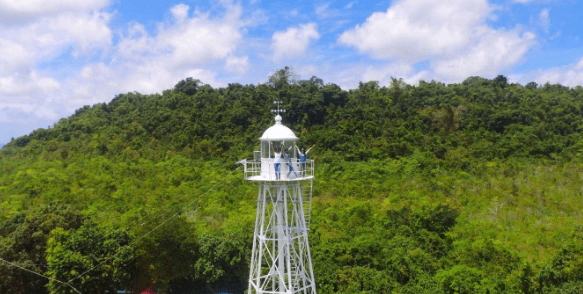
The Waha Lighthouse should be viewed as more than just a colonial-era structure. It must be positioned as part of the collective memory of Wakatobi’s maritime community. Strengthening its status as a maritime cultural heritage site could become an important step in both protecting and sustainably utilizing this historical legacy.
MARITIMEPOSTS.COM – On the coast of Waha, Wakatobi, stands an old lighthouse that for more than a century has witnessed the maritime journeys of the Indonesian archipelago.
Built in 1901 during the Dutch colonial era, the Waha Lighthouse originally served as a navigation marker for ships passing through Wakatobi waters.
To this day, the structure still stands firmly facing the sea—guarding memories of a maritime history that is slowly fading from public consciousness.
Amid the rapid development of Wakatobi tourism as a National Strategic Tourism Area (KSPN), the Waha Lighthouse has not yet been fully positioned as a strategic maritime cultural asset.
More often, it is seen merely as an old building rather than as a space of knowledge and identity with historical, educational, and ecological value.
In fact, a lighthouse is far more than just a navigation tower. In maritime history, a lighthouse symbolizes coastal civilization. It serves as a point of navigational safety, a territorial marker, and evidence that the sea has long been a meeting space for people, trade, and culture.
In Indonesia, lighthouses have been built since the 19th century to support maritime navigation across the archipelago.
The Waha Lighthouse embodies all those layers of history.
Unfortunately, tourism development in many regions is often overly focused on physical infrastructure and visual aesthetics. The sea is marketed merely as scenery, while the maritime history and coastal culture surrounding it are marginalized.
As a result, tourism grows without a strong identity.
Wakatobi actually has a great opportunity to break away from this pattern. So far, Wakatobi’s tourism image has centered on marine attractions: coral reefs, diving, and tropical seascapes.
Yet various studies show that Wakatobi also possesses significant cultural and historical tourism potential that has not been optimally developed.
In this context, the Waha Lighthouse could become a medium for educational ecotourism that connects natural landscapes with the maritime history of coastal communities.
Ecotourism should not merely offer experiences of seeing nature, but also encourage understanding of the relationship between humans and their environment.
The Waha Lighthouse could be developed into a maritime education space where visitors learn about traditional seafaring history, marine navigation, coastal culture, and the changing marine ecology of Wakatobi.
More importantly, strengthening maritime cultural heritage sites such as the Waha Lighthouse carries significant meaning in building ecological awareness among communities.
Amid the climate crisis and increasing pressure on coastal development, maritime heritage reminds us that the sea is not merely an economic object, but a living space that must be protected sustainably.
Ironically, in many coastal regions of Indonesia, development often sacrifices the ecological character of tourism areas themselves. Coastal concretization, beach space exploitation, and development lacking cultural sensitivity gradually erase local identity.
If this continues, Wakatobi risks losing its greatest strength: the harmony between nature and culture.
Therefore, the Waha Lighthouse must be viewed as more than just a colonial relic. It should be recognized as part of the collective memory of Wakatobi’s maritime society.
Strengthening its status as maritime cultural heritage could become an important step in both preserving and sustainably utilizing this historical legacy.
Local governments, academics, local communities, and tourism stakeholders need to build a more integrated approach.
The revitalization of the lighthouse area could be carried out through historical interpretation, a mini maritime museum, educational tourism routes, and the strengthening of cultural narratives from the coastal communities of Waha and Waelumu.
In this way, visitors would not only come to enjoy sunsets or take photographs by the sea. They would also be invited to understand that Wakatobi is a long-standing maritime historical space where humans have lived side by side with the sea for centuries.
Dear readers, the future of Wakatobi tourism cannot rely solely on infrastructure and promotion.
It needs identity. And that identity has long stood on the shores of Waha, towering over the sea since 1901.
That old lighthouse is still shining.
The question is: are we still capable of reading the direction it points toward?
By La Ode Mansyur, S.Pi., M.Si, Lecturer at the Wakatobi Marine and Fisheries Community Academy (AKKP Wakatobi)
Editor: K. Azis