
For Hajjah Bogga and countless Bajo families scattered across eastern Indonesia, the answer may already exist in their way of life. The sea remains the only constant they truly trust.
MARITIMEPOSTS.COM – The morning at Pasar Omele in Saumlaki begins with noise, color, and movement.
Passenger vehicles blast disco music through cracked speakers while traders shout prices over piles of bananas, taro, and vegetables fresh from nearby villages.
The smell of soil and sea salt mixes in the humid air.
In one corner of the market, an elderly woman named Apollonia Maitrona Laikier proudly shows a faded tattoo of the letter “A” etched into her arm during her baptism decades ago.
Around her, life unfolds with ordinary certainty: buyers bargain, porters sweat beneath heavy sacks, and fishermen unload the morning’s catch.
Yet only a few dozen meters away, another reality stands in painful silence.
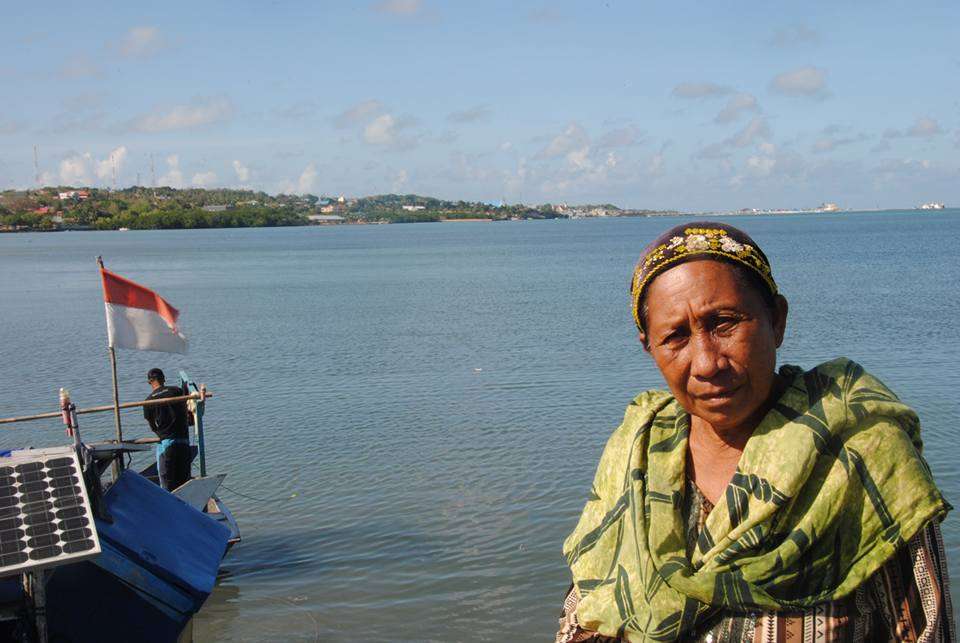
At the edge of the pier, facing the open sea, Hajjah Bogga stares blankly toward the horizon.
Behind her, the market pulses with life. Before her lies the vast ocean that has sustained her people for generations. But somewhere between the sea and the shore, tragedy has interrupted the fragile rhythm of her migrant life.
For the Bajo people, the sea has always been home. The land, however, remains uncertain territory — temporary, combustible, and often cruel.
The People Who Live Between Islands
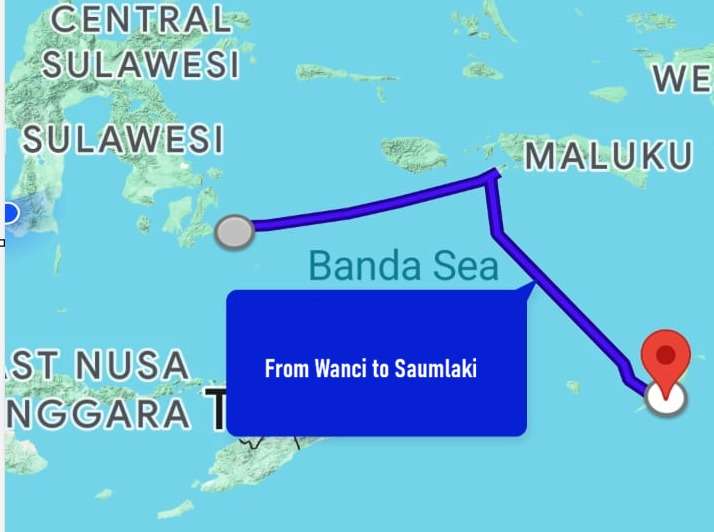
The presence of the Bajo Wanci community in Saumlaki is part of a long maritime migration stretching across eastern Indonesia. Originating from Kampung Mola in Wangi-Wangi, part of the Wakatobi Islands, South-east Sulawesi, these seafaring families travel hundreds of nautical miles searching for better fishing grounds and economic survival.
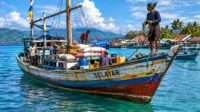
Their voyage is not an easy relocation. It is a three-day and three-night crossing over open waters aboard a jolor — a narrow wooden motorboat vulnerable to storms, currents, and exhaustion.
Often, the boats stop briefly at Binongko Island before continuing toward Saumlaki in the Tanimbar Islands.
For many outsiders, migration suggests opportunity and hope. But for Bajo migrants, migration is also endurance.
Bogga has lived in Saumlaki for two years. In her native tongue, she says softly:
“Duantaungne tambang manditu.”
Two years living here.
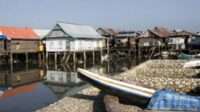
Her family survives by fishing cakalang and tongkol — skipjack and mackerel tuna — balancing daily between the dangers of the sea and the insecurity of rented rooms near the market. They are never fully settled. The shore is merely a temporary anchor between fishing trips.
A Fire on Land, a Husband Lost at Sea
On September 20, at around 10:30 WIT, disaster struck.
A fire erupted near the fuel depot east of the fish market.
Driven by eastern winds, the flames moved quickly through a cluster of small rental units inhabited by migrant fishing families. Within less than an hour, Bogga’s rented home disappeared into smoke and ash.
What remained afterward was almost unbearable in its simplicity: blackened wooden beams, soot-covered drums, grey ash, and twisted remnants of household belongings accumulated through years of hardship.
Yet the cruelest part of the tragedy was not only the fire itself.
At the exact moment Bogga stood watching her home burn, her husband, Haji Muhdar, was far offshore, fishing in deep waters beyond the reach of mobile signals. For three days he had been at sea, unaware that everything on land had vanished.
“Pore missi, tellungngallone madilao, nggaimina takatonang,” Bogga said quietly.
“My husband went fishing; it has been three days at sea, and he still does not know.”
The irony feels almost unbearable. While firefighters blasted water cannons onto burning structures ashore, the man most devastated by the disaster floated endlessly surrounded by water, unable to save the life waiting for him on land.
The sea that feeds them also isolates them.
Language as Home
In places far from their ancestral islands, identity among the Bajo survives not through property ownership or permanent settlements, but through language and kinship.
The emotional wall between strangers dissolved instantly when I asked Bogga one simple question in Bajo language:
“Katonangta Pak Manan?”
Do you know Pak Manan?
Her face softened immediately.
“Baa, keluarga kami itu.”
“Yes, he is our family.”
In that brief exchange, geography disappeared. Wakatobi no longer felt distant from Saumlaki. The Bajo language became a bridge carrying memory, belonging, and trust across the sea.
For migrant communities like the Bajo, home is not necessarily the rented petak that can vanish in flames overnight. Home exists in stories, dialects, kinship networks, and shared memories carried from island to island.
Their identity floats with them.
Living with Ashes and Saltwater
Despite losing nearly everything, survival continues almost instinctively among the Bajo.
Near the ruins, Bogga’s son calmly cleans freshly caught cakalang for sale at the market. Fish still need to be traded. Boats still need fuel. Families still need rice. Life does not pause for grief among maritime communities living on daily income.
Even in the middle of loss, hospitality remains intact.
Before I left, Bogga invited me to visit her temporary shelter someday so she could cook Keladi Pici, one of the traditional dishes loved by Bajo families.
The invitation came naturally, almost defiantly, as if generosity itself were a form of resistance against despair.
This resilience is perhaps the deepest strength of the Bajo people. They understand impermanence better than most communities because their lives have always depended on unstable horizons. Storms arrive unexpectedly. Fish disappear seasonally. Boats sink. Homes burn.
Still, they continue sailing.
The Invisible Cost Behind Seafood Markets
Stories like Bogga’s rarely appear in national conversations about fisheries, migration, or coastal development. Consumers see tuna neatly arranged in market stalls or restaurant displays without ever witnessing the human uncertainty behind every kilogram hauled from the sea.
The Bajo are among Indonesia’s greatest maritime communities — navigators whose knowledge of currents, weather, reefs, and fishing grounds has been built across centuries.
Yet economically and politically, many remain vulnerable migrants surviving without strong protection on land.
Their lives expose an uncomfortable contradiction within Indonesia’s maritime identity. The nation celebrates itself as an archipelagic power while many traditional sea communities continue living precariously between invisibility and displacement.
What does citizenship mean for people whose true territory is the ocean?
What does “home” mean when your existence is divided between unstable waters and temporary rented rooms vulnerable to fire, eviction, and poverty?
For Hajjah Bogga and countless Bajo families scattered across eastern Indonesia, the answer may already exist in their way of life. The sea remains the only constant they truly trust.
Because while land can betray them overnight, the ocean — harsh as it may be — still offers fish, movement, memory, and the possibility to begin again.
___
Written by K.Azis