
Five Things You Didn’t Know About Indonesia’s Traditional Navigators
“This ship is powered by a six-cylinder Mitsubishi engine,” Muhlis explained. “I financed it myself through a credit system. Every month I have to pay three million rupiah.”
H. Muchlis from Rajuni Island, Selayar
MARITIMEPOSTS.COM – The midday heat over Paotere Harbor in North Makassar felt heavy enough to stop time.
On March 24, 2011, I stepped through the harbor security post after paying a modest entry fee of two thousand rupiah.
Beyond the gate stretched a world that seemed suspended between centuries. Dozens of towering Pinisi vessels rested against the dock, their wooden hulls darkened by salt and weather. Some sailors slept beneath makeshift tarpaulins, while others repaired ropes or hauled sacks of cargo beneath the punishing sun.
The harbor smelled of diesel fuel, sea salt, sweat, dried fish, and wet timber.
Paotere was not simply a port. It was the pulse of an older Indonesia still breathing beneath the surface of modern shipping lanes.
I came there searching for a man I had not seen in sixteen years.
After climbing a swaying rope ladder onto the deck of KM Rahmat Ilahi II, I finally found him: Haji Muhlis, a veteran sailor from Kampung Bugis in Desa Rajuni Kecil, part of the Taka Bonerate island chain in South Sulawesi.
We first met in 1994.
Back then, Muhlis belonged to a generation of sailors shaped entirely by the sea.
Today, with many senior captains retired or gone, he has become one of the last “second-layer” maritime elders — men standing between ancestral navigation traditions and the brutal economic realities of modern inter-island trade.
For decades, sailors from Rajuni have quietly maintained one of the most overlooked supply chains in eastern Indonesia.
Their vessels transport rice, flour, cement, fuel, cocoa, and daily necessities across the unpredictable waters of the Flores Sea, connecting isolated islands often ignored by large-scale logistics networks.
Few Indonesians realize how fragile that lifeline truly is.
The Ship Powered by a Car Engine
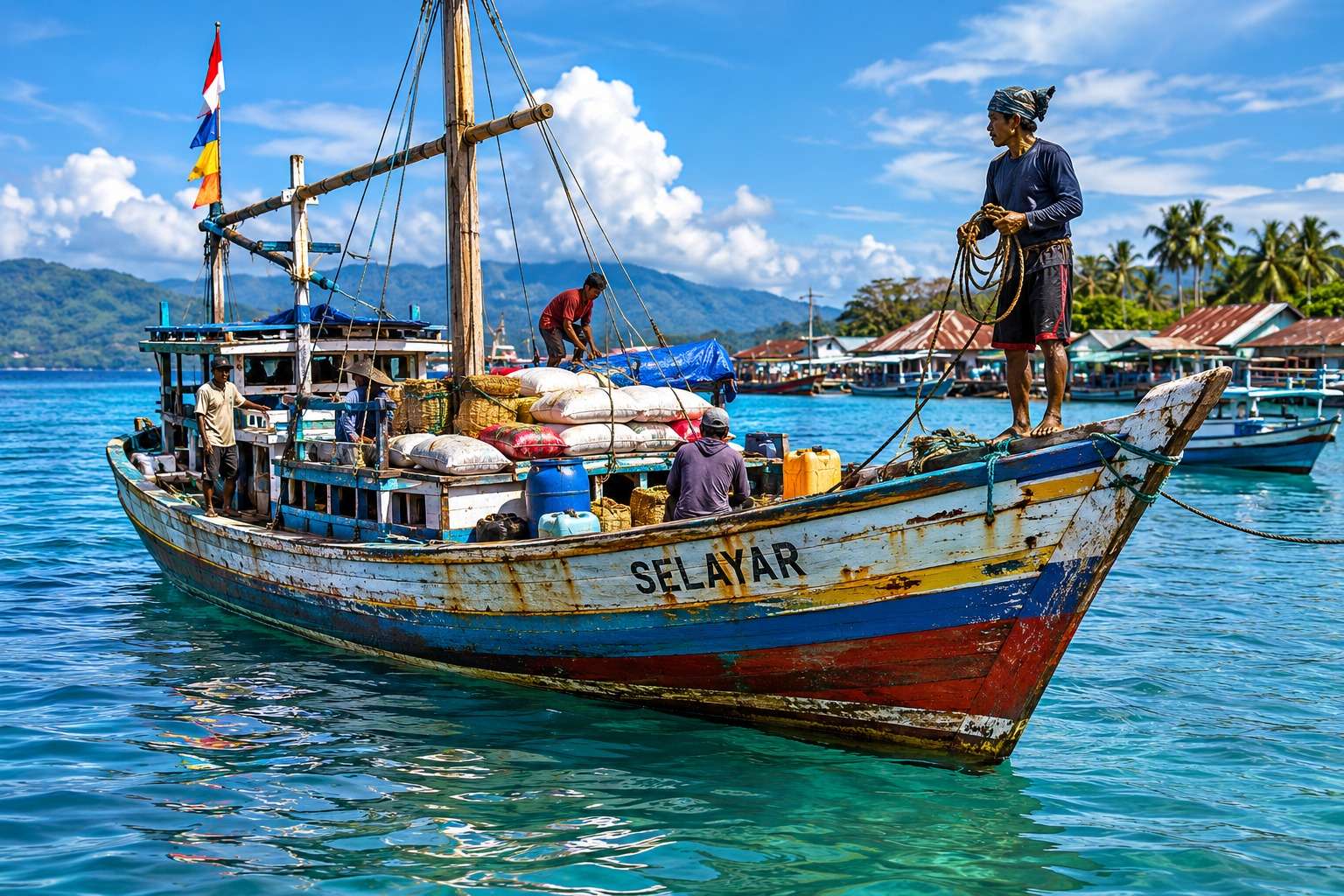
At first glance, KM Rahmat Ilahi II appears like many traditional cargo ships sailing eastern Indonesia: wooden decks, patched sails, rust-stained railings, and sleeping quarters barely large enough for the crew.
But beneath the deck lies a remarkable story of improvisation.
The vessel, now measuring around 75 gross tons, is powered not by an expensive marine engine but by a Mitsubishi six-cylinder automobile engine modified for maritime use.
It is a perfect example of what development experts might call “frugal innovation,” though for sailors like Muhlis, it is simply survival.
“This ship is powered by a six-cylinder Mitsubishi engine,” Muhlis explained. “I financed it myself through a credit system. Every month I have to pay three million rupiah.”
The engine itself cost around 85 million rupiah. Muhlis paid a ten-million-rupiah down payment and spent years repaying the rest in installments.
The modification represents more than technical ingenuity. It marks a profound shift in maritime philosophy.
Older sailors once depended entirely on seasonal winds and navigational instincts. Today, mechanical reliability has become inseparable from debt.
Modern engines allow ships to move faster and more predictably, but they also bind captains into long-term financial obligations that previous generations never faced.
In many ways, the machine beneath Muhlis’s ship reflects the transformation of Indonesia’s traditional maritime economy itself: adaptive, resilient, but increasingly pressured by modern capital.
The Dangerous Mathematics of Diesel Fuel
Life at sea is governed not only by weather, but by arithmetic.
For traditional cargo captains operating across eastern Indonesia, every voyage is a gamble measured in fuel consumption, unpredictable currents, and narrow profit margins.
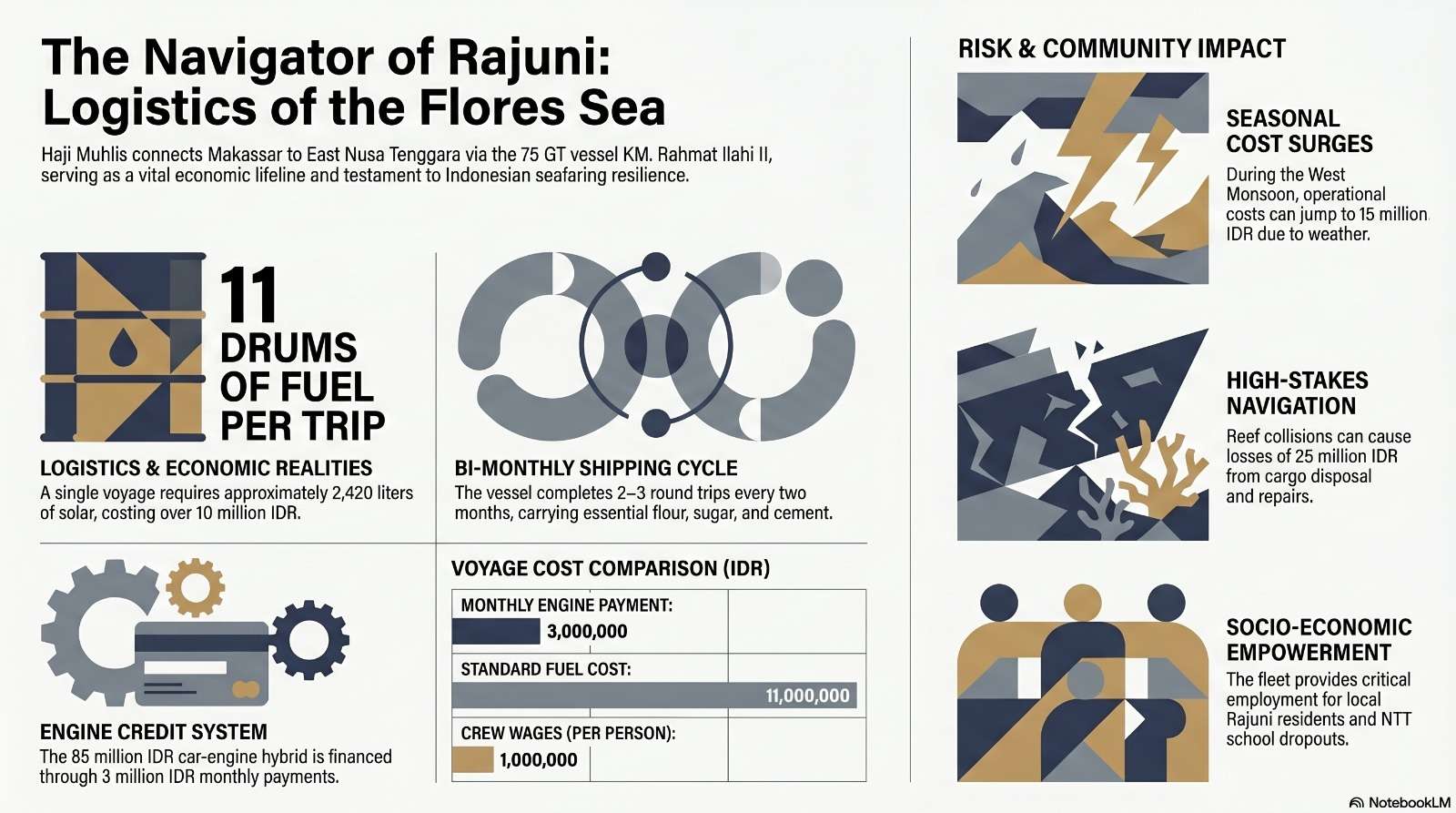
A single voyage from Makassar to East Nusa Tenggara requires approximately eleven drums of diesel fuel.
Each drum contains 220 liters.
Each costs nearly one million rupiah.
Before cargo is even loaded, more than eleven million rupiah disappears into the engine.
Then come crew salaries. Muhlis pays each sailor roughly one million rupiah per trip. During Musim Barat — the dangerous western monsoon season — operational costs can rise to fifteen million rupiah or more due to rough seas, delayed departures, and extended docking periods.
Yet the profit margins remain painfully small.
Transporting cocoa seeds from Maumere, for example, yields only around 150 rupiah per kilogram.
The economics are brutal.
One accident can erase years of earnings.
Muhsin, another captain from the region, recently experienced precisely that nightmare. His ship struck a reef near Kayu Pangga. To prevent the vessel from sinking, the crew was forced to dump its entire cargo of cement and rice into the sea.
The loss reached twenty-five million rupiah.
No insurance.
No compensation.
Only survival.
For traditional sailors in the Flores Sea, financial collapse is never distant. It travels beside them like an invisible passenger.
Floating Schools for Forgotten Youth
The ships of Rajuni do far more than transport goods.
They transport people, memories, and opportunities.
For many young men from remote islands in East Nusa Tenggara and Taka Bonerate, joining a cargo vessel becomes an alternative to unemployment, migration, or social isolation.
Muhlis intentionally recruits school dropouts and unemployed youth to work aboard his ships.
At sea, they learn discipline, navigation, engine repair, cargo management, and endurance. The vessels function as floating classrooms where maritime knowledge passes from one generation to another through lived experience rather than formal education.
But this social role creates tensions with state regulations.
Among coastal communities, hospitality remains sacred. Sailors often describe themselves as orang-orang bebas — free people bound by communal obligation rather than bureaucratic systems.
When relatives or villagers need transportation between islands, refusing them passage can feel morally impossible.
Yet maritime authorities classify excess passengers as safety violations.
Captains like Muhlis are therefore trapped between two competing worlds: government regulations demanding strict passenger limits, and community traditions demanding solidarity.
Every departure becomes a negotiation between legality and humanity.
The Captain Who Once Helped Save Giant Clams
There is another irony hidden within Muhlis’s life story.
Long before transporting flour, rice, and cement across eastern Indonesia, he once worked alongside marine conservation projects in Taka Bonerate National Park.
In 1995, Muhlis helped facilitate the Giant Clam Translocation Project — a collaboration between the World Wide Fund for Nature (WWF) and Hasanuddin University aimed at protecting endangered marine ecosystems.
At the time, he assisted researchers moving giant clams to safer habitats within coral reef systems threatened by human activity.
Today, the same man carefully navigating fragile reefs now carries construction materials and commercial cargo across those waters.
The contradiction reflects the difficult reality facing coastal communities throughout Indonesia.
Conservation and survival often collide in the same body.
Despite struggling with diabetes today, Muhlis still carries the physical calm of a man shaped by ocean winds. His skin remains weathered but healthy. His voice steady.
He represents what many coastal Indonesians call kebahariaan — the spirit of the sea.
A form of resilience impossible to manufacture on land.
The Unsung Architects of the Archipelago
Indonesia frequently celebrates itself as a maritime nation.
Yet the people who sustain that maritime reality often remain invisible.
Captains like Haji Muhlis operate precisely where modern logistics systems fail. They connect isolated islands abandoned by large shipping corporations. They navigate shallow reefs, unpredictable weather, and aging infrastructure using combinations of inherited knowledge and improvised technology.
Their ships may appear old-fashioned beside steel container vessels, but without them, many island communities would face shortages of food, fuel, medicine, and construction materials.
They are the hidden architects of the archipelago.
As Indonesia modernizes its ports and expands industrial shipping corridors, an uncomfortable question emerges:
What happens when traditional maritime knowledge disappears?
What do we lose when the wisdom of navigators, sailors, and island captains is replaced entirely by automation and corporate logistics?
For centuries, the Flores Sea has not divided islands. It has connected them.
And men like Haji Muhlis are among the last living custodians of that connection.
Standing on the deck of KM Rahmat Ilahi II beneath the burning Makassar sun, I realized something simple yet profound: Indonesia’s maritime future may depend not only on giant ships and new ports, but also on preserving the human resilience, improvisation, and sea wisdom carried quietly by these so-called “free people” across the waters of the archipelago.