
At first glance, he looks like any other fisherman supplying tuna to the market. But on his left forearm is a fading tattoo: Juarto. A simple mark that hints at a life once lived far beyond these crowded docks — across dangerous international waters, inside one of the world’s most contested maritime frontiers.
By Kamaruddin Azis
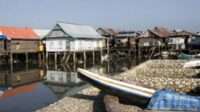
MARITIMEPOSTS.COM – At the stone stairway of Pasar Sentral Wanci, on Wangi-wangi Island in Southeast Sulawesi, the sea arrives every morning carrying stories on its back.
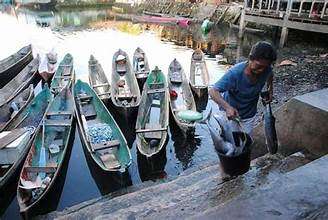
Before sunrise, Bajo women paddle narrow wooden sampans toward the market dock, balancing baskets of fish beneath the pale blue sky. Salt hangs thick in the humid air. Tuna scales glitter on wet cement.
The market does not merely trade seafood; it translates the ocean into survival. Fish become rice, vegetables, school fees, and worn second-hand clothing folded beneath tarpaulin stalls.
On one crowded morning, a sturdy dark-skinned man and a woman struggled to lift a giant yellowfin tuna onto the stone landing.
The fish weighed nearly 50 kilograms, its silver body flashing beneath the sunlight like polished metal. Another smaller tuna lay beside it.
“One million rupiah for both,” the man said quietly.
His name is Juar.
At first glance, he looks like any other fisherman supplying tuna to the market. But on his left forearm is a fading tattoo: Juarto. A simple mark that hints at a life once lived far beyond these crowded docks — across dangerous international waters, inside one of the world’s most contested maritime frontiers.
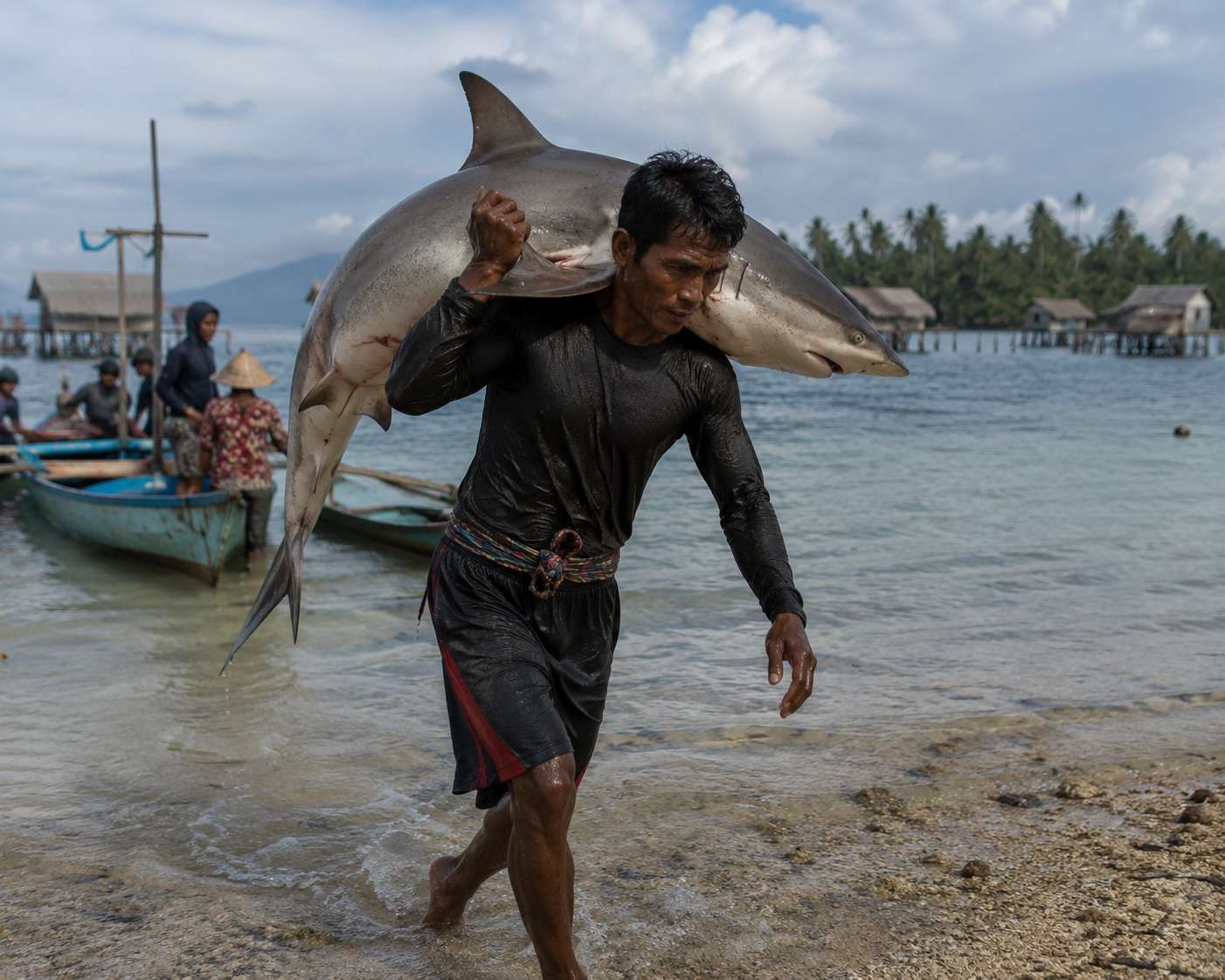
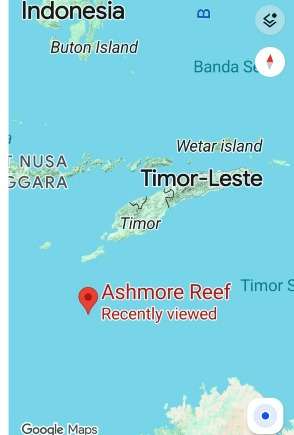
For years, Juar was part of a fading fraternity of Bajo shark hunters who sailed without engines into Australian territory, hunting sharks around Ashmore Reef, or what the Bajo people call Pulau Pasir.
Today, that world is disappearing.
For the Bajo people of Wakatobi, the sea has never been a border. It is a road, a memory, and an inheritance passed between generations long before maps divided Indonesia and Australia. Their ancestors crossed the Timor and Flores seas guided only by stars, currents, and wind.
Juar began joining shark-hunting voyages in 2004 under the command of his father, Pak Haga, an experienced juragan — the captain and leader of the expedition.
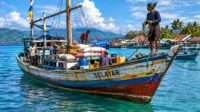
Their vessel weighed nearly 12 tons, built entirely from wood, powered only by sails.
No engines.
Not because they rejected technology, but because engines could destroy everything.
“To reach Pulau Pasir, our boat could not use a motor,” Juar recalled. “Only sails. Because of that, Australian police would not disturb us.”
The absence of machinery became their passport.
Under traditional fishing agreements between Indonesia and Australia, indigenous fishermen using traditional methods were permitted limited access to certain waters near Ashmore Reef. For the Bajo hunters, this loophole created a strange maritime paradox: modernity was dangerous, but primitiveness offered protection.
So while industrial fishing fleets raced toward bigger engines and advanced navigation systems, the Bajo survived by remaining invisible.
Their wooden boats crossed the sea carried only by canvas and monsoon winds.
For outsiders, a shark is simply a predator.
For the Bajo, sharks belong to a far more intimate geography.
Juar recites their names with the precision of a marine biologist and the familiarity of an old neighbor.
There is Nunang, the shovel-nosed ray known locally as Hiu Pasir. There is Mangali, the feared tiger shark. There is Tinumbu, a giant species with a pale white belly stretching more than two meters long.
Then there is Hantugang, a shark requiring different hooks, different bait, and different depths.
The vocabulary reveals something deeper than commerce.
It is evidence of a civilization shaped by the sea itself.
For generations, the Bajo mapped marine ecosystems not with satellite imagery, but through memory, instinct, and oral knowledge carried aboard wooden boats drifting across the Flores Sea.
But romance quickly dissolves under the arithmetic of debt.
Behind every shark expedition stood a rigid hierarchy controlled by financiers known simply as “Bosses.” Men like Haji Ahmad supplied capital for fuel, food, hooks, ropes, and sails. Beneath them were the juragans like Pak Haga, who managed crews often consisting of ten fishermen.
Before leaving shore, crews inherited what locals called “utang hiu” — shark debt.
Around three million rupiah was needed to finance a single voyage.
During the peak years of the shark-fin trade, the gamble seemed worth it. One kilogram of premium shark fin could sell for nearly one million rupiah. The fins traveled through trading hubs like Rote before entering international markets feeding demand in East Asia.
But profits rarely remained with fishermen.
The Bosses took their cuts first. Middlemen followed. Prices fluctuated. Debt accumulated.
To survive, crews pushed against the rhythm of nature itself.
“There was no rest between monsoons,” Juar said.
While ordinary fishermen avoided the dangerous transition between west and east winds, shark hunters continued sailing almost year-round — sometimes fifteen voyages annually. Debt left them no choice.
The sea became less a livelihood than a trap.
And the Flores Sea is unforgiving.
For the Bajo community, 2010 remains a year spoken with lowered voices.
That year, two boats vanished near the maritime border between Indonesia and Australia. Local fishermen say the vessels were swallowed by massive waterspouts — violent sea tornadoes feared throughout the region.
Thirteen men disappeared.
Among them were respected juragans named Tue’ and Roki.
No bodies returned home.
No wreckage was ever found.
“Some of our family became victims in the Flores Sea,” Juar said softly.
The ocean that once carried the Bajo across generations had begun demanding lives in return.
Not long afterward, Juar abandoned shark hunting entirely.
His father was aging. Pak Haga is now over eighty years old and physically weak. Juar himself has three children. Slowly, the calculation changed. The promise of shark fins no longer outweighed the possibility of never returning home.
Today, the great sailboats rarely depart for Pulau Pasir.
Many have disappeared entirely.
At Pasar Sentral Wanci, Juar now sells tuna instead of shark fins. The prices are smaller. The risks are lower. Yet something larger has also faded: an entire maritime culture once carried by wind across international waters.
The old journeys are turning into folklore.
For younger Bajo generations, Ashmore Reef is increasingly not a destination, but a story told by fathers and grandfathers who once crossed forbidden seas without engines, guided only by stars and courage.
As the market grows louder around him, Juar watches buyers negotiate over tuna worth only a fraction of what shark fins once commanded. Behind him, the sea continues breathing against the stone stairs of Wanci.
And somewhere beyond the horizon lies Pulau Pasir — the ancestral fishing ground now separated not only by borders and patrols, but by time itself.
The question haunting Wakatobi today is no longer whether the Bajo can survive the sea.
It is whether a maritime people can survive losing the journeys that once defined who they were.
___
This article was inspired by the Climate Reporting Workshop for Indonesia Journalists in Monash University,organized by Australia-Indonesia Center (AIC) and Monash CliComm, 13-14 May 2026