
Sea Nomad Bajo in Bone and the Struggle to Adapt
By Kamaruddin Azis
The sea once flowed beneath their homes like blood through veins.
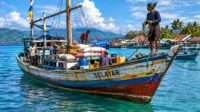
MARITIMEPOSTS.COM – For generations, the Bajo people of Bajoe in Bone, South Sulawesi, lived with no walls between themselves and the tides.
They were known across Southeast Asia as sea nomads—people whose identity was shaped not by land, but by currents, winds, and horizons. Their world stretched from the waters of Sulawesi to Sabah, the Sulu Sea, and eastern Indonesia.
Today, however, the rhythm of that maritime civilization is changing.
As ferries roar into Bajoe Port carrying trucks and passengers between Bone and Kolaka, the traditional Bajo settlement sits quietly behind concrete embankments, bridges, and rows of roadside businesses. The sea is still there, but no longer intimate.
What was once an open maritime space has slowly become enclosed by modern infrastructure.
For the Bajo of Bone, adaptation has become both necessity and burden.
From the Open Sea to the Edge of Land
Research titled Kajian Perubahan Permukiman Suku Bajo Berdasarkan Konsep Transformasi Kebudayaan Ignas Kleden by M. Amir Salipu, Ahda Mulyati, Anggia Riani Nurmaningtyas, and Imam Santoso describes this transformation not merely as a change of settlement, but as a deep cultural transition.
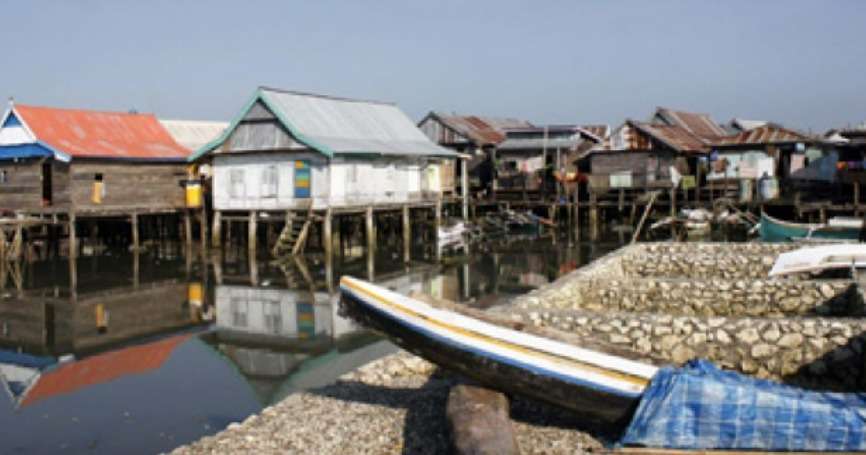
The study shows that the Bajo community in Bajoe gradually shifted from living nomadically on boats to building stilt houses above shallow coastal waters, before eventually settling more permanently on land.
This transformation did not happen overnight. It unfolded slowly through environmental pressure, economic change, social interaction, and state development policies.
Using Ignas Kleden’s theory of cultural transformation, the researchers argue that the Bajo experienced shifts not only in physical space, but also in values, social meaning, behavior, and identity itself.
The process moved through stages of integration, disintegration, and reintegration.
In practical terms, the Bajo were not simply relocating houses; they were renegotiating their relationship with the sea, with neighboring Bugis society, and with modern Indonesia.
The Dangerous Economy of the Sea
Yet despite the movement toward land, the sea remains the economic heartbeat of Bajoe.
In the stilt-house settlement near the port, stories of fishing voyages and dangerous diving expeditions still circulate from one wooden veranda to another.
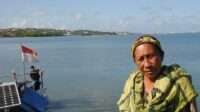
One of those stories belongs to Sanuddin, a 40-year-old Bajo resident whose body carries the scars of the ocean economy.
In the late 1990s, he joined expeditions to Taka Bonerate National Park to hunt teripang—sea cucumbers highly valued in international markets. The work promised income, but the risks were enormous. Divers often descended with rudimentary equipment, relying more on instinct than technology.
Then came paralysis.
While diving near Bajoe in 1999, Sanuddin suffered a decompression-related injury that crippled his wrists and ankles. In many Bajo communities, such injuries are tragically common. Some recover partially; others never walk again. Some die.
“I was treated for a week, massaged, given oil and medicine,” he recalled quietly. “Many people here were attacked by paralysis.”
His limp is more than a medical condition. It is evidence of how deeply survival depends on the sea.
The Bajo economy has always demanded physical sacrifice. Fishing, sea cucumber hunting, and long-distance sailing are not simply occupations—they are cultural obligations tied to masculinity, resilience, and identity.
When Development Builds a Wall
Ironically, modernization meant to improve Bajoe has also distanced the Bajo from the waters that once sustained them.
Concrete bridges, embankments, and coastal roads now dominate the shoreline approaching Bajoe Port. To outsiders, the area may appear more orderly and accessible. But for many Bajo residents, the new infrastructure functions like a barrier.
The sea no longer reaches naturally beneath their homes. Boats that once docked directly outside living rooms are now pushed farther away. Access to the tide—once immediate and intimate—has become interrupted by concrete.
Sanuddin believes the environmental damage is impossible to ignore. Beneath many stilt houses, seawater has turned dark and stagnant.
Plastic waste, wood debris, and sediment accumulate because tidal circulation has been blocked by coastal construction.
“Everything is because of the bridge that was built,” he said. “Look at the stagnant water and the trash under the houses.”
The irony is painful: development intended to modernize the settlement has also accelerated environmental decline.
The smell of fish waste and stagnant water now lingers beneath homes where the sea was once clear enough to reveal coral and sand below.
The Blurring of Identity
But perhaps the deepest transformation is cultural.
The Bajo identity in Bone is no longer isolated. Intermarriage with the Bugis community has become increasingly common, creating new layers of identity among younger generations.
Susan, a graduate of a local Islamic junior high school, represents that transition. Her mother is Bajo, her father Bugis. Her appearance, language, and social environment reflect a blending that would have been rare generations ago.
Yet even as education, marriage, and land-based life reshape the community, the maritime spirit remains stubbornly alive.
Men from Bajoe still disappear for months at sea. Some sail as far as Sapuka and Madura. Children still grow up hearing Bajo language spoken in narrow alleys above the water.
Elderly fishermen still read weather patterns from the wind and clouds rather than smartphone applications.
The sea may no longer physically surround them as it once did, but emotionally and culturally, it remains impossible to abandon.
Living Between Two Worlds
At dusk, Bajoe becomes a portrait of contradiction.
Children laugh along cracked concrete roads while ferries illuminate the harbor with industrial lights. Women clean fish beside stagnant water trapped beneath houses. Young people attend schools on land but still inherit stories of migration, tides, and distant islands from their grandparents.
The Bajo of Bone now live between two worlds: the fading memory of mare liberum—the free sea—and the unavoidable realities of modern coastal development.
Their adaptation is neither complete assimilation nor total resistance. It is negotiation.
A negotiation between mobility and permanence.
Between maritime identity and terrestrial citizenship.
Between tradition and survival.
Between strengths and adaptation to the climate changes.
The tragedy is not simply that the sea nomads are settling on land. Cultures evolve; adaptation is natural. The deeper question is whether modernization allows enough space for maritime cultures like the Bajo to survive with dignity, memory, and autonomy intact.
Because once the connection between a sea people and the water is severed, what disappears is not merely a livelihood.
It is an entire way of seeing the world.
___
This ‘revisit’ of the story was inspired by a workshop on Climate Reporting for Indonesian journalists held at Monash University, organized by MonashCliComm and the Australia-Indonesia Centre.