
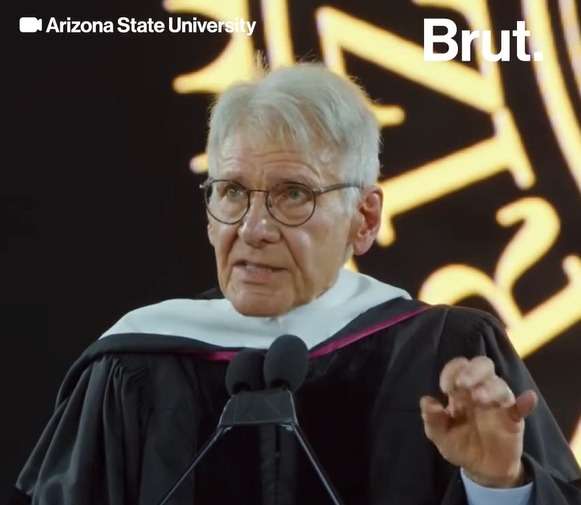
MARITIMEPOSTS.COM – At 83 years old, actor and environmental advocate Harrison Ford stood before more than 14,000 graduates at Arizona State University and delivered something far from a typical commencement speech.
There were no highlights from his film career, no nostalgic reflections on Hollywood success, and no polished motivational clichés.
Instead, he offered a blunt assessment of the world his generation is handing over.
“The world you’re stepping into, the world my generation left you, is a real mess.”
There was no attempt to soften the message. No spin. No excuses. Just a rare moment of public accountability from someone who has spent decades in the spotlight—and just as long advocating for environmental protection.
Nature Doesn’t Need Us—We Need Nature
One of the most striking statements from his speech was also one of the simplest:
“Nature doesn’t need people. People need nature to survive.”
It was not framed as poetry or metaphor, but as a fundamental truth. Ford, who has served for over 30 years as Vice Chair of Conservation International, used his platform to emphasize that environmental protection is not a philosophical luxury—it is a matter of survival.
His message was clear: ecosystems are not external to human life. They are the foundation of it.
A Generation With Power—and Responsibility
Rather than framing the younger generation as passive inheritors of global problems, Ford shifted the narrative toward agency.
“Your generation has far more power than you may realize. And if you harness that power—if you find your leadership, your issues, your voice—the world will not be able to ignore you.”
This was not a call for patience. It was a call for action. He positioned young people not as future leaders in waiting, but as present-day actors capable of influencing systems already in motion.
Leadership Beyond Titles
Ford’s speech also challenged conventional ideas of leadership. Instead of status or position, he defined leadership through action and impact.
He offered three direct imperatives:
- Build something that didn’t exist yesterday.
- Stand up for someone who can’t stand up for themselves.
- Bring people together who weren’t talking before.
These statements reframed leadership as something lived, not awarded. Not a role to be attained, but behavior to be practiced.
A Closing Challenge
He ended his address with a simple directive to the graduating class:
“Go change the world.”
It was not framed as inspiration alone, but as expectation.
In a culture where leadership is often reduced to branding, metrics, or visibility, Ford’s message cut in a different direction. It pointed back toward responsibility, collective survival, and the uncomfortable truth that environmental degradation is not abstract—it is immediate and shared.
Beyond the Stage
The broader significance of Ford’s speech lies not in celebrity endorsement of environmentalism, but in the consistency of his message over decades. His advocacy work through Conservation International reflects a long-standing commitment rather than a momentary appearance.
What made the address resonate was its refusal to separate personal responsibility from systemic crisis.
The message was not that change is easy. It was that ignoring the scale of the problem is no longer an option.
A Question Left Behind
As the applause fades from commencement ceremonies, one question remains from Ford’s message:
What are you building that didn’t exist yesterday?
Not as a rhetorical flourish—but as a challenge to action, accountability, and urgency in a world that can no longer afford delay.