
MARITIMEPOSTS.COM— Hasanuddin University, through its 2026 Community Service Program under the University Community Partnership Scheme (PPMU-PK-M), conducted a community engagement activity in Bontosunggu Village, Bontoharu District, Selayar Islands Regency, on Friday, June 13, 2026.
The program, titled “Empowering Coastal Fisheries Business Groups Based on Mangrove Ecosystems through Value Addition and Financial Management Strengthening in Bontosunggu Village, Bontoharu District, Selayar Islands Regency,” was funded by the Institute for Research and Community Service (LPPM) of Hasanuddin University.
The initiative was implemented as part of Hasanuddin University’s commitment to strengthening the capacity of coastal communities, particularly small-scale fisheries business groups, enabling them to develop their enterprises in a more sustainable and organized manner.
The activity took place from 10:00 a.m. to 2:00 p.m. Central Indonesia Time (WITA) and was attended by 32 participants representing four community business groups.
Among those present were the Head of the Fisheries Office of Selayar Islands Regency, division heads and staff from the Fisheries Office, as well as the Head of Bontosunggu Village.
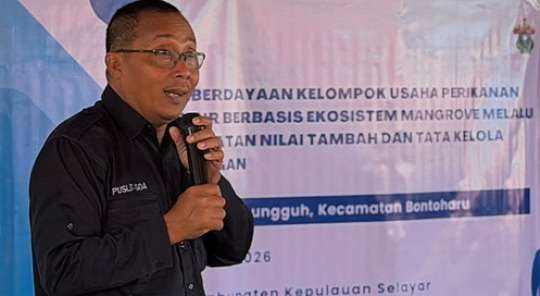
The implementation team was led by Prof. Dr. Ir. Abd. Rasyid J., M.Si. from the Faculty of Marine Science and Fisheries, Hasanuddin University.
Team members included Fakhrul Indra Hermansyah, S.E., M.Sc. from the Faculty of Economics and Business, Hasanuddin University, and Muhammad Try Dharsana, S.E., M.Sc. from the Faculty of Marine Science and Fisheries, Hasanuddin University.
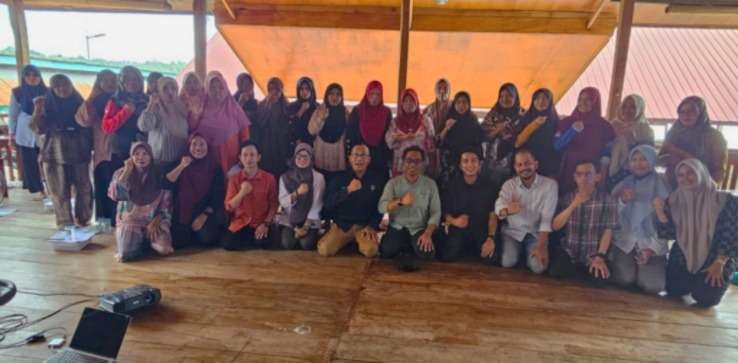
In addition, five Hasanuddin University students were involved in supporting the technical implementation of the program, including participant administration, documentation, and the administration of pre-tests and post-tests.
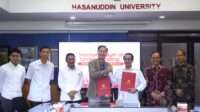
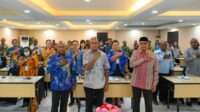
The activity was also attended by the Head of the Fisheries Office of Selayar Islands Regency, Zul Janwar (center), several Fisheries Office staff members, and the Head of Bontosunggu Village. (Photo: Special Documentation)
The training materials focused on three main aspects. First, enhancing community understanding of the importance of mangrove ecosystems in supporting the productivity and sustainability of coastal fisheries businesses.
Second, increasing the value-added potential of fisheries products through institutional development and the exploration of business opportunities for community groups.
Third, improving financial management practices through simple bookkeeping, cash inflow and outflow recording, and basic calculations of business costs and revenues.
The program was conducted using a participatory approach. Participants not only received training materials but also actively engaged in discussions, shared experiences, and raised concerns regarding challenges encountered in managing their fisheries businesses.
Participants showed strong enthusiasm, reflected in the numerous questions raised, particularly regarding strategies for increasing product value, managing business groups, and implementing simple and practical financial record-keeping systems.
As part of the evaluation process, the implementation team administered both pre-tests and post-tests to participants. These instruments were used to assess changes in participants’ knowledge and understanding before and after the training.
Strengthening knowledge of mangrove ecosystems, value-added business development, and financial governance represents an important step toward fostering more independent, productive, and competitive coastal communities.
Through this evaluation process, the program was designed not only to deliver knowledge but also to measure improvements in the capacity of participants as beneficiaries.
The program is expected to generate tangible benefits for coastal fisheries business groups in Bontosunggu Village.
Enhancing understanding of mangrove ecosystems, business value addition, and financial management remains a critical strategy for empowering coastal communities to become more self-reliant, productive, and competitive.
Through this initiative, Hasanuddin University reaffirmed its commitment to delivering science-based solutions that address community needs.
The synergy between higher education institutions, local government agencies, and community business groups is expected to continue, ensuring that community service outcomes extend beyond training activities and serve as a foundation for ongoing mentoring and sustainable development of coastal fisheries enterprises.
___
Maritimeposts.com