
MARITIMEPOSTS.COM – ANTALYA — As Turkey accelerates preparations for COP31, climate civil society organizations are calling for a more inclusive governance process, stronger commitments on fossil fuel phase-out, and a greater role for climate justice and just transition in shaping the conference agenda.
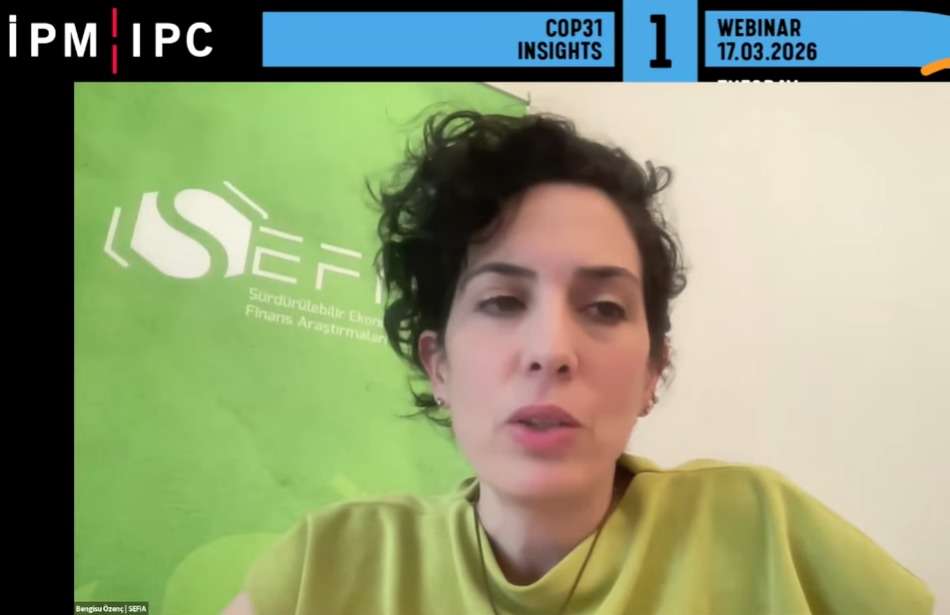
These concerns were highlighted by Bengisu Özenç, Director of the Sustainable Economics and Finance Research Association (SEFiA) and a representative of the Climate Network of Turkey, during the first webinar of the COP31 Insight Series organized by the Istanbul Policy Center.
While welcoming Turkey’s COP31 presidency as a historic opportunity, climate groups argue that meaningful participation by civil society remains one of the country’s biggest challenges.
A Historic Opportunity for Climate Transformation
According to Özenç, Turkish climate organizations have supported Turkey’s bid to host COP31 from the beginning, viewing the presidency as an opportunity for the country to strengthen its climate ambitions and demonstrate genuine leadership on climate action.
SEFiA, a research-oriented NGO based in Ankara, focuses on economic and financial policies for just energy transitions. It is also a founding member of the Climate Network of Turkey, a coalition of 16 environmental organizations established to advocate for science-based climate policies aligned with the Paris Agreement’s 1.5°C target.
For the coalition, COP31 represents more than a diplomatic event.
“It is an opportunity for Turkey to move beyond its current climate policies and demonstrate a genuine will for transformation,” Özenç said.
At the same time, the conference presents a chance for Turkish climate NGOs to become more visible and influential in both national and international climate policy discussions.
Concerns Over Limited Civil Society Participation
Despite positive dialogue with government ministries on technical issues, climate groups argue that Turkey still lacks inclusive decision-making mechanisms in climate governance.
According to Özenç, civil society organizations remain absent from many formal climate policy structures, including the country’s highest-level climate coordination mechanisms.
While business organizations are represented in climate governance bodies, environmental NGOs and independent experts often have no formal role in decision-making processes.
“This weakens the legitimacy, quality, and social ownership of climate policies,” she argued.
The same concern extends to the governance structure established for COP31.
Although the Turkish government organized a large consultation meeting in February involving more than 400 participants from academia and civil society, NGOs describe the event more as a launch meeting than a structured consultation process capable of influencing policy decisions.
Climate organizations are therefore calling for continuous, transparent, and institutionalized dialogue throughout the COP31 preparation process.
An Evolving Action Agenda
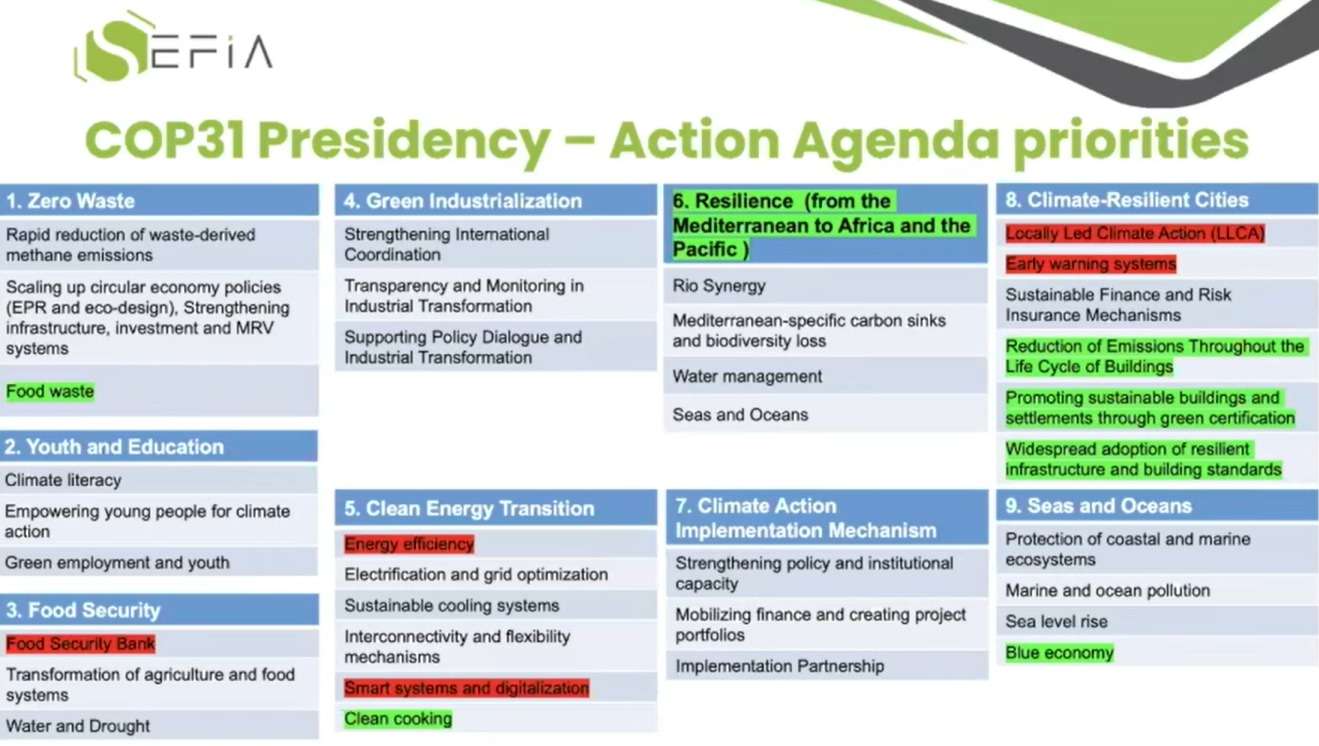
One of the most closely watched elements of Turkey’s COP31 preparations is the development of the Action Agenda.
According to Özenç, the agenda remains under revision.
Early drafts contained 14 thematic priorities, but more recent versions have reduced the list to nine major areas.
Several topics initially included have been removed or merged into broader categories, including:
- Tourism and cultural heritage
- Sustainable transport systems
- Climate digitalization
- Certain mitigation technology initiatives
Meanwhile, climate finance, which previously appeared as a standalone priority, has been integrated into broader implementation and resilience frameworks.
The latest draft currently focuses on the following themes:
- Zero Waste and methane reduction
- Youth and education
- Food systems
- Clean energy transition
- Climate resilience
- Seas and oceans
- Green industrialization
- Climate action implementation mechanisms
The agenda remains subject to further consultation before its official launch.
Zero Waste and Methane Reduction Move to the Forefront
One of Turkey’s flagship priorities is the expansion of its internationally promoted Zero Waste initiative.
The government is increasingly linking waste management to climate action by emphasizing methane emissions reduction and food waste prevention.
According to climate observers, this reflects an effort to connect a well-known domestic environmental campaign with broader climate mitigation objectives.
Methane reduction has emerged as one of the most prominent climate priorities within the evolving agenda.
Clean Energy Transition Without a Strong Renewable Focus
Climate organizations also expressed concern about the energy section of the draft Action Agenda.
Although clean energy transition remains one of the headline priorities, environmental groups note that the current drafts place relatively limited emphasis on renewable energy deployment.
Topics such as smart energy systems, digitalization, and energy efficiency have reportedly been reduced in prominence compared to earlier versions.
Instead, newer drafts have introduced issues such as clean cooking technologies.
For climate advocates, the challenge will be ensuring that COP31 advances a broader energy transition agenda consistent with global climate goals.
Green Industrialization and Implementation
Among all proposed priorities, two themes appear to receive the strongest support from the Turkish presidency:
Green Industrialization
The proposed framework focuses on identifying industrial transformation pathways, technology deployment opportunities, and investment mechanisms needed to accelerate low-carbon economic development.
Climate Action Implementation Mechanism
The initiative aims to close the gap between climate commitments and actual implementation through a four-stage approach:
- Technical analysis and modeling
- Project development
- Financial mobilization and investment matching
- Institutional and international integration
Observers see these themes as central to Turkey’s vision of COP31 as an “Implementation COP.”
Climate NGOs Call for Fossil Fuel Phase-Out
Beyond procedural concerns, climate organizations are also urging Turkey to adopt stronger substantive climate commitments.
The Climate Network of Turkey is calling on the government to place fossil fuel phase-out, just transition, and climate justice at the center of COP31 discussions.
According to Özenç, Turkey’s current climate policies remain insufficient to achieve the country’s long-term climate objectives, particularly due to continued dependence on coal.
Climate groups are therefore demanding:
- A commitment to no new coal projects
- A clear timetable for coal phase-out
- National plans aligned with a just transition framework
- Institutional mechanisms to support workers and communities affected by energy transition
“Just transition cannot be governed through ad hoc mechanisms,” Özenç emphasized, arguing that social and economic planning must accompany any fossil fuel phase-out strategy.
Looking Ahead
As Turkey prepares to unveil the final COP31 Action Agenda, the debate over participation, ambition, and implementation is intensifying.
For climate NGOs, the success of COP31 will not only be measured by diplomatic outcomes in Antalya but also by whether Turkey uses the presidency to strengthen its own climate governance and accelerate the transition toward a low-carbon future.
The coming months will reveal whether the evolving Action Agenda can bridge the gap between government priorities and the expectations of civil society organizations that want COP31 to become a turning point for climate action in Turkey and beyond.
This version reads like a policy-analysis feature and complements the first article on Turkey’s official COP31 vision by presenting the civil society perspective.