
MARITIMEPOSTS.COM – Climate change is no longer a distant environmental concern—it is a tightly interconnected global system crisis driven by human activity, amplified by natural feedback loops, and ultimately reflected in escalating ecological and societal disruption.
Understanding its structure as a system reveals not only the causes and effects, but also why the crisis accelerates once it begins.
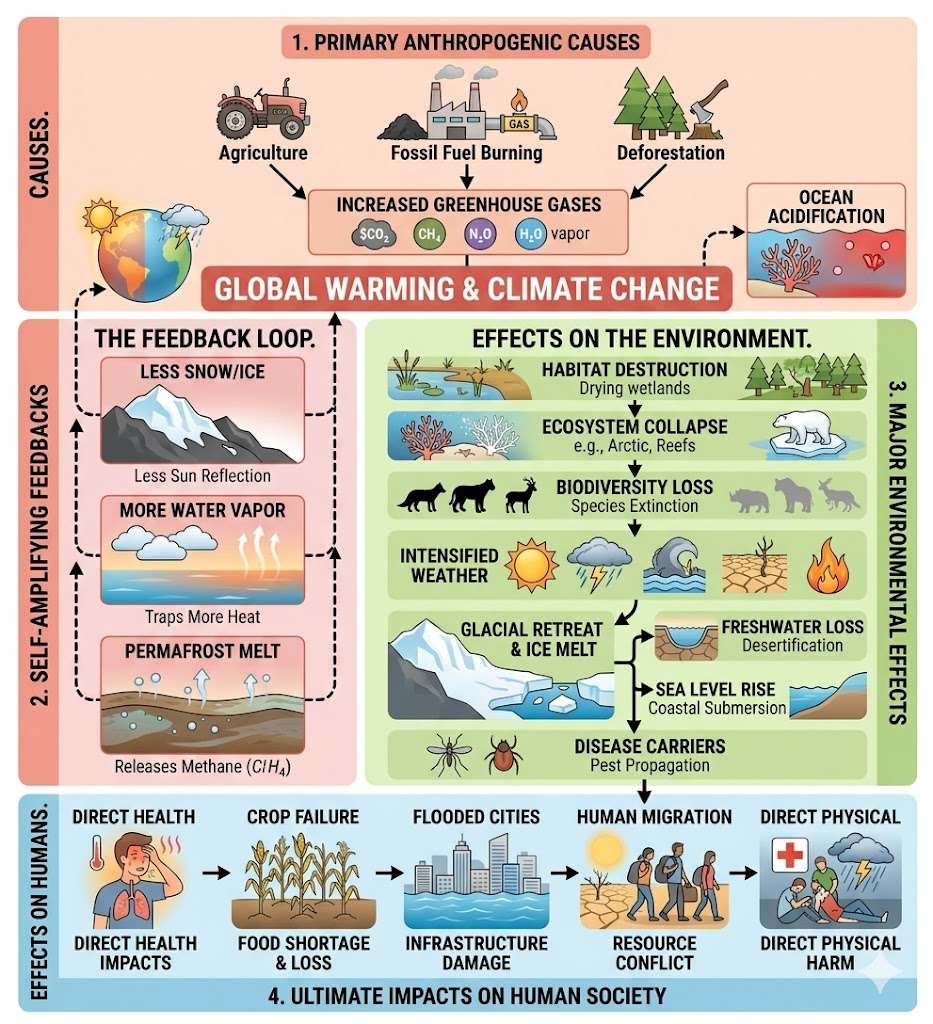
This overview synthesizes the full chain of global warming dynamics—from its industrial origins to its human consequences—showing how seemingly separate processes are in fact deeply interdependent.
Human Drivers: The Industrial Engine of Warming
At the foundation of global warming lies modern economic activity. Three dominant sectors shape the initial pressure on Earth’s climate system:
- Agriculture
- Fossil fuel combustion
- Deforestation
These activities release large volumes of greenhouse gases (GHGs), primarily:
- Carbon dioxide (CO₂)
- Methane (CH₄)
- Nitrous oxide (N₂O)
- Water vapor (as an amplifying atmospheric component)
As these gases accumulate in the atmosphere, they trap outgoing heat and initiate the process known as global warming.
A parallel but equally critical pathway is ocean acidification, where excess CO₂ dissolves into seawater, altering marine chemistry even before temperature effects fully unfold.
Feedback Loops: Why Warming Accelerates Itself
Once warming begins, Earth’s natural systems start to respond in ways that often intensify the problem. These are known as positive feedback loops:
Loss of Snow and Ice Cover
Melting snow reduces Earth’s reflectivity (albedo), causing more solar energy to be absorbed and further increasing temperatures.
Water Vapor Amplification
Warmer air increases evaporation. Since water vapor is itself a greenhouse gas, it traps additional heat and strengthens warming.
Permafrost Thaw
Rising Arctic temperatures thaw frozen soils, releasing methane—a greenhouse gas significantly more potent than CO₂—creating a dangerous reinforcing cycle.
These feedbacks transform climate change from a linear process into an accelerating system.
Environmental Consequences: A Planet in Transition
As warming intensifies, Earth’s natural systems begin to undergo large-scale structural changes:
Ecosystem Collapse and Biodiversity Loss
Habitat disruption leads to ecosystem instability, including coral reef degradation, Arctic ecosystem stress, and widespread species decline.
Extreme Weather Intensification
The climate system becomes more volatile, producing:
- Heatwaves
- Storm surges
- Flooding
- Droughts
- Wildfires
Cryosphere Collapse and Water Stress
Melting glaciers and ice sheets contribute to:
- Sea level rise
- Coastal submersion
- Freshwater shortages
- Expansion of arid zones
Marine and Biological Disruption
Ocean warming results in coral bleaching, fish stock depletion, and shifting marine ecosystems. Meanwhile, warmer climates expand the range of disease vectors such as mosquitoes and other pests.
Human Impact: From Environmental Stress to Social Crisis
The environmental changes ultimately converge on human systems, producing cascading social and economic consequences:
Health Impacts
Rising temperatures and pollution-related stressors contribute to increased respiratory illness, heat stress, and disease spread.
Food and Economic Instability
Climate disruption leads to crop failure, reduced agricultural productivity, and loss of arable land, threatening food security and rural livelihoods.
Displacement and Conflict
Rising seas, extreme weather, and agricultural collapse force population movement. In many regions, resource scarcity increases the risk of social tension and conflict.
The System Logic: A Chain Reaction Earth Cannot Ignore
At its core, the climate crisis operates as a connected system:
Human activity → greenhouse gas accumulation → planetary warming → feedback amplification → ecological disruption → human and societal crisis
What makes this system particularly dangerous is not any single component, but the reinforcing interactions between them. Once triggered, the system tends to accelerate rather than stabilize.
Conclusion: A Turning Point in Earth’s System Stability
Global warming is not simply an environmental issue—it is a systemic transformation of Earth’s life-support structure. The diagram reveals a clear truth: the longer emissions continue at scale, the more self-reinforcing the system becomes.
Understanding this chain is essential not only for awareness, but for designing interventions that break feedback loops, restore ecological balance, and prevent long-term systemic collapse.
Editorial Team