
MARITIMEPOSTS.COM – COP—the big climate negotiations, the United Nations climate thing. Ask most people what exactly COP is, and they will probably struggle to explain it.
That is where I come in. I’m Jordan Dunbar, and I’m one of the hosts of The Climate Question podcast from the BBC World Service. In this guide, I’m asking simple questions and getting simple answers, with the help of some leading climate experts.
Source:
The Genesis: Rio 1992 and the Birth of the “Alphabet Soup”
To understand what COP actually is, we have to travel back to Brazil in 1992. Everyone had big hair, big suits, and they were about to have massive talks.
Representatives from all around the world arrived in Rio de Janeiro for the first-ever Earth Summit. There had never been a day in human history when so many national leaders came together in a single place. The United Nations had called this conference to talk about the environment.
Here was a tremendous opportunity to conduct international environmental cooperation in a way that was much more serious about engaging developing countries. It marked the start of a whole series of processes that will need to go on for the rest of your life, and far beyond it, in order to protect the environment.
From the Rio summit came three major declarations or agreements. One of them specifically targeted the climate, leading directly to the creation of the UNFCCC—prepare yourself for a lot of acronyms:
UNFCCC: The United Nations Framework Convention on Climate Change.
This framework was the very first time countries collectively said, “Hey, let’s cooperate and try to keep global temperatures from rising, and we should also try and cope with the damage these growing temperatures are doing.” It was a truly historic moment.
Grounding the Politics in Science: The IPCC
To figure out how exactly to do that, another body called the IPCC was created:
IPCC: The Intergovernmental Panel on Climate Change.
A man who knows all about climate change negotiations is Professor Adil Najim. He explains the purpose behind it:
“The purpose of the science of the IPCC was to get the world’s scientists together to advise the policymaker on the state of the science of climate change.”
Essentially, the UN tasked a super-group of scientists with giving their best assessment every few years on climate change science—answering how serious it is, how big it is, and what types of solutions work or do not work. This gives humanity an accurate idea of how bad climate change actually is.
What Does “COP” Actually Stand For?
Once you have the scientists looking at the data, you need to get everybody to agree on how to tackle it. That is where the party starts. Not just any party, but a Conference of the Parties.
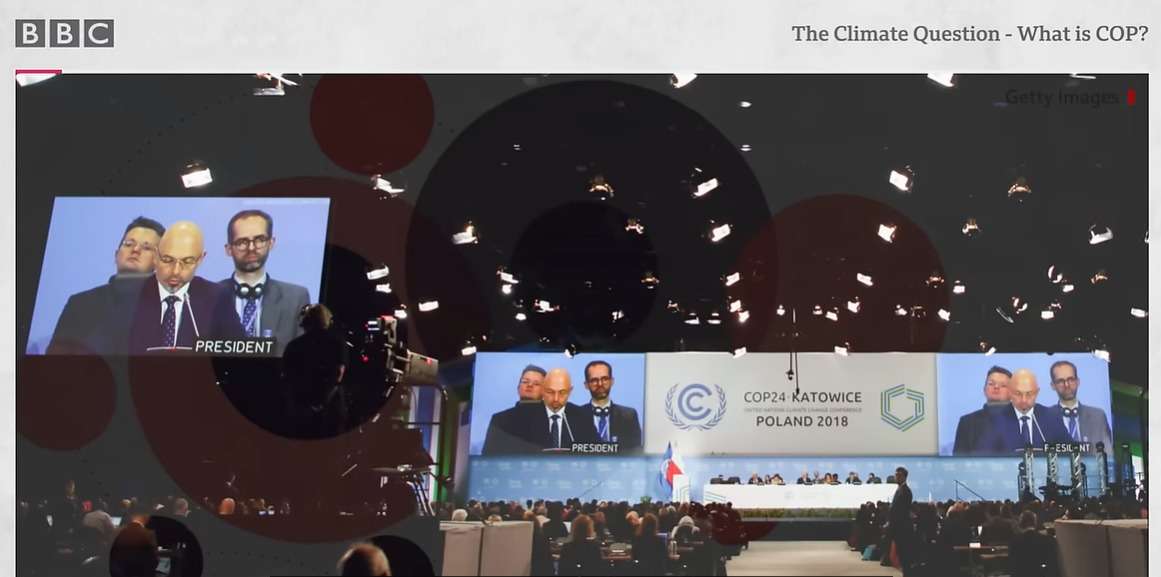
In diplomatic speak, “the parties” are simply the countries who are getting together to negotiate. The formal name is the Conference of the Parties of the United Nations Framework Convention on Climate Change, but because that is not very catchy, we just call them COPs.
COPs happen every single year in a different country. Cities from different regions around the world bid to host them. Over the years, the world has been welcomed to Glasgow, to Egypt, to Marrakesh, and beyond.
Each host country nominates a president for the negotiations, and that president helps shape what gets debated. The overall point of these COPs is for all the countries that signed that original UNFCCC framework to come to a global consensus on how to adapt to and limit climate change. Organized by the United Nations, delegates discuss how to reduce the planet-warming gases being pumped into the sky and come up with a unified plan.
The Homework: What are NDCs?
While everyone tries to agree on a global plan, each individual country is expected to do some homework. For example, they must come up with a specific strategy for how they are going to reduce their greenhouse gas emissions, and by how much.
These individual commitments are pledges formally known as Nationally Determined Contributions (NDCs). These pledges allow the rest of the world to see what countries have and haven’t done. Essentially, their homework is marked in public view.
Professor David Victor, who has studied these international climate agreements so extensively he literally wrote a book about them, points out a unique feature of this system:
“Those pledges are flexible; they’re updated every five years—or more often if a country wants to do that—and those are extremely ambitious. That’s where COP is unique: the opportunity to see what progress has been made by countries around the world.”
Every five years at COP, there is a massive show-and-tell. It is called the Global Stocktake, and its purpose is to officially score the world’s progress.
The Reality of Attending: A Climate Carnival
The clock is ticking. We are in the fight of our lives, and we are losing. Greenhouse gas emissions keep growing, global temperatures keep rising, and our planet is fast approaching tipping points that will make climate chaos irreversible.
That is where journalists like me come in. We are there to make sure what has and hasn’t been done gets reported to the people back home.
When I was reporting live from Sharm El-Sheikh for COP27 in Egypt, the event felt like a bizarre mixture of a climate festival, science gathering, business convention, media circus, and an actual party scene. At one point, there was a video of a COP party featuring a dancing dinosaur named Frankie grooving around a pool with a sign reading “Don’t choose extinction.”
One night, I even took a wrong turn at a fancy hotel and ended up in a very swanky drinks reception for a wind turbine company featuring an Abba tribute band—definitely not what I expected at a solemn climate conference! Unfortunately, security promptly escorted me out.
From Negotiation to “Mela”
Fast forward to today’s summits, like COP28 in Dubai, United Arab Emirates. Over time, the event has fundamentally transformed. Professor Adil Najim describes it using a wonderful term from his native South Asia:
“In one way, the COP remains a Conference of the Parties, meaning the negotiators from 200 countries in the world trying to come to an agreement. But it has become also a large—in my language in South Asia, what you would call a mela, a carnival. A major conference, a bringing together of everyone who is working on climate… it becomes sort of this platform that brings together once a year all the major players.”
It has almost become “cool” to attend now. Recent COPs attract over 70,000 people—politicians, negotiators, climate scientists, business people from both the green and the fossil fuel industries, activists, and even celebrities. (We’ve seen Leonardo DiCaprio being mobbed by crowds when he visited COP26 in Glasgow).
The Power of “Civil Society” and the Struggle for Equity
Much more important than film stars is the presence of what is called civil society. This refers to ordinary people who are not government officials or United Nations employees: climate activists, business leaders, indigenous groups, and faith leaders.
COP veteran Dr. Musonda Mumba emphasizes why having these diverse voices physically in the room is absolutely crucial:
“Just for argument’s sake, if I’m from the government of Australia and I really want to talk about the challenges of the fires across Australia, but in the room there is no indigenous Aboriginal person… they get affected more by the challenges. We’ve seen this in Canada as well; indigenous peoples came up to the floor and said, ‘Look, these fires, we’ve been warning you for the longest, and look at how we’re being affected.’
How do we hear from these individuals live in person to hear about their stories, their challenges, their issues, their narratives? That can only happen when they are in the room. There’s a saying that says: ‘You cannot talk about us without us.’“
The Visual Gap in Representation
The sheer popularity of the event has created an environment where the people whose voices most need to be heard sometimes cannot even afford to get in the door.
The truly vulnerable people often cannot afford a plane ticket to attend. When the summit was happening in Sharm El-Sheikh, local businesses and hotels spiked their prices drastically. It becomes ridiculous; no grassroots organization or small government can afford to pay $500 a day for a standard hotel room.
This raises a serious question: Has COP truly succeeded in bringing the Global South into these negotiations?
While it has made strides, it could do much more. Consider the structural inequality of the negotiation rooms:
-
The European Union negotiates as a unified bloc. They represent 27 countries and walk into rooms with an army of about 10 dedicated negotiators.
-
A small island nation like Samoa might come with only one single negotiator.
If you are a solo negotiator, and there is a session on agriculture happening over here, a session on “loss and damage” happening over there, and another negotiation process all running in parallel on the exact same day, how do you split yourself? If you physically cannot be in that room, your voice is not at the table. Ensuring an equal footing remains an ongoing battle against unequal representation.
The “Secret Weapon” of COP: Side Events and Speed Dating
Interestingly, away from the main negotiation chambers where nearly 200 countries are arguing over text, the true value of getting the right mix of people together stands out in the side events.
According to Professor David Victor, these side events have actually become bigger and frankly more important than the main intergovernmental debates. Why? Because they are where concrete commitments get made by actors other than national governments to stop emissions. While it makes COP a much noisier and chaotic process, it is also what makes it a success.
I like to think of these side events as climate speed dating. Companies who want to try out new green technologies and governments or organizations that want to help fund them can get together directly. They don’t have to wait for global consensus; they can simply agree amongst themselves and get to work.
Case Study: The Just Energy Transition
A prime example of this occurred when the United Kingdom, the United States, and the European Union bypassed the broader floor to partner directly on a new plan to help South Africa move away from coal without losing thousands of domestic jobs. This is a so-called “just or fair transition” away from fossil fuels—a model that is now being actively looked at by other nations like Vietnam and Indonesia.
We even received a direct update on this historical deal from an impeccable source: South African President Cyril Ramaphosa, speaking at one of the many press conferences in Egypt. The deal struck at Glasgow was able to happen precisely because it did not require all 200 countries to agree to it.
Is COP a Failure? How to Truly Measure Progress
Despite the obvious drawbacks, bureaucratic gridlock, and flaws, we should not view COP as a total failure. Professor David Victor argues that the right way to measure climate progress is to compare where we are today to where we would have been without these summits:
“About 15 years ago, the world was on track to maybe 4 or 5 degrees Centigrade of warming above pre-industrial levels. Right now, we’re on track for maybe 2.5 degrees.
Now, 2.5 is not 2 degrees, so that looks like failure. But 2.5 is not 5 degrees. It’s much, much lower than 5, and that I think is the right way to measure progress. Are we doing enough? Absolutely not. Should we have started with a better framework 30 years ago? Absolutely, but we didn’t, and so now we are where we are.”
The Verdict: The Only Show in Town
Why should the average person care about what happens at these massive summits?
Even with its deep systemic problems and frustratingly slow pace, COP remains the only international negotiation on climate of its kind. It is the only show in town. Through its iterative process, it has effectively helped cut projected global warming in half since the annual meetings began in 1995.
If the system can successfully deliver on its promises—like delivering promised financial aid to poorer countries to fight climate change and creating reliable ways for those countries to adapt—then COP can win back the trust of those taking part.
Ultimately, it commands global attention. The eyes of the entire world turn to climate change, albeit for a short time every year, and that intense spotlight encourages change and places unavoidable pressure on politicians.
Plus, it has given us loads of brilliant acronyms. And as I always say, using acronyms makes you look very clever—or AUAMYLVCO (“As Using Acronyms Makes You Look Very Clever”), as I like to call it!
If you want more simple answers to simple climate questions, check out our other audio explainers: “What is climate change?” and “What is 1.5°?” wherever you get your podcasts.
Special Thanks to our Expert Panel:
-
Professor Adil Najim – Professor of International Relations, Earth and Environment at Boston University’s Pardee School.
-
Dr. Musonda Mumba – Secretary General of the Wetlands Convention.
-
Professor David Victor – Professor of Innovation and Public Policy, University of California, San Diego.
-
The Production Team – Series producers Alex Lewis and Tom Brignell for all the editing magic.