

Informal institutions consist of unwritten yet widely recognized rules governing relationships, authority, cooperation, negotiation, and decision-making. Although unofficial, these rules frequently influence political outcomes more directly than formal regulations.
MARITIMEPOSTS.COM – For decades, democracy was widely understood through formal institutions such as constitutions, elections, legislatures, courts, and bureaucracies. These institutional arrangements were expected to guarantee accountability, participation, and effective governance.
Experience across many developing countries, however, demonstrated that strong formal institutions alone rarely produced strong democratic outcomes. Similar constitutional systems often generated remarkably different patterns of governance, public participation, and policy implementation.
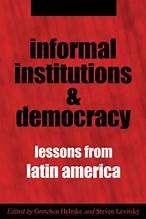
This paradox motivated Gretchen Helmke and Steven Levitsky to edit Informal Institutions and Democracy: Lessons from Latin America, a landmark volume exploring how unwritten rules shape democratic governance alongside formal political institutions.
The book argues that democracy functions through two institutional worlds simultaneously. Formal institutions establish official rules, while informal institutions create socially shared expectations that guide everyday political behavior beyond legal frameworks.
Informal institutions consist of unwritten yet widely recognized rules governing relationships, authority, cooperation, negotiation, and decision-making. Although unofficial, these rules frequently influence political outcomes more directly than formal regulations.
Rather than treating informal institutions as cultural curiosities, the contributors demonstrate that they represent stable systems of governance capable of organizing political behavior, distributing authority, and shaping institutional performance over long periods.
A central lesson of the book is that democracy cannot be understood by examining constitutions alone. Researchers must also investigate how politicians, bureaucrats, communities, and citizens actually behave within everyday political practice.
The volume challenges the common assumption that informality necessarily weakens democracy. In many circumstances, informal institutions complement formal governance by facilitating cooperation, resolving conflicts, and compensating for weak administrative capacity.
Traditional leaders, neighborhood associations, kinship networks, and community organizations often provide governance functions where formal institutions lack legitimacy, resources, or public trust. Informality therefore may strengthen rather than weaken democratic practice.
At the same time, the book cautions that informal institutions may also undermine democracy. Patronage, clientelism, elite capture, political brokerage, and corruption frequently emerge through informal arrangements operating alongside formal political systems.
The critical issue is therefore not whether informal institutions exist, but how they interact with formal institutions. Their relationship determines whether governance becomes more inclusive, more exclusive, or more adaptive to local realities.
Helmke and Levitsky emphasize that informal institutions are fundamentally political. They shape access to resources, influence public decisions, determine whose voices matter, and establish the practical boundaries of participation.
Consequently, democratic participation cannot be evaluated solely through attendance at public meetings or compliance with official procedures. Genuine participation depends upon who influences deliberation and whose interests ultimately shape collective decisions.
Many governance reforms fail because they improve formal procedures without recognizing the informal rules governing political behavior. Development programs frequently underestimate these invisible institutional dynamics during both planning and implementation.
The book further demonstrates that governments themselves actively produce informality. Public officials regularly negotiate through personal relationships, trusted intermediaries, political alliances, and unofficial networks that extend beyond bureaucratic regulations.
Informality therefore should not be viewed simply as existing outside the state. Instead, it often becomes an integral component of how states actually govern, negotiate authority, and implement public policy.
These insights have profound implications for development studies. Community empowerment, decentralization, participatory planning, and collaborative governance all operate within institutional environments shaped simultaneously by formal and informal rules.
Development practitioners frequently evaluate whether projects follow official procedures. Informality encourages a different perspective by asking what unwritten rules actually determine implementation, participation, resource allocation, and collective decision-making.
This perspective also deepens our understanding of power. Informal institutions reveal how authority emerges through social reputation, kinship, patronage, historical relationships, and strategic alliances rather than exclusively through formal administrative positions.
Consequently, communities displaying high levels of participation may still experience unequal influence if informal power structures systematically privilege particular actors over others during planning and implementation processes.
The lessons extend directly to collaborative governance. Sustainable collaboration requires more than inviting stakeholders to formal meetings; it demands recognizing hidden interests, unequal bargaining capacities, and informal networks shaping collective action.
Effective governance therefore depends not only upon institutional design but also upon understanding how formal regulations interact with informal political practices. Collaboration succeeds when both institutional dimensions are acknowledged and carefully navigated.
The Latin American experiences presented throughout the volume demonstrate that democratic governance is not simply implemented through legal frameworks. It is continuously negotiated through relationships, trust, authority, conflict, and informal institutional arrangements.
For scholars of development, the book offers an essential methodological reminder: studying governance requires moving beyond official documents toward observing everyday political practice, local negotiations, and the unwritten rules guiding institutional behavior.
This perspective encourages researchers to analyze not only whether development programs achieve their intended objectives, but also how informal institutions influence implementation, reshape participation, and ultimately determine policy effectiveness.
Ultimately, Informal Institutions and Democracy transforms our understanding of governance by demonstrating that democracy is sustained not merely through laws and organizations, but through the continuous interaction between formal institutions, informal rules, and evolving power relations. Recognizing this interaction enables researchers and practitioners to develop more realistic explanations of why development initiatives succeed, fail, or produce unintended outcomes across different social and political contexts.