

MARITIMEPOSTS.COM – Indonesia is a titan shackled by its own geography. As the world’s largest archipelagic state—the “Bangsa Maritim Besar”—it commands the most strategic maritime crossroads on the planet.
The information above was obtained from a discussion held by the Doctoral Study Class in Development Studies at the Graduate School of Universitas Hasanuddin, concerning a comparison of Indonesia’s and the Netherlands’ maritime sectors, on Tuesday, April 7, 2026. The topic was presented by Syamsu Marlin from Pangkep Polytechnic and Wahidin from PLN Gorontalo.
Based on the discussion, controlling vital International Sea Lanes and serving as the definitive gateway to the Asia-Pacific, Indonesia possesses a colossal geospatial arbitrage opportunity. With a population exceeding 270 million and a wealth of marine resources, the nation should be the undisputed heartbeat of global trade.
Yet, Indonesia remains a “Sleeping Maritime Giant.” It is a paradox of potential: a nation of 17,000 islands that is consistently outpaced in efficiency and value creation by the Netherlands, a country with a fraction of its coastline.
To awaken this giant, we must move beyond the romanticism of being a “maritime nation” and conduct a cold-eyed analysis of the systemic architecture that separates a regional player from a global powerhouse.
The 400-Year Hangover: Breaking Free from “Path Dependency”
In global logistics, history is more than just a memory; it is a structural anchor. Indonesia’s current maritime struggle is a textbook case of “Path Dependency.” The nation is currently struggling to outrun a 400-year-old design.
The maritime infrastructure of the archipelago was never originally built for national prosperity; it was engineered for colonial extraction.
The Dutch “Hub-and-Spoke” system was a predatory web designed to funnel raw commodities from the islands to colonial centers and then directly to Europe. This legacy of fragmentation remains the invisible blueprint of modern Indonesia.
This historical inertia has left Indonesia with a centralized system that lacks inter-regional integration, trapping the economy in a “Low Maritime Value Chain” that prioritizes the export of raw materials over sophisticated industrial growth.
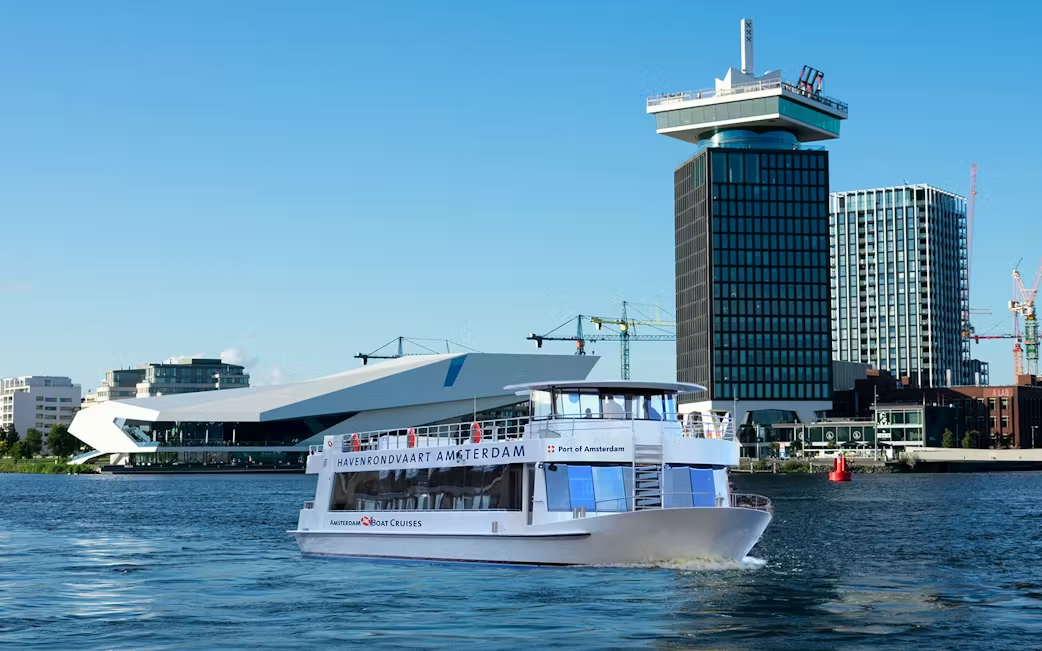
The “Efficiency Gap”: Why Logistics is a 15% Tax on the Future
For a strategist, the data points in the Indonesia-Netherlands divide are not merely statistics—they are an indictment of current inefficiency. The “efficiency gap” between these two nations acts as a massive, hidden friction on Indonesia’s GDP.
Logistics Costs: Indonesia’s logistics consume 23–25% of its GDP, while the Netherlands has optimized this to a lean 8–10%. The delta between these figures represents a staggering 15% inefficiency tax embedded into every product Indonesia exports or consumes.
Dwelling Time: Time is the ultimate maritime currency. Indonesia’s cargo averages 3–5+ days to clear, whereas the Netherlands achieves the same in 1–2 days.
Global Ranking: The Netherlands holds a Middle-upper Maritime Power rank (Rank 12), while Indonesia remains in the Middle-lower tier (Rank 20).
Economic Contribution: Despite its vast territory, Indonesia’s maritime sector contributes only 2–3% to its GDP, dwarfed by the 6–7% contribution in the Netherlands.
Geography is only an asset if it is matched by velocity. Without it, geography is simply a distance that adds cost.
Fragmented vs. Integrated: The Tale of Two Systems
The divergence in performance is rooted in the “Pola Indonesia” (Fragmented & Domestic) versus the “Pola Belanda” (Integrated & Global).
In Indonesia, ports often function as “islands within an island.” Industrial clusters and logistics hubs operate in silos, disconnected by poor infrastructure. Conversely, the “Rotterdam Model” is defined by total integration.
The Dutch success is built on powerful hinterland connectivity—utilizing the Rhine river, extensive rail networks, and advanced road systems to link the port directly to the European heartland.
Indonesia’s domestic-oriented shipping and separated clusters lead to “Low Value” fleets. The Netherlands, however, has mastered the art of the integrated maritime hub where physical proximity to industry and digital synchronization create a high-velocity ecosystem.
The Innovation Deficit: Beyond Just Moving Boxes
True maritime power is not measured by the volume of containers moved, but by the sophistication of the services surrounding them. Indonesia faces a “Gap Besar” in the invisible infrastructures of trade, exacerbated by a critical deficit in Human Capital (SDM Maritim Rendah).
While Indonesia’s maritime industry is currently limited to transport, distribution, and medium-sized shipyards, the Netherlands dominates the high-value rungs of the ladder. They lead in:
High-Tech Offshore & R&D: Moving beyond basic shipping to specialized offshore support and innovation.
Maritime Finance & Law: Providing global access to capital and world-class maritime arbitration, areas where Indonesia’s legal framework remains weak.
Strategic Human Capital: The Dutch invest heavily in the skills required for a high-value maritime service economy, whereas Indonesia remains trapped in low-tier labor roles.
The 20-Year Roadmap: Awakening the Giant
Awakening the giant requires more than just capital; it requires a disciplined, multi-decade strategic briefing. The transformation must follow three distinct phases:
Phase 1: Foundation (0–5 Years): Focus on aggressive regulation reform and “Smart Port” digitalization. We must fix the “Akar Masalah” of institutional fragmentation and weak governance.
Phase 2: Integration (5–10 Years): Transition from isolated ports to true maritime clusters. This involves developing national hubs that mirror the Rotterdam model of hinterland connectivity.
Phase 3: Global Expansion (10–20 Years): Full integration into the global supply chain, shifting the focus from domestic transport to high-value global maritime services and finance.
Success Enablers: This roadmap will fail without two engines: Public-Private Partnerships (PPP) to drive infrastructure investment and Policy Consistency. Policy-makers must resist the urge for short-term fixes and maintain a 20-year commitment to technology investment and structural reform.
Conclusion: A Question of Consistency
The divide between Indonesia and the Netherlands is not a deficit of natural resources, but a deficit of integration and political will. The root cause—the “Akar Masalah”—is a fragmented archipelagic mentality that remains domestically focused and stuck in low-value activities.
To become a “Global Maritime Hub,” Indonesia must undergo a cultural and structural shift toward a high-value, integrated economy. The largest hurdle is not the sea itself, but the consistency of the policies governed from the land.
The geostrategic opportunity is ripe for the taking. However, we must ask: “Can a nation with the world’s most strategic maritime crossroads afford to remain a ‘Sleeping Giant’ in an age of hyper-connected global trade?”
___
Sources: A presentation file by Mr. Syamsu Marlin (Politeknik Pangkep), Mr. Wahidin (PLN Gorontalo)