

As the FAO moves from 450 to 2,570 assessed stocks, a new high-definition picture of our oceans emerges—and it exposes a jarring contradiction.
MARITIMEPOSTS.COM – Marine fisheries are a cornerstone of global survival, providing at least 20 percent of the per capita animal protein for 3.2 billion people.
Beyond basic calories, aquatic food systems deliver essential micronutrients and omega-3 fatty acids, supporting the livelihoods of roughly 600 million people worldwide.
For coastal communities, the health of the ocean is not merely an environmental concern; it is the bedrock of food security, cultural identity, and economic stability.
For over a decade, however, our global understanding of these resources relied on a framework established in 2011. Since then, the landscape of world fisheries has shifted dramatically.
New tools—ranging from machine learning to sophisticated empirical approaches for data-limited regions—made a massive update to our 14-year-old methodology a necessity. To meet the ambitious targets of the UN Sustainable Development Goals (SDG 14), we needed to move beyond broad averages to see the reality of what is happening in the water.
The resulting 2025 FAO Review of the State of World Marine Fishery Resources is more than a technical update; it is a survival guide for the ocean’s future.
By leveraging a staggering data explosion and the collective wisdom of hundreds of global experts, the report acts as the “GPS” for the FAO’s “Blue Transformation” roadmap. Here are the six essential takeaways from this landmark assessment.
We’ve Been Flying Partially Blind (Until Now)
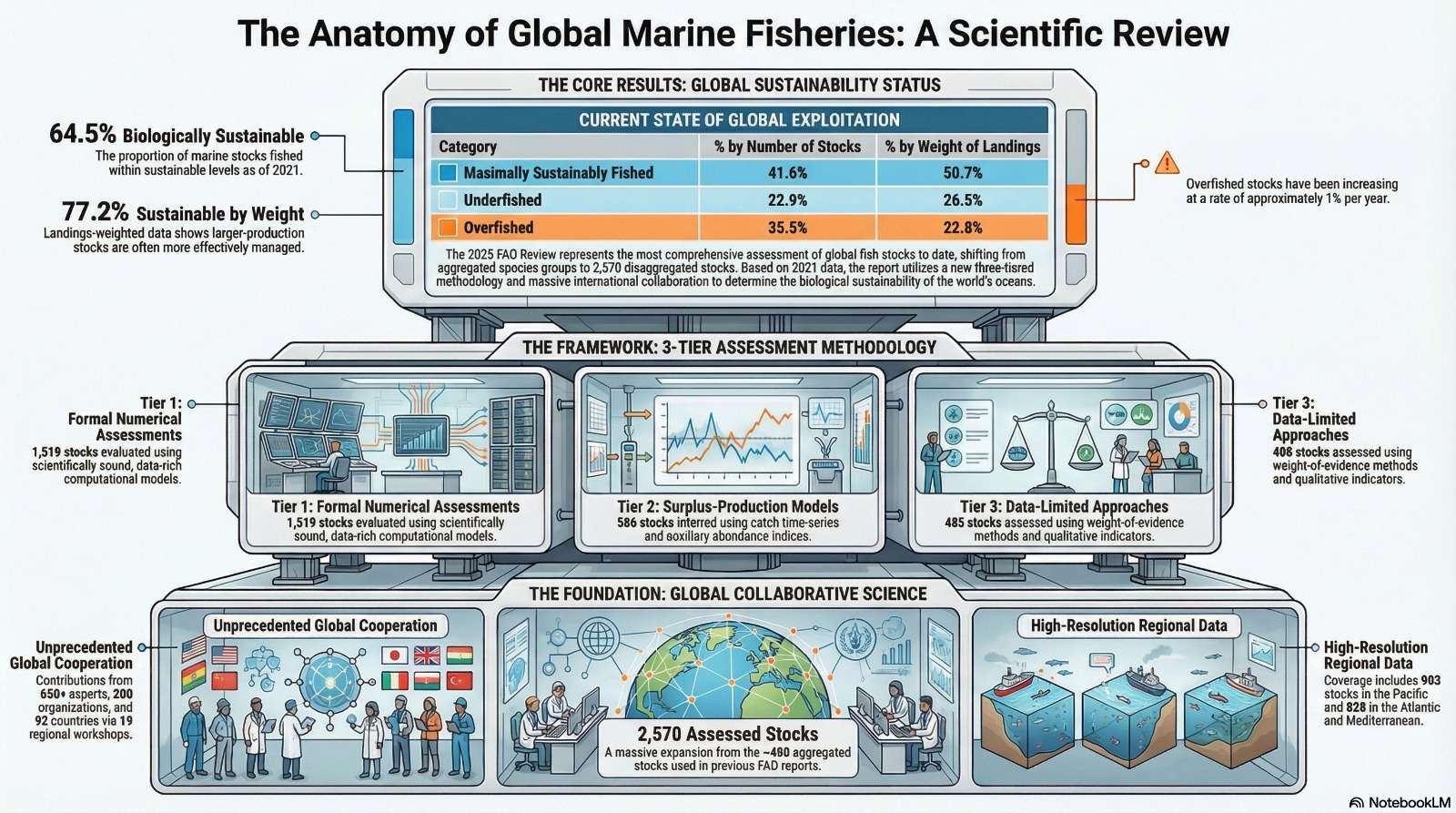
The most striking feature of the 2025 report is its massive “data explosion.” Previous assessments relied on approximately 450 aggregated stocks to proxy the health of the world’s oceans. This new report shatters that limitation, moving to a staggering 2,570 disaggregated stocks.
This shift toward “granularity” allows scientists to see regional nuances that were previously hidden in the fog of broad data.
Nowhere is this more apparent than in the Indian Ocean, where the number of assessed stocks increased tenfold. In the Central Pacific, coverage saw a fivefold increase.
By moving from broad species groups to specific management units, the FAO can now monitor the state of resources at a sub-regional level with unprecedented accuracy.
“This report represents, without a doubt, the most comprehensive, evidence-based, community-built assessment of global fish stocks to date, providing a strong foundation for informed management policies.” — Foreword, 2025 FAO Report
The Sustainability Paradox: Counting Stocks vs. Counting Plates
The data exposes a jarring contradiction: the “Sustainability Paradox.” When looking strictly at the number of individual fish stocks, the situation is concerning: only 64.5% are considered biologically sustainable.
However, when you look at the actual weight of fish being landed and consumed, the picture brightens to 77.2%.
This discrepancy stems from the effective management of high-volume commercial species. In fact, 85.8% of landings from the “Top Ten” species—including the Alaska pollock and Skipjack tuna—are estimated to be from sustainable stocks.
While these heavy hitters feed the majority of the planet, the paradox serves as a warning: smaller, more diverse stocks like the Atlantic cod remain under immense pressure and frequently fall into the overfished category.
By the Numbers
- 64.5%: The proportion of individual fish stocks classified as biologically sustainable.
- 77.2%: The proportion of total global landings (by weight) that come from sustainable stocks.
- 35.5%: The percentage of stocks currently classified as overfished—a figure rising by roughly 1% annually.
Tunas are the Gold Standard of Global Cooperation
If there is a definitive success story in the 2025 report, it is the status of tunas.
These highly migratory fish move across vast distances and multiple jurisdictions, making them some of the hardest species to manage. Yet, they have become a benchmark for what is possible when the world cooperates.
The report finds that 87% of tuna stocks are sustainable. Even more impressively, 99.3% of all tuna landings come from biologically sustainable stocks. This transformation from “at-risk” to “gold standard” is driven by strong management actions and the implementation of rigorous, science-based plans by Regional Fisheries Management Organizations (RFMOs). It proves that when the political will exists, even the most elusive species can be managed for the long term.
A Tale of Two Oceans: The Geography of Success
Sustainability is not evenly distributed; it is a direct reflection of the strength of regional management systems. The 2025 data reveals a world divided by the quality of its fisheries governance:
- The Overachievers: The Northeast Pacific (Area 67) leads the world with a 92.7% sustainability rate, followed by the Southwest Pacific (Area 81) at 85.5%.
- The Challenged: The Mediterranean and Black Seas (Area 37) remain under heavy pressure, with only 35.1% of stocks considered sustainable.
- The Southeast Atlantic Anomaly (Area 47): In a curious statistical quirk, management efforts here have resulted in 33.3% of stocks being classified as “underfished.” However, these stocks represent a mere 5.9% of the area’s landings, offering little impact on regional food production.
- The Reporting Red Flag: While the Eastern Indian Ocean (Area 57) reports a 72.7% sustainability rate, the report adds a crucial cautionary note: these results may be overly optimistic because many vulnerable species are missing from the current data set due to reporting gaps.
The Fragility of the Deep and the Great Migrators
While commercial tunas are thriving, the report identifies two groups in a much more precarious position: deep-sea species and highly migratory sharks.
Deep-sea fisheries are exceptionally vulnerable; only 29% of these stocks are sustainably fished. Because these species have long lifespans and slow maturation rates, they cannot bounce back quickly from overexploitation. Similarly, highly migratory sharks face immense pressure as bycatch in longline fisheries, with only 56.5% of stocks considered sustainable.
“These highly migratory shark species have cross-jurisdictional ranges that require international cooperation to implement management measures and secure their conservation and sustainable use.” — Key Messages, 2025 FAO Report
The “Tiered” Truth: Embracing Uncertainty
In a significant move toward scientific maturity, the 2025 report adopts a new three-tier methodology. This system acknowledges that not all data is equal, but that even “data-limited” information is better than no information at all.
- Tier 1: Formal numerical assessments (1,519 stocks).
- Tier 2: Surplus-production models used for stocks with reliable catch history (566 stocks).
- Tier 3: Data-limited methods based on expert knowledge and “weight-of-evidence” (485 stocks).
By explicitly including Tier 3, the FAO is prioritizing transparency over the illusion of perfect data. This participatory process involved over 650 experts from 92 countries, ensuring the global index represents the whole world—not just the wealthiest fishing nations.
Conclusion: The Road to 100% Management
The 2025 report serves as the essential GPS for the FAO’s “Blue Transformation”—the ambitious vision of reaching 100% effective management for all marine fisheries.
The data provided in this assessment is a major milestone, offering the clarity needed for policymakers to act before it is too late.
However, a critical question remains: the data is now clearer than ever, but is the political will there to act on it? As we approach the 2030 deadline for the Sustainable Development Goals, the evidence shows that management works when it is applied.
As a global citizen and a consumer, you must ask: how can we support a transition where every fish on our plate comes from a stock managed for the next century, rather than just the next catch?
Source FAO
___
Edited for this website by K. Azis