

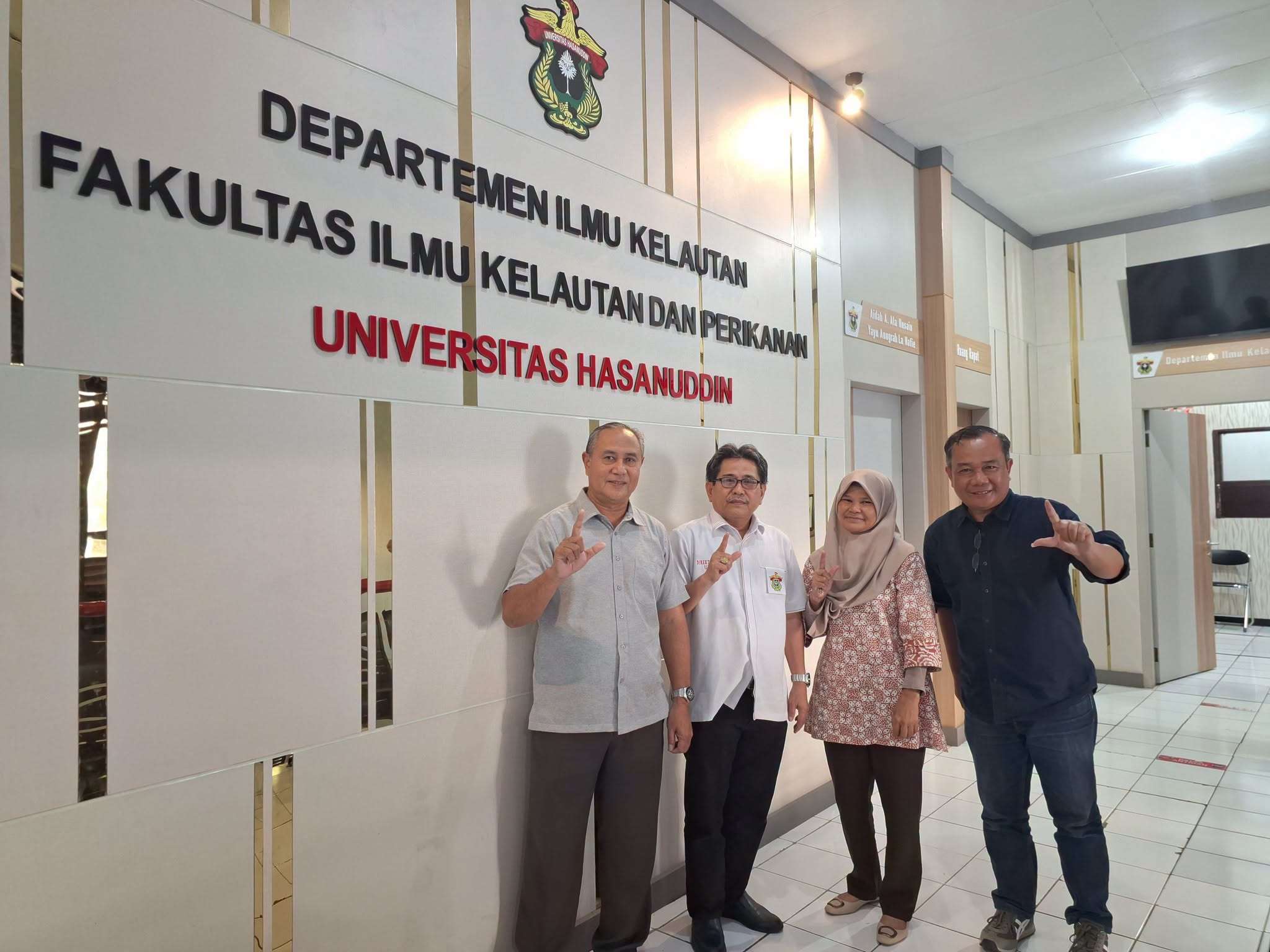
MARITIMEPOSTS.COM – There was a time when marine science was still a relatively unfamiliar academic discipline in Indonesia. In the late 1980s, when most universities focused on agriculture, engineering, medicine, or fisheries, Hasanuddin University (Unhas) made a bold decision: to establish a dedicated program for the scientific study of the sea.
It was not merely the opening of a new study program. It was a declaration that Indonesia’s future as an archipelagic nation must be built upon science.
Today, nearly four decades later, the Department of Marine Science at Hasanuddin University has become one of Indonesia’s leading centers for coastal and marine research.
Thousands of alumni now serve as scientists, lecturers, government officials, consultants, conservationists, entrepreneurs, and leaders across the country’s maritime sector.
Born from Indonesia’s Maritime Identity
The establishment of the Marine Science Study Program in 1988 was closely tied to Hasanuddin University’s commitment to developing knowledge based on the concept of the Indonesian Maritime Continent.
Through the Directorate General of Higher Education’s decree in 1988, Unhas officially launched what was initially known as the Marine Science and Technology Study Program. At that time, the program did not yet belong to a faculty but operated directly under the Rector due to its interdisciplinary nature.
This decision was visionary.
Located in Makassar—the gateway to eastern Indonesia—Hasanuddin University sits at the heart of one of the world’s richest marine biodiversity regions. The Spermonde Archipelago, the Makassar Strait, the Flores Sea, and Wallacea provide an extraordinary natural laboratory for marine research.
The university recognized that Indonesia did not simply need more fisheries experts; it also needed scientists capable of understanding marine ecosystems, coastal dynamics, oceanography, conservation, marine biotechnology, and interactions between coastal communities and their environment.
From a Study Program to a Faculty
A significant milestone came in 1996.
Recognizing the growing importance of marine sciences, the Indonesian government established the Faculty of Marine Science and Fisheries (FIKP) through the Minister of Education and Culture’s decree. The Marine Science Study Program became one of the faculty’s two founding academic pillars, alongside Fisheries.
The transformation reflected Indonesia’s changing perspective toward the ocean.
No longer was the sea viewed merely as a source of fish. It became understood as an ecological system, an economic frontier, a transportation corridor, a cultural space, and a strategic asset.
Marine Science was expected to provide the scientific foundation for managing these complex systems.
Building a Scientific Tradition
Over the years, Marine Science at Unhas developed a reputation for combining classroom education with intensive field experience.
Students learned not only in lecture halls but also on beaches, coral reefs, mangrove forests, seagrass meadows, fishing villages, research vessels, and coastal laboratories. Practical fieldwork became part of the department’s identity, producing graduates familiar with both scientific methods and real-world coastal challenges.
Research themes gradually expanded into: Coral reef ecology, seagrass ecosystems, mangrove conservation, coastal geomorphology, oceanography, marine spatial planning, hydrographic surveys, marine biotechnology, environmental impact assessment, marine protected areas, coastal community development, scientific diving, marine ecotourism, remote sensing and GIS, blue economy and coastal governance.
These areas mirror Indonesia’s increasingly complex maritime agenda.
A Generation that Helped Shape Indonesia’s Marine Policy
The department has produced generations of marine scientists who now work throughout Indonesia.
Many alumni became university lecturers and researchers. Others joined the Ministry of Marine Affairs and Fisheries, provincial governments, environmental agencies, NGOs, international organizations, consulting firms, and marine industries.
Some specialize in coral reef restoration.
Others dedicate themselves to fisheries management, marine protected areas, environmental impact assessments, offshore industries, climate adaptation, or coastal spatial planning.
Collectively, they represent one of Unhas’ strongest academic networks. For many alumni, Marine Science was never merely an academic major—it became a lifelong commitment to Indonesia’s seas.
The People Behind the Legacy
The department’s development has been shaped by many distinguished academics who built laboratories, designed curricula, supervised generations of students, and established international collaborations.
Professors and researchers such as Prof Natsir Nessa, Prof Jamaluddin Jompa, Prof Andi Muhammad Iqbal, Prof Amran Saru, Prof Nurjannah Nurdin, Prof. Mahatma Lanuru, Dr Syafyuddin Yusuf, Dr Ahmad Bahar, Dr Supriadi Mashoreng, Dr. Yayu A. La Nafie, and many others have strengthened the department through research on oceanography, seagrass ecology, remote sensing, marine conservation, coastal ecosystems, and environmental management.
Each generation has contributed to expanding the scientific frontier while mentoring the next.
Their influence extends beyond publications; it lives on in thousands of alumni working across Indonesia’s maritime landscape.
Facing New Challenges
Marine Science today faces a different world from that of 1988.Climate change, marine pollution, coastal erosion, blue carbon, marine spatial planning, offshore renewable energy, artificial intelligence, satellite monitoring, autonomous underwater systems, and digital oceanography are reshaping marine science worldwide.
At the same time, Indonesia’s vision as the world’s largest archipelagic state requires stronger scientific capacity than ever before.
Marine Science departments must therefore continue evolving—not only producing graduates but also generating innovations that support national development.
Alumni as Strategic Partners
One of the department’s greatest strengths lies outside the campus gates.
Its alumni community has become an invaluable social and professional network spanning academia, government, business, NGOs, and international organizations.
This network presents enormous opportunities: collaborative research; student internships and field placements; professional mentoring; policy advisory work; industry partnerships; international cooperation; scholarship development; and community-based coastal innovation.
As conversations among Klaners alumni often reveal, strengthening the department is no longer solely the responsibility of lecturers or university leaders.
It is a shared mission.
Looking Ahead
Marine Science at Hasanuddin University began with a simple yet ambitious vision: to build knowledge rooted in Indonesia’s maritime identity. Nearly forty years later, that vision remains as relevant as ever.
Indonesia’s future will increasingly depend on healthy oceans, resilient coastal communities, sustainable fisheries, marine conservation, and scientific innovation.
The Department of Marine Science has already contributed significantly to this journey. Its next chapter, however, will depend not only on laboratories and classrooms but also on the collective commitment of its alumni to reconnect with the institution that shaped them.
For those who once walked the corridors of Marine Science, every return to campus is more than nostalgia.
It is a reminder that the sea continues to call—and that the mission which began in 1988 is still unfinished.