
MARITIMEPOSTS.COM – The European maritime industry is entering a structural turning point as it confronts the challenge of decarbonization. Moving toward hydrogen and other sustainable fuels is not simply a technological substitution, but a systemic transformation that reshapes how ships are designed, how ports operate, how fuels are produced, and how maritime services are delivered.
Using insights from Complex Adaptive Systems (CAS) theory and DEMATEL analysis, the transition can be understood as an interconnected “system-of-systems” in which changes in one part of the value chain generate cascading effects across all others.
The Maritime Industry as a System-of-Systems
Rather than functioning as a linear supply chain, the maritime sector is better understood as a network of interdependent subsystems. These include four core value chains:
- Fuel production and sourcing
- Shipbuilding and design
- Port and infrastructure systems
- Vessel operations and maintenance
In this structure, no single chain operates independently. Decisions in fuel selection, for instance, directly influence ship architecture, port requirements, and operational logistics.
Under Complex Adaptive Systems theory, the industry behaves as a network of autonomous agents—shipowners, fuel producers, port authorities, regulators—each acting based on local incentives and constraints. Their interactions generate emergent outcomes that cannot be predicted by analyzing individual components in isolation. This makes coordination essential, yet inherently difficult.
Fuel Choice as the System’s Primary Driver
One of the most influential insights from the DEMATEL analysis is the central role of fuel choice and fuel sourcing. These are “driving factors” that shape the entire transition landscape.
The selection of hydrogen as a marine fuel, for example, determines:
- The type of onboard storage systems required
- The redesign of engine and propulsion systems
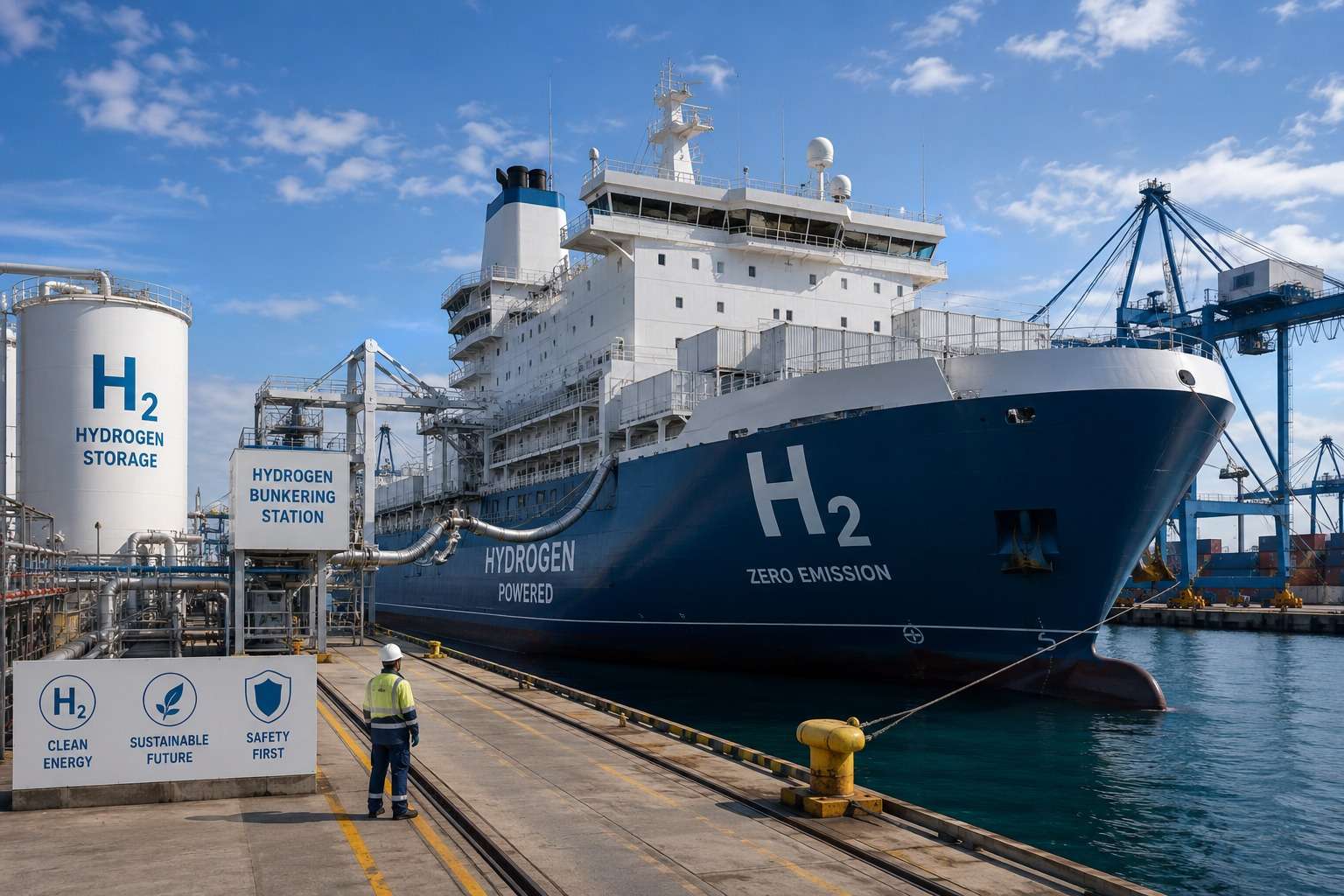
- The need for new bunkering infrastructure
- The spatial and operational constraints on vessels
In this sense, fuel choice functions as the initial condition that triggers a chain reaction across the maritime ecosystem.
Infrastructure as a Strategic Catalyst
Among all components, port infrastructure plays a catalytic role in accelerating or delaying the transition. Hydrogen bunkering facilities, storage systems, and safety protocols at ports are not merely supportive elements—they are enabling conditions for the entire hydrogen economy.
Early investment in port infrastructure reduces uncertainty for shipowners and shipbuilders. Without it, even technically viable hydrogen vessels may remain commercially unfeasible due to the lack of refueling networks.
This creates a sequencing challenge: infrastructure often needs to be developed ahead of demand, rather than in response to it. Ports therefore become de facto managers of the energy transition, shaping adoption curves through readiness and investment timing.
Hydrogen’s Technical Trade-Offs
Hydrogen introduces significant technical constraints that directly affect ship design and operations. Its low volumetric energy density means that storage requirements are substantially higher compared to conventional marine fuels.
Two main storage approaches dominate current discussions:
- Compressed hydrogen (high-pressure tanks, e.g., 350 bar)
- Liquid hydrogen (cryogenic storage systems)
While compressed hydrogen is simpler to handle, it requires significantly more onboard space for the same energy output. Liquid hydrogen offers better energy density but introduces complexity due to extreme cooling requirements and insulation systems.
These trade-offs directly reduce cargo capacity or require major redesigns of vessel architecture, influencing commercial viability.
Fuel Storage as the System’s Balancing Node
Fuel storage occupies a unique position in the system. It is both shaped by upstream fuel decisions and a determinant of downstream ship and port design.
For example:
- Fuel type determines storage technology
- Storage technology dictates ship layout and safety systems
- Ship design influences port compatibility and bunkering methods
This dual role makes fuel storage a “balancing component” in the system-of-systems structure.
Regulatory Pressure and External Drivers
The transition is not occurring in a vacuum. The International Maritime Organization (IMO) has set ambitious decarbonization targets aiming for net-zero greenhouse gas emissions by 2050. Through instruments such as the Energy Efficiency Design Index (EEXI) and Carbon Intensity Indicator (CII), the industry faces increasing regulatory pressure to reduce emissions.
These frameworks reshape investment decisions and accelerate experimentation with alternative fuels, including hydrogen, ammonia, and methanol.
The Overlooked Dimension: Ship Lifecycle Management
One of the weaker links identified in the analysis is ship maintenance, retrofitting, and lifecycle management. Despite being currently underdeveloped, this area holds strategic importance.
Retrofitting existing vessels with hydrogen-compatible systems could significantly reduce transition costs and accelerate decarbonization. However, limited technical expertise and lack of standardization currently constrain its development.
Ignoring lifecycle management risks locking the industry into a “fleet replacement only” model, which would slow the overall transition.
Policy Implications: Coordination Over Fragmentation
The hydrogen transition cannot be achieved through isolated interventions. Instead, it requires coordinated action across all four value chains.
Effective policy approaches include:
- Multi-stakeholder coordination platforms involving fuel producers, shipyards, and port authorities
- Incentives that align infrastructure development with fleet readiness
- R&D funding for storage, propulsion, and safety technologies
- International standards to ensure interoperability and safety consistency
The key shift is from siloed policymaking to system-level governance, where feedback loops and interdependencies are explicitly managed.
Conclusion
The transition of Europe’s maritime industry toward hydrogen is not merely a technological upgrade—it is a structural transformation of an interconnected system. Fuel choice, infrastructure readiness, ship design, and regulatory pressure interact in complex and often non-linear ways.
Applying Complex Adaptive Systems thinking reveals that success depends not on optimizing individual components, but on synchronizing the evolution of the entire ecosystem. In this sense, the future of maritime decarbonization will be determined not only by innovation, but by coordination.
Source from this