
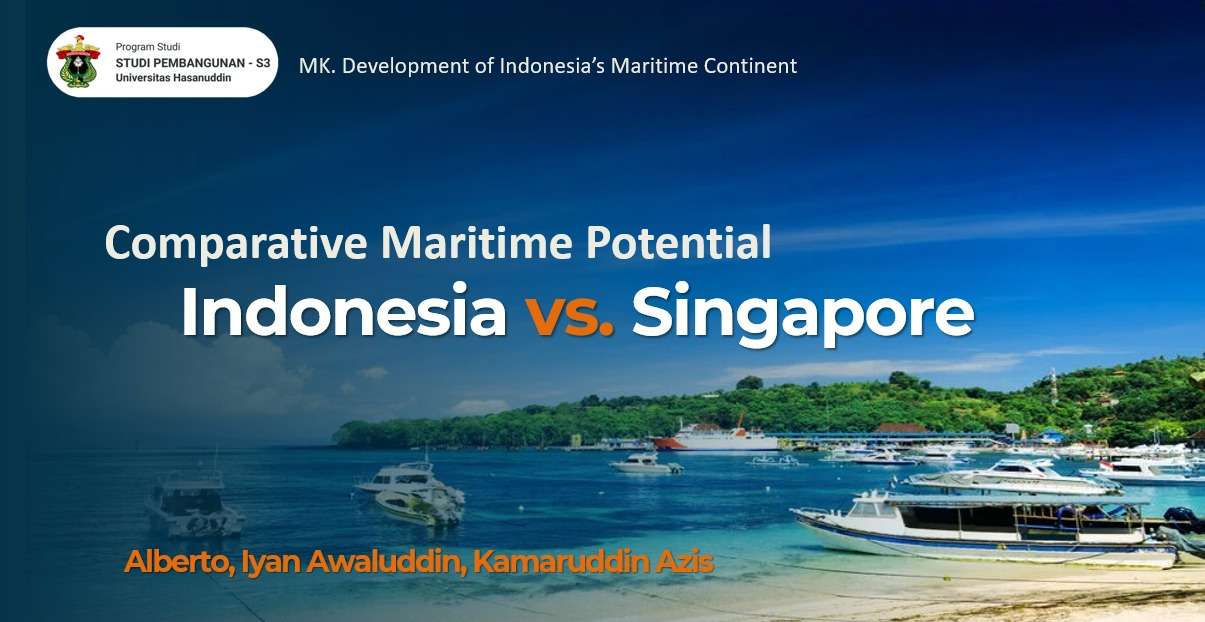
MARITIMEPOSTS.COM – In the theater of global maritime trade, geography is frequently mistaken for destiny. On paper, Indonesia is an undisputed titan—a “Maritime Continent” comprising over 17,000 islands and the world’s second-longest coastline.
Yet, the economic reality tells a different story. Just across the Malacca Strait, Singapore—a city-state with a landmass smaller than some Indonesian municipalities—commands a maritime presence that systematically outshadows its neighbor.
This presents a stark “Geography vs. Efficiency” paradox: Indonesia possesses 560 times the coastline of Singapore, yet it struggles to match the tiny island’s logistical throughput and economic gravity. For the strategic analyst, the lesson is clear: maritime power is no longer measured by the length of one’s shores, but by the seamlessness of one’s systems.
1. The Productivity Paradox: Scale vs. Performance
The disparity between physical scale and economic output is the first indicator that Indonesia’s maritime economy remains an unpolished diamond. While Indonesia manages a vast domestic market, Singapore has optimized every square inch of its territory for maximum capital generation.
| Indicator | Indonesia | Singapore |
| Land Area | ±1.9 million km² | ±734 km² |
| Coastline | ±108,000 km | ±193 km |
| GDP per Capita (2024) | US$4,960.3 (Rp78.6 million) | ~US91,100 (S121,161) |
As regional development planners at Bappenas and other agencies have noted:
“Singapore excels not because its territory is vast, but because every economic node—ports, logistics, finance, maritime services, technology, and regulation—works very efficiently and is interconnected.”
2. The Throughput Gap: Destinations vs. Intersections
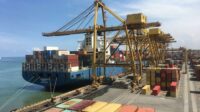
The true measure of maritime dominance lies in “throughput”—the volume of cargo handled and the speed at which it moves. Singapore’s port is a global juggernaut, consistently ranked in the top two worldwide, handling 39.01 million TEU (twenty-foot equivalent units). Indonesia’s primary gateway, Tanjung Priok, manages approximately 17 million TEU.
The structural difference is profound. Indonesia’s ports currently function as “end-of-the-line” destinations, serving a massive but largely internal regional market. Singapore, conversely, is the world’s “middleman.” It is a Global Transshipment Hub—a critical intersection where cargo is reorganized and redistributed.
This status is reinforced by Singapore’s massive registry power. Its flagged fleet reaches 140,737k DWT (Deadweight Tonnage—a measure of total carrying capacity), dwarfing Indonesia’s 32,703k DWT. Singapore is not just where ships stop; it is where the world’s fleet is legally and operationally anchored.
3. The Invisible Engine: The “Stickiness” of Maritime Services
Singapore’s dominance is fueled by a “Maritime Cluster” that extends far beyond the physical docks. In the modern era, the most lucrative maritime activities happen in high-rise office towers, not just on crane-lined wharves.
Singapore provides the “soft infrastructure” that creates ecosystem “stickiness.” Even if a neighboring port upgrades its physical hardware, global shipping lines remain tethered to Singapore for:
- Shipping Finance: Access to the deep liquidity required for fleet expansion.
- Maritime Insurance: Sophisticated risk management for global trade routes.
- Maritime Arbitration: A world-class legal framework for resolving complex international disputes.
These services ensure that Singapore remains the nerve center of the global supply chain, a feat Indonesia has yet to replicate as its own maritime service industry remains in its infancy.
4. Frictionless Trade: The Regulatory Advantage
Efficiency is the child of regulatory clarity. According to the World Bank’s Doing Business 2020 report, Singapore holds the #2 global rank (86.2 score), while Indonesia sits at #73 (69.6 score).
For global investors, the Indonesian regulatory environment is often perceived as a “drag factor”—relatively complex and reliant on manual processes. Singapore, by contrast, has engineered an ecosystem that is “fast, simple, and certain.” In a world where a delay of a few hours can cost shipping lines thousands of dollars, regulatory certainty is as valuable as deep-water berths.
5. The Technology Frontier: Automation vs. Legacy Hurdles
As the industry pivots toward Industry 4.0, the technological divide is widening. Singapore’s “Tuas Mega Port” represents the future of the trade: a facility defined by total automation and digitalized logistics.
Indonesia remains shackled by a legacy of manual operations and fragmented infrastructure. Beyond the tech gap, Bappenas identifies several critical hurdles—or “drag factors”—that impede Indonesia’s progress:
- High Logistics Costs: Fragmented connectivity across 17,000 islands inflates prices.
- Fossil Fuel Dependency: A reliance on traditional energy sources that complicates the transition to “green” shipping.
- Maritime Security Risks: Persistent challenges in patrolling a vast archipelagic territory.
6. The Sleeping Giant: Untapped Biological and Strategic Wealth
Despite Singapore’s operational lead, Indonesia holds biological and geographical assets that no amount of engineering can replicate. It is a “Sleeping Giant” sitting on a literal gold mine of maritime resources:
- The Strategic Alur Laut (ALKI): Indonesia controls the Sea Lanes of Communication (SLoC) that bisect the archipelago. While Singapore has mastered the Malacca Strait, Indonesia has yet to fully monetize the transit through its own internal sea lanes.
- The Coral Triangle: Indonesia hosts 76% of the world’s coral species and 37% of reef fish species.
- Food Security: Indonesia contributes 10% of global fishery commodities; crucially, 54% of the nation’s animal protein is derived from fish.
- Economic Potential: The theoretical value of Indonesia’s maritime economy is a staggering IDR 36,000 to 60,000 trillion annually.
Conclusion: Bridging the Architecture Gap
The comparison between these two neighbors provides a roadmap for Indonesia’s future. To transition from a “geographical maritime nation” to a “maritime economic power,”
Indonesia must look past the water and focus on the architecture of its systems: strengthening hub ports, aggressively slashing logistics costs, and fostering a digital-first regulatory environment.
The ultimate question for the next decade is this: Can a massive “Maritime Continent” eventually leverage its sheer scale to match the precision of a “Maritime Hub”? Or is extreme efficiency a quality that only thrives in smaller, more concentrated spaces? Indonesia’s future depends on whether it can build the digital and political architecture necessary to finally bridge its 17,000 islands.