
MARITIMEPOSTS.COM – As the world’s largest archipelagic nation, Indonesia possesses one of the richest marine ecosystems on Earth. Its vast waters support millions of livelihoods, provide strategic food resources, and position the country as a major maritime power in the Indo-Pacific region.
Yet behind this enormous potential lies a growing web of challenges that increasingly place Indonesia’s marine and fisheries sector at a critical crossroads.
Today, marine and fisheries policy is no longer solely about increasing fish production or boosting exports.
It now intersects with climate change, social inequality, environmental sustainability, food security, energy politics, and even geopolitical competition. The complexity of these challenges demands a more adaptive, inclusive, and sustainable policy approach.
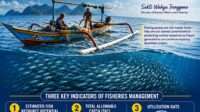
One of the most pressing concerns is overfishing and the declining condition of fish stocks in several Indonesian Fisheries Management Areas (WPP).
Valuable species such as tuna, shrimp, reef fish, and small pelagic fish are under mounting pressure due to industrial fishing activities, illegal fishing practices, weak monitoring systems, and rising domestic as well as international demand.
Indonesia faces the difficult task of balancing economic growth with ecological sustainability while ensuring the livelihoods of millions of fishers remain protected. Without stronger fisheries management and stricter stock control, several strategic fishing zones risk long-term depletion.
At the same time, climate change has emerged as a major disruptor of marine ecosystems and coastal livelihoods.
Rising sea temperatures, coastal erosion, sea-level rise, and increasingly extreme weather events are already affecting fish migration patterns, coral reefs, seaweed cultivation, and small-scale fishing communities across the archipelago. For many coastal villages, climate change is no longer a future threat but an everyday reality.
This creates urgent policy questions regarding climate adaptation, coastal resilience, and how Indonesia can build a sustainable blue economy capable of surviving environmental uncertainty.
Another highly sensitive issue revolves around fuel subsidies and fisher welfare. Fuel remains one of the largest operational costs in capture fisheries, making access to subsidized fuel crucial for small-scale fishers.
However, distribution problems, unequal access, and the emergence of illegal mixed fuel markets — often referred to as “BBM oplosan” — continue to create tensions among fishers, fuel distributors, industrial fleets, and regulators.
Although the government allocates subsidized fuel for small fishers, many coastal communities still struggle to access it efficiently. The issue is closely tied to poverty, operational costs, and broader social inequality in Indonesia’s maritime economy.
Indonesia also continues to face serious challenges from Illegal, Unreported, and Unregulated (IUU) Fishing. Illegal foreign fishing vessels, destructive fishing methods, transshipment violations, and weak seafood traceability systems remain persistent concerns.
Although enforcement efforts have improved over the past decade, major gaps still exist in maritime surveillance capacity, inter-agency coordination, and law enforcement consistency. IUU fishing not only damages marine ecosystems but also causes significant economic losses and undermines Indonesia’s maritime sovereignty.
Beyond ecological and enforcement issues, tensions between industrial fisheries and traditional fishers are becoming increasingly visible.
Many small-scale fishers argue that industrial fleets enjoy disproportionate access to marine resources, while coastal communities face restricted fishing grounds, declining catches, and unfair competition.
Marine zoning policies and large-scale investment projects have also sparked concerns about social justice and unequal resource distribution.
These conflicts raise deeper questions about who truly benefits from Indonesia’s blue economy agenda and whether development policies adequately protect traditional maritime communities.
Marine pollution and plastic waste represent another growing crisis. Indonesia remains one of the countries struggling with severe marine plastic pollution, which affects coral reefs, fish habitats, tourism areas, seafood safety, and coastal health.
The increasing presence of microplastics in seafood has also raised concerns about long-term human health impacts. As a result, marine policy today extends beyond fisheries management into broader environmental governance, including waste management systems, circular economy initiatives, and public awareness campaigns.
Meanwhile, the government continues to aggressively promote the concept of the blue economy through aquaculture expansion, marine tourism, seafood exports, offshore investment, and even carbon trading initiatives.
While these programs offer economic opportunities, critics warn that rapid marine-based development without strong ecological safeguards may repeat the extractive patterns often associated with land-based industries. The central challenge remains whether Indonesia can grow its marine economy while preserving ecosystems and protecting local communities from marginalization.
Food security and fisheries downstreaming have also become central components of national marine policy. Indonesia is under increasing pressure to strengthen domestic fish consumption, expand aquaculture production, stabilize seafood prices, and develop value-added seafood industries.
Efforts to improve cold-chain logistics, seafood processing, and export competitiveness are now closely tied to broader economic development strategies. However, modernization must also ensure that the benefits are shared fairly among fishers, small processors, and coastal micro-enterprises rather than concentrated only within large corporations.
Ultimately, Indonesia’s marine and fisheries sector is no longer merely about catching fish. It has become a strategic arena where environmental sustainability, economic development, climate resilience, food security, and social equity intersect. The future of Indonesia as a maritime nation will depend not only on how much wealth it can extract from the sea, but on whether it can build policies that are economically productive, ecologically responsible, and socially inclusive at the same time.