






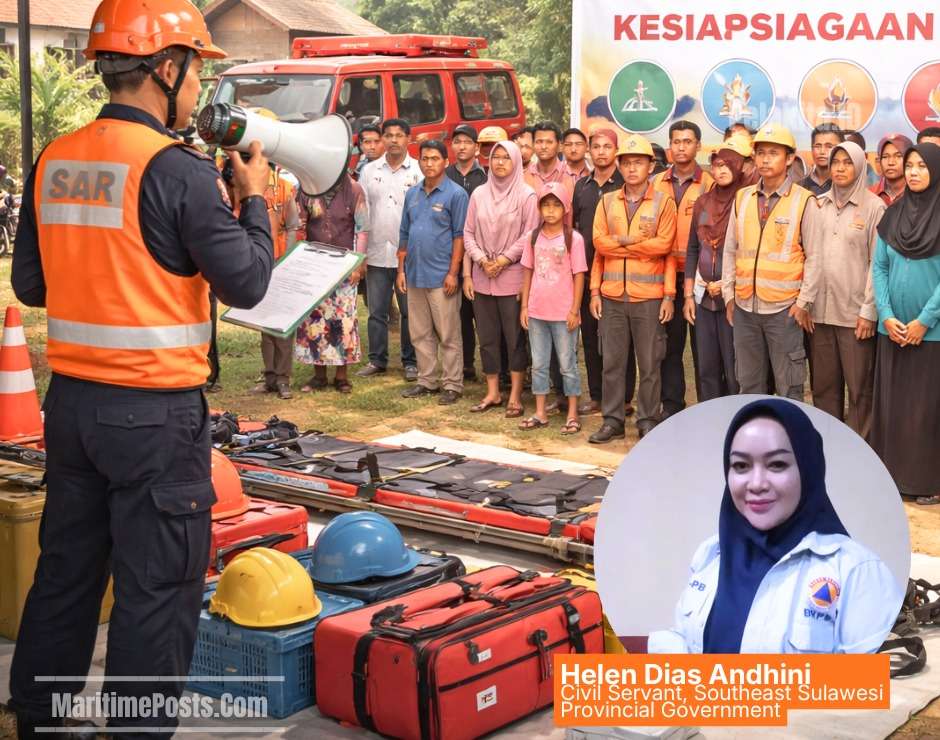
Author: Helen Dias Andhini
Civil Servant, Southeast Sulawesi Provincial Government
MARITIMEPOSTS.COM — Natural disasters are an integral part of human life and, to a certain extent, unavoidable.
Phenomena such as earthquakes, floods, landslides, droughts, disease outbreaks, fires, and even socio-economic crises often occur suddenly, demanding not only physical preparedness but also mental and social readiness.
In many cases, the scale of a disaster’s impact is determined not only by the magnitude of the threat, but also by a community’s ability to respond, adapt, and recover.
In Indonesia, a country highly prone to disasters, vulnerability levels remain significant. This makes discussions on disaster management increasingly important.
However, these discussions often focus more on structural and technocratic aspects, such as early warning systems, risk mapping, disaster-resilient infrastructure, and logistics management. In fact, cultural, moral, and spiritual elements also play a crucial role in shaping community behavior during emergencies.
In this context, Ramadan can be seen as a valuable source of learning. It is not merely a month of fasting, but also a period of character building—instilling discipline, strengthening social empathy, and realigning life priorities.
These values are closely linked to the fundamental principles of disaster management. Individuals trained to practice self-restraint, patience, discipline, compassion, and simplicity are generally better prepared to face limitations, uncertainty, and pressure during disasters.
In general, disaster management consists of four main stages: mitigation, preparedness, response, and recovery. Mitigation—often overlooked—focuses on reducing risks before disasters occur.
Preparedness emphasizes building systems, resources, and behavioral readiness so communities can respond quickly and effectively. Response involves actions during a disaster, while recovery focuses on rehabilitation and rebuilding after the event.
While this framework is essential, its success depends heavily on the quality of the people implementing it. This is where values become critical. Communities that embody discipline, care, solidarity, and patience tend to implement disaster management more effectively.
Conversely, when communities are individualistic, panic-driven, undisciplined, and poorly coordinated, disaster impacts tend to worsen. Ramadan can be viewed as an intensive one-month learning mechanism for these values.
During this period, individuals are trained to manage needs, control emotions, enhance social awareness, build discipline, and strengthen their relationship with God.
All these elements contribute to building resilience. One of the key lessons from Ramadan is discipline. Fasting teaches time management, adherence to rules, and the ability to adjust behavior within defined boundaries.
Activities such as eating and drinking are regulated within specific hours. From this, individuals learn that safety and success often require compliance with procedures.
In disaster management, discipline is crucial. Successful evacuation, the use of safe routes, adherence to official information, and readiness in emergencies all depend on a community accustomed to order.
Many casualties in disasters occur not only due to the primary hazard but also because of panic, misinformation, and failure to follow safety protocols.
In this sense, Ramadan trains individuals to submit to collective rules for a greater purpose. Beyond discipline, it also builds readiness to face limitations. Fasting is a conscious experience of living with restrictions for several hours each day, fostering self-control, energy management, and an understanding of basic needs.
Social Solidarity
During disasters, communities often face shortages of food, water, energy, transportation, and information. Those accustomed to constant comfort are more likely to panic when confronted with scarcity.
On the other hand, individuals trained in self-restraint are better equipped to respond rationally in emergencies.
Fasting also allows individuals not only to understand but to feel hunger, thirst, and limitation firsthand. This experience nurtures empathy for the poor, vulnerable groups, and those living in hardship.
In disaster contexts, empathy becomes a vital social force. Disaster response cannot rely solely on the state or formal institutions.
In many cases, the first responders are family members, neighbors, local communities, and nearby volunteers. Social solidarity becomes the backbone when formal systems are not fully present.
Ramadan strengthens solidarity through practices such as zakat, charity, communal breaking of the fast, and care for those in need.
Sociologically, these practices build stronger social networks and foster a culture of sharing. This culture is highly relevant in disaster management, particularly in aid distribution and socio-economic recovery.
Communities shaped by the spirit of Ramadan solidarity are better able to organize assistance, identify vulnerable groups quickly, and maintain social cohesion after disasters.
This is crucial, as disasters often trigger competition for resources, minor conflicts, and even social fragmentation. Ramadan, by contrast, teaches sharing, calming, and strengthening one another.
Disasters require leadership that is calm, honest, and capable of managing complex situations. At the same time, individuals must also be able to lead themselves. Ramadan teaches deep self-control—restraining anger, guarding speech, avoiding conflict, and maintaining integrity even in difficult conditions.
This lesson is essential during crises. When disasters strike, emotions can escalate quickly. Mass panic, rumor spread, blame, and selfish behavior can worsen the situation.
In such circumstances, self-control becomes a powerful social asset. Individuals who can manage their emotions are better able to think clearly, help others, and make sound decisions.
Moreover, Ramadan fosters service-oriented leadership.
Many Ramadan activities involve community coordination: collecting and distributing zakat, organizing communal meals, managing mosques, and coordinating worship activities. These are simple yet meaningful forms of social organization training.
In disaster management, coordination, communication, and role distribution are key to effective response. In other words, Ramadan not only shapes individuals spiritually but also builds communities that are more organized and ready to act collectively in emergencies.
Lessons from Ramadan should not stop at moral reflection but should be integrated into disaster education and social policy. Value-based disaster education can utilize Ramadan as a moment to instill preparedness, sharing, discipline, and mutual cooperation.
Mosques, schools, universities, and communities can serve as effective platforms to expand disaster literacy.
Religious institutions can also play a more proactive role in disaster risk reduction.
Religious outreach can be broadened beyond individual rewards to include social responsibility, protection of vulnerable groups, environmental stewardship, and crisis preparedness.
This is important, considering that many disasters are worsened by human behavior, such as environmental degradation, poor spatial planning, and weak prevention culture.
With this approach, Ramadan can become a strategic moment to build a society that is not only symbolically religious but also socially resilient and collectively prepared.
Ramadan holds valuable lessons for disaster management. Through fasting and its social-spiritual practices, it cultivates discipline, self-control, empathy, solidarity, leadership, and mental resilience.
These values align closely with the core principles of disaster management, particularly in preparedness, collective response, aid distribution, and community-based recovery.
Thus, learning disaster management from Ramadan means understanding that crisis preparedness is not built solely through tools, systems, and policies, but also through the character and culture of society.
Ramadan teaches that resilience grows from disciplined individuals, compassionate communities, and the belief that every hardship must be faced with patience, effort, and togetherness.