









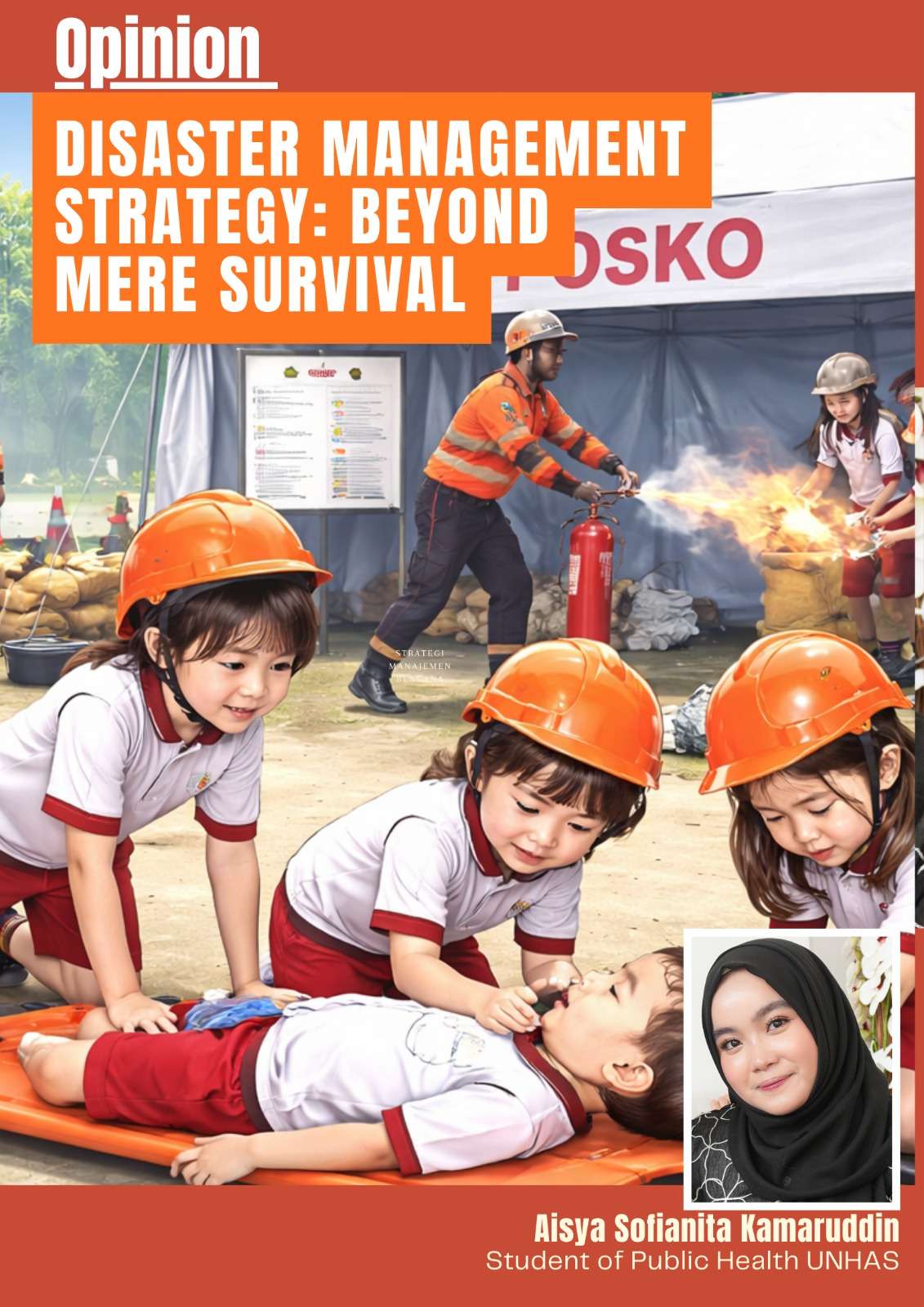
The author is a student of the Department of Occupational Safety and Health, Faculty of Public Health, Hasanuddin University.
MARITIMEPOSTS.COM – In the dynamics of modern life, humans are often trapped in an illusion of safety. We tend to view disasters as unexpected “shocks” or inevitable bitter fate.
In reality, disasters are not merely sudden natural phenomena; they are manifestations of risks that we have failed to manage properly.
Understanding disaster management is no longer just the domain of technical experts—it has become an existential necessity for every individual living in vulnerable areas.
This article examines the key elements of transformative disaster management policies in Indonesia, focusing on the shift from merely responding to impacts toward building sustainable resilience.
Risk Is Not Fate: Why Collective Capacity Is Key
We often blame nature when disasters strike. However, from a scientific perspective, disaster risk is the result of a complex interaction between three main components: hazard, vulnerability, and capacity.
The level of risk in a region is determined by how significant the threat and vulnerability are compared to the available capacity.
Technically, we often have little control over eliminating hazards—such as tectonic activity that triggers earthquakes. However, we have full control over reducing risk by strengthening capacity.
Capacity here is not merely about advanced equipment, but about the “collective intelligence” of a community.
Through education, continuous training, and preparedness, we strengthen our social immunity system. The higher a community’s capacity, the smaller the impact they will suffer from the same threat.
Stop Putting Out Fires, Start Preventing Sparks: A Shift in Paradigm
Modern disaster management has moved beyond the old reactive mindset—one that only becomes active during emergencies.
Today, national policy has shifted radically toward a proactive approach, emphasizing the pre-disaster phase, including mitigation, preparedness, and early warning systems.
This strategy is far more effective in reducing casualties and material losses. To understand its foundation, we can refer to the strong legal definition in Law No. 24 of 2007:
“A disaster is an event or series of events that threaten and disrupt community life caused by natural, non-natural, or human factors, resulting in loss of life, environmental damage, property loss, and psychological impacts.”
This law explicitly classifies disasters into three categories: natural, non-natural, and social.
This expanded definition is crucial, enabling the government—through the National Disaster Management Agency (BNPB) and Regional Disaster Management Agencies (BPBD)—to design policies tailored to specific threats, ensuring that risks are anticipated before they become tragedies.
Between Rapid Response and the Philosophy of Rebuilding
Although the focus has shifted toward prevention, the “during disaster” phase remains the ultimate test of coordination readiness.
Here, BNPB and BPBD play a vital role in leading evacuation, rescue, provision of basic needs, healthcare services, and protection for vulnerable groups.
However, the work does not stop once logistics are distributed.
Smart disaster management adopts the philosophy of “Build Back Better.”
In the post-disaster phase, there is a fundamental distinction between:
- Rehabilitation – restoring social conditions and public services so that community life can return to normal.
- Reconstruction – rebuilding damaged physical infrastructure.
This approach does not merely restore conditions to their previous state but improves them to be more resilient. The goal is clear: to break the cycle of vulnerability so that the same tragedy does not recur in the future.
Disaster Risk Assessment and AI: Reading Patterns Amid Climate Chaos
In an era of climate change where weather patterns are increasingly extreme and unpredictable, technology has become a life-saving instrument.
The foundation of modern disaster management policy today is the Disaster Risk Assessment (KRB)—a data-based document analyzing hazard levels, vulnerability, and capacity in a given area.
The integration of technology into KRB development and field operations is a “game changer” for several reasons:
- Geographic Information Systems (GIS): Enable precise mapping of vulnerable areas through spatial data analysis.
- Artificial Intelligence (AI): Crucial in processing big data to uncover hidden patterns amid chaotic weather conditions, offering predictions beyond traditional models.
- Early Warning Systems: Provide real-time information, allowing communities to conduct timely and accurate evacuations.
Disasters as a Mirror: When Development Becomes a Boomerang
We must have the courage to acknowledge that the increasing intensity of disasters is often “feedback” from our own mismanaged human activities.
Hydrometeorological disasters such as flash floods and landslides rarely occur purely due to natural causes.
Uncontrolled urbanization, massive land-use changes in catchment areas, and illegal mining are real contributors to increasing environmental vulnerability.
Therefore, disaster management must not stand in isolation. It must be deeply integrated with spatial planning and environmental management policies.
Without this synergy, the development we pursue today may become the seeds of disaster in the future.
Conclusion: The Future of Our Resilience
Effective disaster management is not solely the responsibility of the government or technical institutions like BNPB and BPBD. Amid limited resources and coordination challenges, synergy between government and society is the only way forward.
We must transform our collective mindset—from passive “victims” waiting for aid into active, prepared actors.
Our future resilience depends on how boldly we invest in capacity, value risk data, and maintain harmony with the environment.
A Reflection for All:
If a disaster alarm sounded five minutes from now, would your capacity be enough to save the person next to you?
___
References
Alimuddin, I. (2025). Kebencanaan dan Observasi. Materi perkuliahan Fakultas Kesehatan Masyarakat, Universitas Hasanuddin, Makassar: Pusat Studi Kebencanaan (PUSBEN) LPPM UNHAS.
Manurung, R., et al. (2024). Strategi penanggulangan bencana pada BPBD: Kajian literatur. Jurnal Manajemen dan Kewirausahaan, 12(2), 45–56.
Mufimah, S., & Kamaludin, A. (2025). Pelatihan manajemen bencana terhadap kesiapsiagaan mahasiswa: Literature review. Jurnal Ilmiah Kesehatan, 10(1), 15–25.
Putri, D. A., et al. (2025). Manajemen bencana (pra, saat, dan pasca) dalam penanggulangan banjir. Journal of Management and Public Policy, 8(1), 22–30.
Raj, A., et al. (2025). AI and generative AI transforming disaster management. International Journal of Disaster Risk Reduction, 95, 103800.
Syahwanes, M., et al. (2024). Analisis kebijakan manajemen risiko bencana di daerah rawan bencana. Journal of Multidisciplinary Inquiry, 5(1), 60–72.
Yulianti, N., et al. (2024). Kebijakan manajemen bencana berkelanjutan: Pendekatan terpadu untuk mitigasi dan adaptasi bencana. Journal of Multidisciplinary Science Research, 3(2), 101–11