








MARITIMEPOSTS.COM – The Fisheries Management Area of the Republic of Indonesia (WPPNRI) 715 represents a marine biodiversity epicenter that plays a vital role in maintaining food security and supporting the national economy.
Administratively, this strategic region encompasses eight provinces in Eastern Indonesia:
- Maluku
- North Maluku
- North Sulawesi
- Central Sulawesi
- Gorontalo
- Papua
- West Papua
- Southwest Papua
As a resource-rich geographical unit, WPPNRI 715 is positioned as a “large laboratory” for implementing the Measured Fishing Policy (Penangkapan Ikan Terukur – PIT). Governance success in this region serves as a crucial barometer for the effectiveness of Indonesia’s future marine policies.
Operational Realities: Capacity Strengthening and Field Initiatives
Based on the annual meeting held on July 15–19, 2025, in Makassar, the Fisheries Management Unit (UPP) of WPPNRI 715 formulated strategic measures to align the Fisheries Management Plan (RPP) with field realities. The UPP acts as a coordination anchor among stakeholders to ensure fair distribution of fish resource quotas across provinces.
Capacity-building initiatives include:
- “Fishermen Champions” Program: Technical training to enhance fishermen’s competencies in vessel engine management and fishing gear maintenance.
- Technical Guidance on SKN and “Relief Service Centers”: Socialization of the National Contract System (SKN) and the operation of integrated service outlets to accelerate licensing administration.
- Vessel Document Legalization Assistance (“Lembuk”): A large-scale effort to process vessel registration books, with accelerated implementation in key port hubs such as North Maluku.
- Fisheries Status Data Dissemination: Transparency in information on small and large pelagic stock status at Coastal Fishing Ports (PPI) to ensure business certainty for economic actors.
From a managerial perspective, the UPP WPPNRI 715 is fully responsible for integrating cross-regional production data. This is essential to ensure that resource utilization does not exceed environmental carrying capacity.
Strategic Issues and Key Challenges in the Field
Policy evaluation reveals a gap between central regulatory ambitions and regional socio-economic realities. The following outlines the key challenges:
- Regulatory/Financial
- Issue: Absence of revenue-sharing (DBH) from non-tax state revenue (PNBPSDA) in capture fisheries.
- Cause: Law No. 1/2022 centralizes all revenues to the national government.
- Impact: A “policy irony” where local governments bear monitoring responsibilities but are financially marginalized.
- Technical/Operational
- Issue: Inconsistent PIT zoning and proliferation of illegal Fish Aggregating Devices (FADs/rumpon).
- Cause: Misalignment between zoning policies and traditional fishing patterns.
- Impact: Disruption of fish migration routes and conflicts over marine space access.
- Bio-Ecological
- Issue: Overexploitation beyond Allowable Catch (JTB).
- Cause: Pressure on pelagic and coral-associated stocks, including illegal harvesting of flying fish eggs in conservation areas.
Structural Threat: The weakening capacity of internal working groups (Pokja) within the UPP WPPNRI 715 poses a serious risk to program success. This condition hampers policy responsiveness and weakens inter-agency data synchronization, widening the gap between planning and implementation.
2025–2026 Action Plan: Science-Based Policy Solutions
To mitigate these risks, a comprehensive action agenda has been established, consisting of 29 priority activities in 2025 and 29 in 2026 (a total of 58 activities). This plan emphasizes a science-based approach through the following measures:
Policy Advocacy
Resolving regulatory barriers through coordinated efforts with the Ministry of Finance and the Ministry of Home Affairs, particularly advocating for the redistribution of fisheries revenue-sharing (DBH PNBPSDA) to regions to balance provincial management burdens.
Technical Reform and Spatial Planning
Assigning the WPPNRI 715 Scientific Panel to conduct cross-zone studies as a basis for revising PIT zoning to be more inclusive of traditional fishermen. This includes digital inventory of FAD locations integrated with simplified licensing mechanisms (PKKPRL).
Conservation and Stock Management
- Habitat Protection: The UPP will issue formal communication to the National Secretariat to enforce action against illegal harvesting of flying fish eggs.
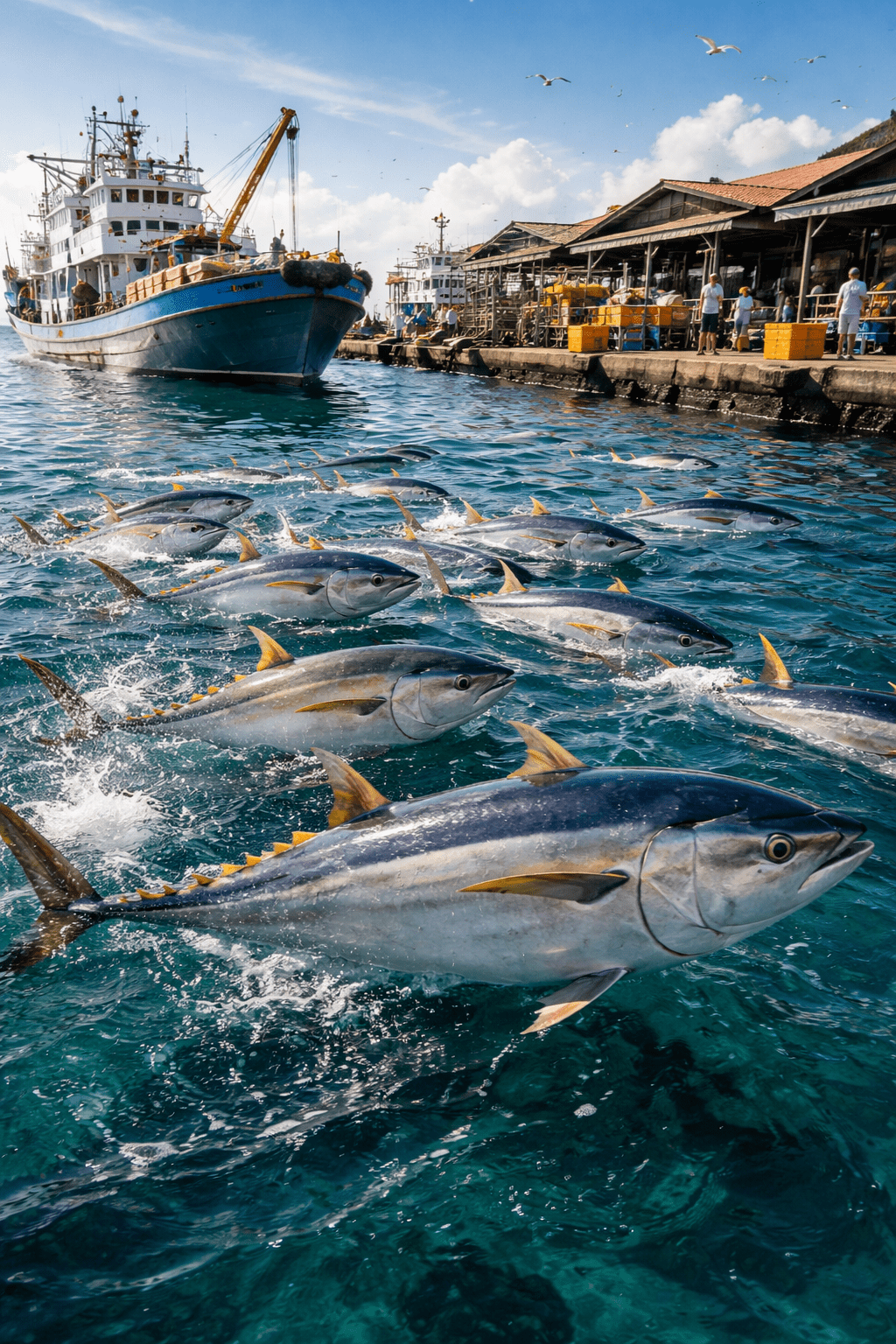
- Quota Control: Strict catch limitations for Yellowfin Tuna, Bigeye Tuna, and Skipjack based on the latest stock assessments from the Directorate General of Capture Fisheries (DJPT-KKP).
Integrated Surveillance
Increasing the frequency of joint surveillance operations across WPPNRI 715 to reduce fishing violations and ensure regulatory compliance.
Stakeholder Synergy Ecosystem
Effective governance of WPPNRI 715 requires harmonized roles among stakeholders:
- Regional Governments (DKP): Responsible for production data validation, FAD inventory, and territorial coordination.
- Universities (Scientific Panel): Provide scientific data, fisheries analysis, and technical recommendations for PIT zoning revisions.
- Ministry of Marine Affairs and Fisheries (DJPT-KKP): Sets macro policies, determines national quotas, and provides operational technical support.
- Fishing Ports: Serve as frontline facilitators for technical training, integrated licensing services, and incentives for fishermen in reporting production data.
- Partners/NGOs: Provide field assistance, strengthen conservation pillars, and support grassroots-level stock data collection.
Toward Equitable Fisheries Governance
The future of WPPNRI 715 depends heavily on precise synchronization between scientific findings and practical policy implementation. Strengthening the role of the UPP as the primary coordinator is essential to ensure resource sustainability in Eastern Indonesia.
Vertical and horizontal harmonization in resolving regulatory deadlocks—particularly revenue-sharing issues—and aligning PIT zoning with local wisdom are key to transformation.
Through these strategic steps, WPPNRI 715 is projected to become a model of fisheries governance that is not only ecologically sustainable but also economically equitable for regional governments and traditional fishing communities.