




In a rare and bold move for a developing maritime nation, Indonesia is grounding its economic quotas in biological limits rather than political intuition. This is achieved through rigorous collaboration with KOMNASKAJISKAN (the National Commission for Fisheries Resources Research), ensuring every quota is backed by evidence-based stock data.
MARITIMEPOSTS.COM – Indonesia is a nation defined by its horizon. With over 17,000 islands and a maritime territory that dwarfs its landmass, the archipelago faces a monumental challenge: how to harness its vast “natural capital” to feed millions while safeguarding the delicate pulse of the planet.
For decades, the ocean was treated as an inexhaustible mine, but a shift toward maritime sovereignty and ecosystem resilience is now underway.
This transformation is not merely a policy change; it is a quiet revolution. At its heart lies the GEF6 Coastal Fisheries Initiative (CFI), a strategic catalyst that has spent years bridging the gap between traditional wisdom and modern governance.
As we navigate the complexities of the 21st century, Indonesia is proving that a nation can indeed balance the scales of economic necessity and environmental diplomacy.
From Domestic Policy to Global Leadership
Indonesia is no longer just a participant in the global maritime conversation; it is rewriting the playbook. At the 24th Annual Large Marine Ecosystem (LME) and Coastal Partners Conference in Athens, the Indonesian delegation moved beyond rhetoric to showcase tangible results in Ecosystem-Based Fisheries Management (EAFM).
By presenting these successes on the world stage, Indonesia is leveraging its status as a “Mega-Biodiversity” nation to exert significant soft power in international maritime negotiations.
This shift signifies a move from a focus on raw resource extraction to a sophisticated model of ecosystem management. This is the new face of Indonesian environmental diplomacy—one where local successes become global benchmarks.
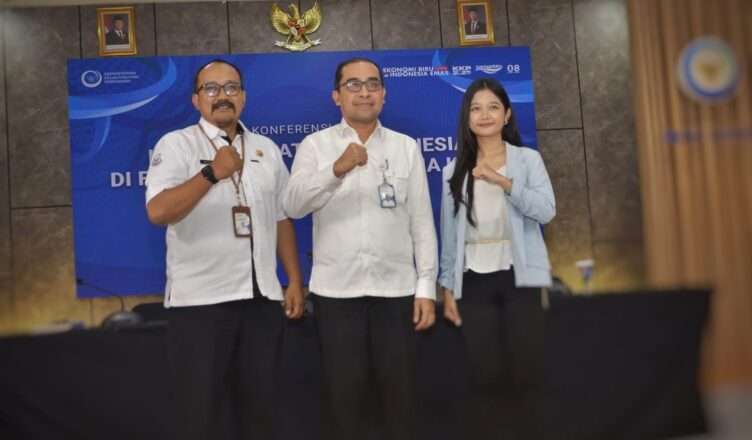
“This project is a tangible manifestation that Indonesia is not only committed but is also taking real steps to realize measurable fishing and sustainable ocean management,” stated Moh Abdi Suhufan, Expert Staff for the Protection of Fishermen and Fishing Vessel Crews.
Empowering the “Small” with High-Tech Tools
The “Blue Economy” is often discussed in high-level boardrooms, but its true success is measured on the decks of small-scale fishing vessels. In Fisheries Management Areas (WPP) 715, 717, and 718, technology is being deployed to foster resilient livelihoods. The modernization includes:
- GPS and Fish Finders: These aren’t just navigational aids; they are safety nets that reduce the life-threatening risks of the deep sea and ensure fathers spend less time searching for catch and more time with their families.
- Fuel Savers: A critical tool for lowering operational costs while simultaneously reducing the carbon footprint of the traditional fleet.
- e-Logbooks: The digitalization of catch records transforms a traditional trade into a data-driven enterprise.
The e-logbook, in particular, is a game-changer for financial inclusion. By creating a verifiable data trail of their yields, small-scale fishermen can finally access formal credit and insurance—the very pillars of a modernized Blue Economy that were once out of reach for the “small” player.
The Science-First Approach to Quotas
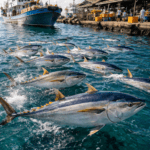
Indonesia’s transition to “measured” fishing is anchored in the Quota-Based Fishing (PIT) policy.
In a rare and bold move for a developing maritime nation, Indonesia is grounding its economic quotas in biological limits rather than political intuition.
This is achieved through rigorous collaboration with KOMNASKAJISKAN (the National Commission for Fisheries Resources Research), ensuring every quota is backed by evidence-based stock data.
This science-first approach is the cornerstone of the national Blue Economy agenda. As Lotharia Latif, DG Capture Fisheries MMAF, noted, the policy is a top priority that requires global partners who share a vision of sustainable growth.
“Global cooperation is very important so that we can realize SDG 14: A Clean and Sustainable Ocean,” emphasized Syahril Abd. Raup, Director of Fish Resource Management and National Coordinator of the CFI Indonesia Project.
A Fundamental Mindset Shift: Sea as Life, Not Just Resource
The most profound element of Indonesia’s maritime evolution is a philosophical one. The nation is transitioning from viewing the sea merely as a “resource” (Sumber Daya) to respecting it as a “source of life” (Sumber Kehidupan).
This shift is the vital guardrail that prevents the Blue Economy from becoming a new euphemism for industrial exploitation.
By viewing the ocean as a living system to be nurtured rather than a commodity to be consumed, Indonesia is creating inclusive and fair policies that protect the most vulnerable. This narrative of coexistence and innovation is the message Indonesia is carrying forward as it prepares for the 3rd United Nations Ocean Conference (UNOC3) in France this coming June.
Conclusion: Navigating Toward a Blue Future
As the GEF6 project matures toward 2026, Indonesia is already looking toward the GEF-9 cycle as its next frontier.
The nation is no longer just following a roadmap; it is carving a permanent seat at the head of the global maritime table, offering a model where technology and tradition don’t just coexist—they thrive.
As the “blue heart” of the planet begins to beat with a new, data-driven rhythm, the global community must decide.
Will the rest of the world follow Indonesia’s lead in treating the ocean as a source of life, or will they continue to treat the deep as an inexhaustible mine? The answer will define the legacy of our generation.
Reference: https://uritanet.com/2025/05/26/lewat-proyek-gef6-indonesia-pimpin-transformasi-perikanan-global/
Editor: K. Azis