









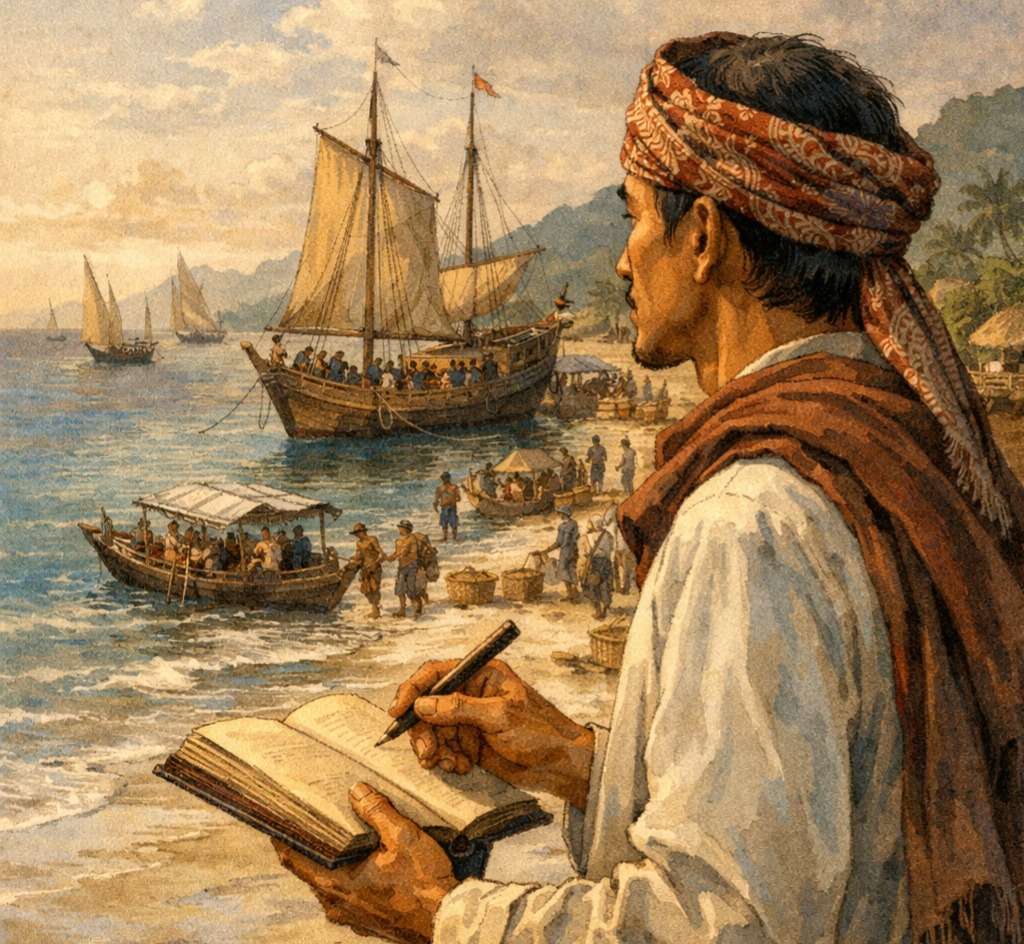
He hailed from the Wajo Kingdom on Sulawesi’s eastern coast and later established himself in the Gowa–Tallo Kingdom in the west, where he rose to prominence. Within this vibrant and cosmopolitan port setting, he emerged as a distinguished patron of commerce—celebrated for his acumen in organizing trade, maintaining rigorous systems of accounting, and managing complex transactions with foreign merchants.
MARITIMEPOSTS.COM – In the long history of maritime Southeast Asia, the seas were not empty spaces. They were highways of trade, zones of encounter, and sometimes arenas of conflict.
What made these vast waters function smoothly was not just ships or courage—it was law. Among the figures who understood this deeply was Amanna Gappa, a 17th-century thinker from South Sulawesi whose ideas helped organize life at sea.
Amanna Gappa lived during the height of the Gowa Kingdom, one of the most powerful maritime states in eastern Indonesia.
At a time when Makassar was a bustling international port—visited by traders from across Asia and beyond—he played a crucial role in shaping the rules that governed maritime trade.
Rather than relying on force or arbitrary decisions, he contributed to a structured system of law known as Ade’ Allopi-loping Bicaranna Pabbalué, or the laws of shipping and commerce.
What makes Amanna Gappa remarkable is that his legal system was both practical and fair. It clearly defined the roles and responsibilities of everyone on board a ship—from the captain to the crew and the merchants.
Profits were shared according to agreed rules, risks were distributed proportionally, and disputes were settled through established mechanisms. In this way, the sea became not a chaotic frontier, but a regulated and predictable environment.
This achievement becomes even more impressive when placed in global context. During the same period, European powers like the Dutch East India Company were expanding their influence in the region. Yet long before colonial legal systems took hold, local societies such as those in Gowa had already developed sophisticated frameworks to manage international trade.
Amanna Gappa’s work demonstrates that legal innovation was not exclusive to Europe—it was also thriving in the Indonesian archipelago.
Even after the fall of Makassar in the Makassar War, the influence of Amanna Gappa did not disappear. His maritime laws traveled with Bugis and Makassarese sailors as they migrated across the region.
From Sulawesi to the Malay world and beyond, these communities carried with them not only ships and goods, but also a shared legal culture that helped maintain order in distant ports.
The French anthropologist Christian Pelras highlights Amanna Gappa as a key example of indigenous intellectual achievement. He was not merely a figure of authority, but a thinker who understood the importance of rules, agreements, and accountability in sustaining a maritime society.
Today, Amanna Gappa can be remembered as more than a historical name. He was a lawgiver of the seas, someone who transformed maritime life through ideas rather than conquest. His legacy reminds us that the oceans connecting Indonesia were shaped not only by winds and currents, but also by human wisdom and a deep commitment to fairness.