








The Invisible Crisis Beneath the Heart of the Coral Triangle
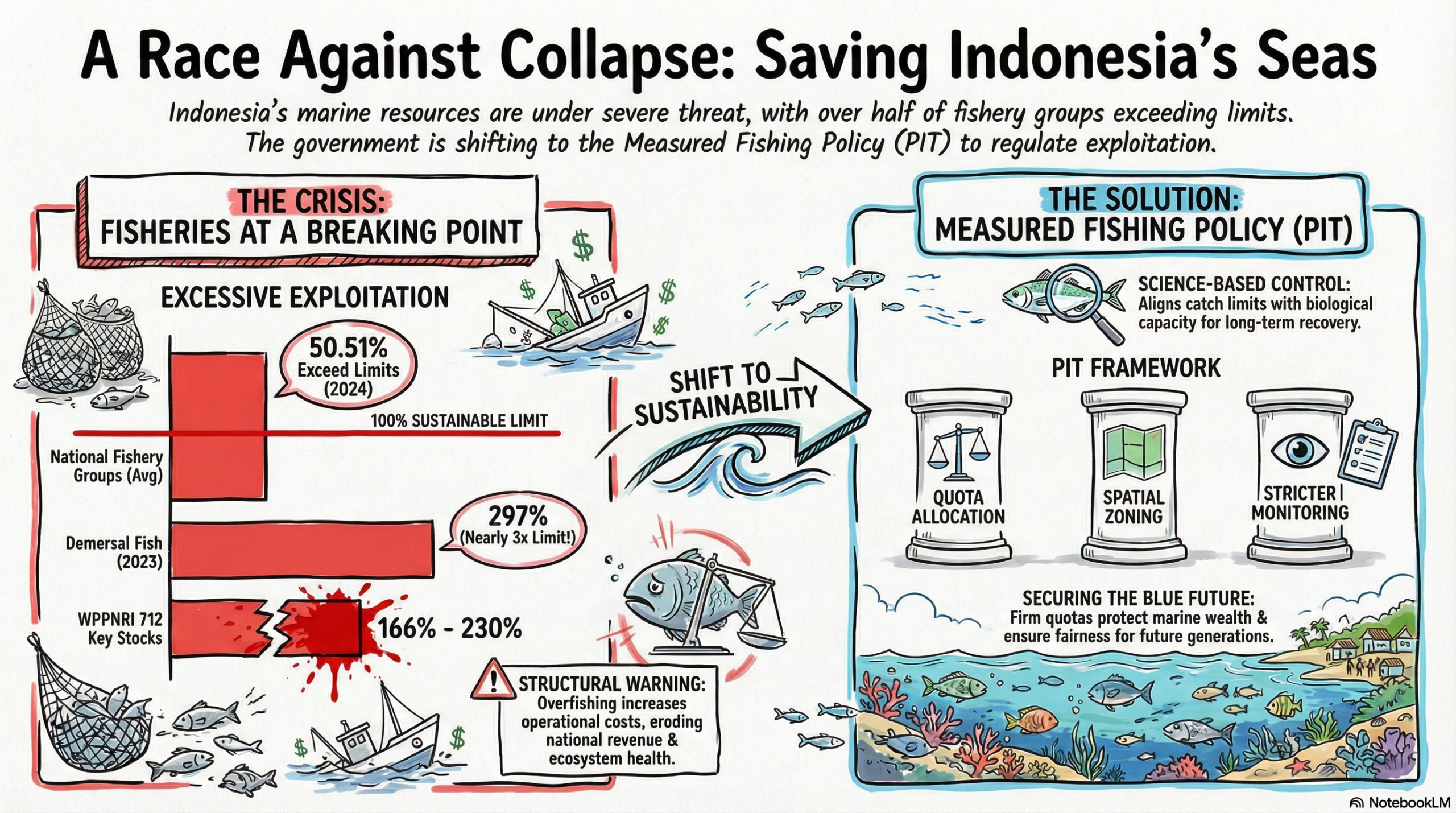
The latest 2024 evaluation from the KKP provides a portrait of an ecosystem under siege. Of the 99 fishery resource groups assessed across the archipelago, 50 groups—precisely 50.51 percent—have already exceeded 100 percent of their allowable catch, known locally as Jumlah Tangkapan yang Diperbolehkan (JTB).
MARITIMEPOSTS.COM – Indonesia is an archipelagic giant, a nation of over 17,000 islands stitched together by the most biodiverse waters on the planet.
For decades, it has stood as a global maritime powerhouse, the beating heart of the Coral Triangle and a primary provider of the world’s seafood. But beneath the turquoise surface, a quiet, systemic failure is unfolding.
We are no longer merely harvesting the ocean’s bounty; we are locked in a “Race Against Collapse.”
The reality is that we are now in the precarious position of having to save the ocean from ourselves. As global demand for protein surges, the biological limits of Indonesia’s seas are being pushed to a definitive breaking point.
To prevent a total ecological shuttering, the Ministry of Marine Affairs and Fisheries (KKP) is moving to implement a radical management shift: Measured Fishing (Penangkapan Ikan Terukur / PIT).
It is a transition that seeks to replace the “Wild West” of unregulated extraction with a sophisticated, data-driven architecture of survival.
The 50% Tipping Point: A Coin Toss for Sustainability
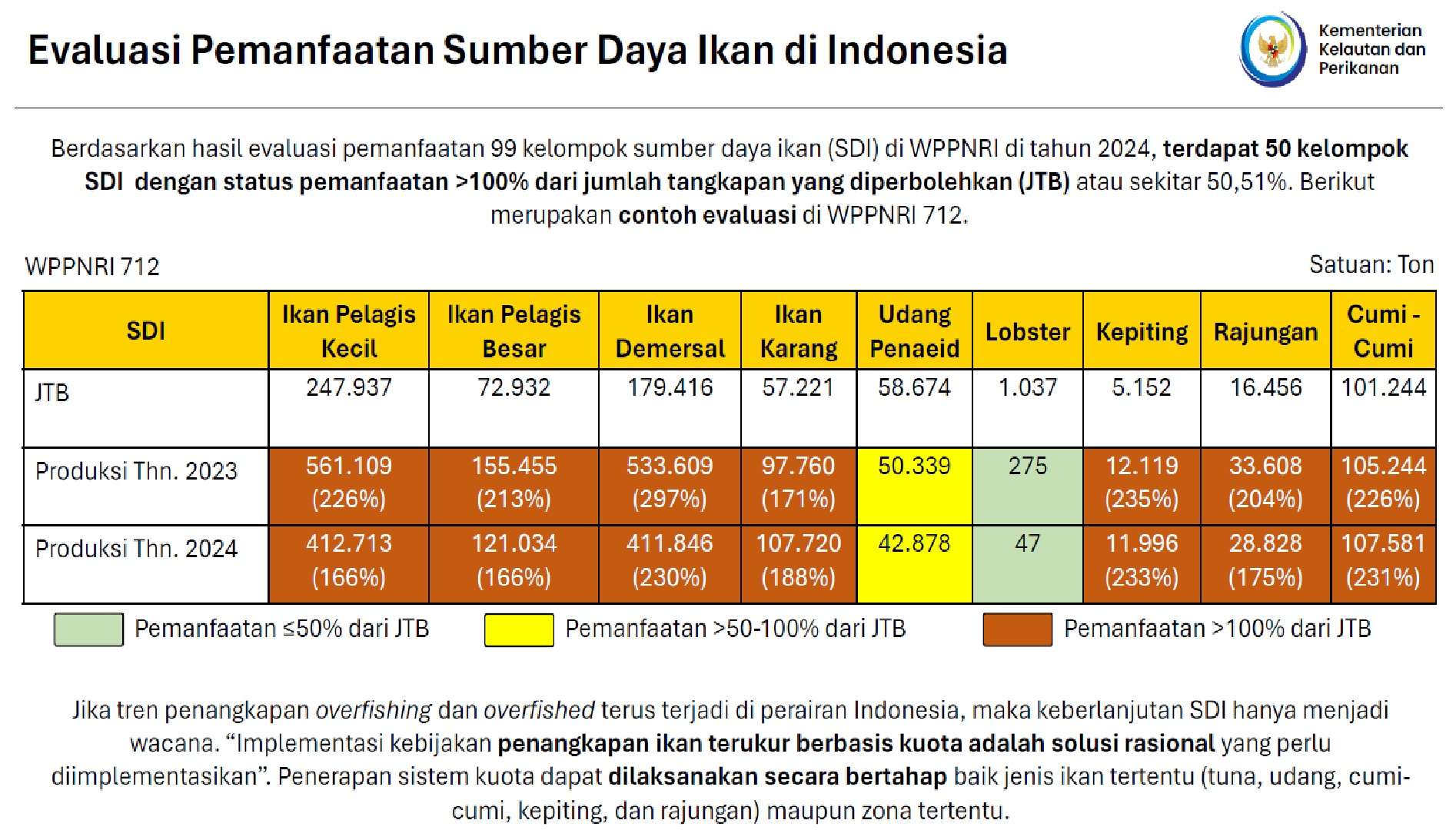
The latest 2024 evaluation from the KKP provides a portrait of an ecosystem under siege. Of the 99 fishery resource groups assessed across the archipelago, 50 groups—precisely 50.51 percent—have already exceeded 100 percent of their allowable catch, known locally as Jumlah Tangkapan yang Diperbolehkan (JTB).
This is not a statistical fluke or a localized anomaly; it is a coin toss where the ocean is losing every other time. When more than half of a nation’s fishery resources are being extracted beyond their natural capacity to regenerate, the crisis is no longer marginal—it is structural.
“This is not a marginal issue; it is a structural warning that the current model of fisheries utilization is pushing ecosystems beyond their capacity to recover.”
The 300% Factor: Ground Zero in WPPNRI 712
To see the “signal in the noise,” one must look at Fisheries Management Area (WPPNRI) 712. If Indonesia’s fisheries are under pressure, WPPNRI 712 is the epicenter of the strain.
The data reveals a sustained crisis of over-extraction: in 2024, stocks of small pelagic, large pelagic, and demersal fish are being harvested at 166 to 230 percent above sustainable thresholds.
This follows an even more staggering 2023, where demersal fish exploitation peaked at 297 percent of the allowable catch—nearly triple the sustainable limit.
This isn’t just a threat to local food security; it is a disruption of global supply chains.
The species under the most intense fire—reef fish, crab, squid, and blue swimming crab (rajungan)—are high-value commodities destined for dinner plates in North America, Europe, and East Asia.
The disparity between what the ocean can give and what we are taking has reached a level of ecological brinkmanship.
The Paradox of Effort: The High Cost of “Free” Fishing
There is a persistent economic myth that “open-access” fishing—where anyone can catch anything—is a boon for industry.
The KKP data reveals the opposite: the absence of control creates a “Paradox of Effort.” As fish populations vanish, boats are forced to travel further and stay out longer, burning more fuel and requiring more labor to find fewer, smaller fish.
This leads to a vicious cycle where operational costs skyrocket while the quality and value of the catch diminish.
What appears to be a short-term gain for an individual vessel is actually the steady erosion of national fisheries revenue. In the world of “free” fishing, the harder you work, the less you ultimately earn.
“Overfishing does not only reduce fish populations; it disrupts marine ecosystems… the absence of control today guarantees scarcity tomorrow.”
Ending the Era of Open-Access Exploitation
The transition to Measured Fishing (PIT) is an admission that the era of the frontier is over. PIT moves the needle from “open-access exploitation” to “controlled, sustainable use” through three primary pillars:
- Quota Allocation: Moving away from a “first come, first served” scramble to a science-based limit on total extraction.
- Spatial Zoning: Protecting sensitive habitats by managing where fishing happens, not just how much.
- Stricter Monitoring: Using technology to ensure that quotas are respected and the “race to the bottom” is halted.
By ending the unregulated race, PIT seeks to stabilize the market. Quotas aren’t just limits; they are the floor upon which a stable, long-term economy can be built.
The Survivors: A Blueprint in Lobster and Shrimp
In a landscape of systematic overfishing, there are rare glimmers of hope. The 2024 evaluation identifies a few outliers—specifically lobster and penaeid shrimp—that currently remain within or below safe exploitation limits.
These species are not just survivors; they are the potential blueprint for what a managed recovery could look like.
They represent a slim margin of opportunity to prove that proactive management can keep a stock healthy before it hits the 300 percent “danger zone.” If PIT is implemented successfully, these outliers could become the norm rather than the exception.
Beyond Rhetoric to Reality
The urgency of the PIT implementation is no longer a matter of policy debate; it is a matter of national survival.
If the current trajectory of over-extraction continues, “sustainability” will remain a hollow rhetorical device while the actual resource disappears. We have a real, if narrow, window to reverse these trends and protect Indonesia’s immense marine wealth.
The path forward requires a transition that is strategic, consistent, and grounded in the hard truths of the data.
As we stand at this crossing, we must confront the most uncomfortable truth of all: Can a nation built on the waves survive an ocean that has been emptied by its own hand?
Editorial Team