









Reflections on the Thoughts of Prof. Dr. H. Yuddy Chrisnandi, SH., SE., MM.
MARITIMEPOSTS.COM – Pancasila has long been established as the foundational ideology of Indonesia. It is not merely a normative formulation enshrined in the Preamble of the 1945 Constitution, but a guiding framework for collective life in a pluralistic society.
The fundamental question we must ask today is: to what extent is Pancasila truly internalized and practiced in everyday life?
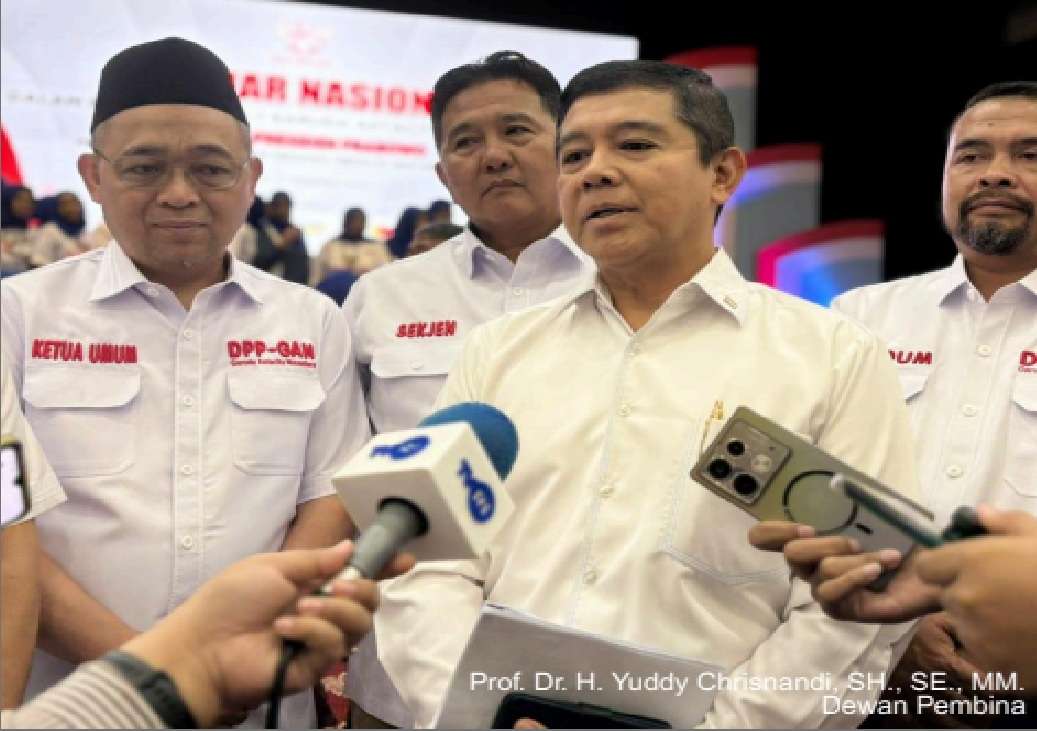
In his remarks, Prof. Yuddy Chrisnandi emphasized that the core problem of Pancasila does not lie in any conceptual or philosophical weakness, but rather in the widening gap between its values and their actual implementation.
Pancasila is often glorified in speeches and official documents, yet it has not fully become a lived collective ethic of the nation.
According to him, the key to implementing Pancasila lies in the most basic and immediate sphere of Indonesian life: the family.
The family is the cornerstone of Pancasila in practice. It is within this space that the values of Belief in One Almighty God, Humanity, Unity, Deliberation, and Social Justice are first introduced, exemplified, and passed on.
In this context, the role of the head of the family—particularly the father—is crucial. Exemplary conduct is the essence of ideological practice. Without real examples, Pancasila risks remaining a mere slogan.
The principle of belief in God should not only be memorized, but reflected in tolerance and consistent religious life.
Just and civilized humanity is demonstrated through care for others, starting within the family and extending to the broader community. National unity begins with the ability to maintain harmony at home. Deliberation grows from the habit of listening and respecting differing opinions. Meanwhile, social justice takes root from fairness practiced in the smallest units of society.
When these values fail to develop within the family, the failure spreads in layers to wider social structures—from neighborhood units to the state. Therefore, the lack of exemplary leadership, even at the most basic level, becomes a serious national concern.
Beyond the issue of role models, Prof. Yuddy identified several major challenges in implementing Pancasila. One of the most pressing is the persistent gap in social and economic inequality.
This disparity often leads lower-income groups to perceive Pancasila as unjust, while more privileged groups tend to delegate issues of justice entirely to the state. As a result, social solidarity weakens.
Another challenge is corruption and abuse of power. When justice is not upheld consistently—whether in the distribution of aid at the grassroots level or in merit-based systems at higher levels—the principle of social justice loses its substantive meaning. Pancasila then risks being reduced to a mere symbol rather than serving as a moral compass.
Equally concerning is the persistence of intolerance and the potential for identity-based conflict. Difficulties in establishing places of worship in certain regions highlight that the values of divinity and humanity have yet to be fully realized. This stands in stark contrast to the national motto, Bhinneka Tunggal Ika (Unity in Diversity).
Prof. Yuddy also pointed to the tendency toward a formalistic understanding of Pancasila. Education on Pancasila often stops at memorization and ceremonial practices.
In the past, however, Indonesia embraced a more substantive approach through the Guidelines for the Appreciation and Practice of Pancasila (P4), which emphasized internalization through discussion, practice, and reflection. The absence of such an approach today has diminished the vitality of Pancasila, particularly among younger generations.
In the digital era, the challenges have grown more complex. Social media—often saturated with misinformation, hate speech, and polarization—undermines the civic virtues that lie at the heart of Pancasila.
Young people consume information rapidly, often without verification. This fosters suspicion and negative perceptions, which contradict the spirit of humanity and unity.
Political pragmatism and the rise of identity politics further exacerbate the situation. Tolerance is frequently driven not by genuine value awareness, but by short-term interests. Respect for diversity is no longer rooted in recognition of human dignity, but in political calculation.
Above all, Prof. Yuddy stressed the urgent need to revive a healthy culture of dialogue and deliberation. Many public policies today are not the result of inclusive and participatory processes.
Yet, the nation’s founders demonstrated how differences can be managed through open dialogue and deliberation to reach consensus.
The accumulation of these challenges has prevented Indonesia from fully realizing itself as a welfare state.
Compared to countries with high human development indices—such as Finland, Sweden, Norway, Denmark, Canada, and New Zealand—the values they practice are, in fact, aligned with Pancasila: social justice, universal healthcare, quality education, and strong state protection for citizens.
Therefore, Prof. Yuddy concludes that a fully ideal implementation of Pancasila may still seem utopian. However, utopia is not a reason to give up.
The establishment of the Pancasila Ideology Development Agency (BPIP) is an important step, as is the role of civil society organizations in driving value-based movements at the grassroots level.
Through exemplary leadership, substantive value education, meaningful dialogue, and a genuine commitment to social justice, Pancasila can be revived—not only as a state ideology, but as a public ethic and a way of life.
From the household to the republic, from the family to the state—Pancasila must once again become the soul of Indonesia.
Jakarta, March 20, 2026
Muhammad Burhanuddin
Chairman
DPP Garuda Astacita Nusantara
___
Editor by Denun