








As the philosopher Saint Augustine once observed: “Di ketiadaan keadilan, apalah makna kedaulatan selain pencurian?” (In the absence of justice, what is sovereignty but theft?) For the people of Anambas, the next chapter of their history must be written with a focus on equity, ensuring that the wealth of the North Natuna Sea finally serves the hands that have guarded it for generations.
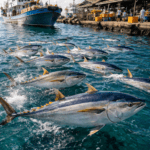
MARITIMEPOSTS.COM – To stand at the Tarempa Fish Market today is to witness a paradox of plenty. Tarmizi, a seasoned veteran of the Anambas fishing community, looks out over the water and recalls a far grimmer reality.
In the 1980s and through the era of Minister Freddy Numberi, these waters were a playground for foreign “garong”—maritime thieves from Thailand and Vietnam who plundered the archipelago’s riches with impunity.
Tarmizi remembers the frustration of watching national patrol boats, their numbers far too few, struggle to defend the frontier.
The captured ships were often merely towed to Kampung Antang or the Pelabuhan Perikanan Pantai (Coastal Fisheries Port) in East Tarempa, while dozens more remained on the horizon, invisible to the law but felt in every empty net.
The tide turned with a roar after 2014. Under a new national mandate of “sink the vessels,” the North Natuna Sea became a theater of uncompromising enforcement.
The sight of a few towed ships was replaced by the spectacle of over 300 foreign vessels being captured, burned, and blown apart. Sovereignty, long a theoretical concept in these remote reaches, was finally etched in smoke and fire.
Yet, as the international pirates vanished, a haunting irony emerged. The fish are back, teeming in numbers not seen in decades, but the prosperity promised by their return remains elusive.
For the people of Anambas, the departure of the foreign “garong” has been followed not by local wealth, but by a tangle of domestic industrial encroachment and paralyzing bureaucracy. The “bad old days” of foreign theft have been replaced by a modern, domestic struggle for survival.
From Foreign “Garong” to Domestic Giants: The New Sovereignty Gap
The victory over foreign poachers has revealed a gaping hole in how Indonesia manages its domestic waters. Tarmizi observes that while the Vietnamese and Thai flags have disappeared, they have been replaced by a different kind of titan: large-scale domestic purse seine vessels from provinces like North Sumatra.
These ships, often exceeding 30 gross tons (GT), possess technology and harvesting power that dwarf the traditional armadas of Anambas.
For a local fisherman, “sovereignty” is a hollow victory if traditional fishing grounds are simply handed over to domestic industrial players who disregard local boundaries.
Tarmizi, active in the local fishers’ union, views this as a new form of injustice—one where the local “home” waters are encroached upon by those with the capital to bypass the struggles of the small-scale fisher.
As Tarmizi poignantly pleaded during a recent discussion:
“Janganlah masuk ke zona yang selama ini jadi wilayah tangkapan tradisional atau nelayan-nelayan kecillah. Mana sangguplah kami?” (Do not enter the zones that have long been traditional or small-scale fishing grounds. How can we possibly compete?)
The “Ketipas” Crisis: 160,000 Fish Caught in a Regulatory Net
Perhaps no issue illustrates the disconnect between international policy and local reality better than the Napoleon Wrasse, known locally as Ketipas.
For generations, the Ketipas was the economic heartbeat of Anambas. It was a “home-grown” side hustle so integrated into the community that even schoolchildren would head to the docks after class to catch juveniles. These seeds, sold for 100,000 to 150,000 IDR each, provided a vital supplement to household incomes.
Today, that engine has stalled. The intersection of CITES regulations, IUCN endangered classifications, and rigid national export bans has created a logistical nightmare.
Currently, an estimated 146,000 to 164,000 Napoleon fish are effectively held hostage in local cages. They have been raised to harvestable size by families who invested their last remaining capital, yet they cannot be exported to the high-value markets of Hong Kong or Singapore.
In areas like Air Sena, the “derita nelayan” (suffering of the fishermen) is palpable. While conservationists in Jakarta or Geneva celebrate the protection of the species, the families of Anambas see their traditional livelihood paralyzed by a regulatory net that offers no alternative for survival.
The “Simalakama” of Maritime Logistics
Bupati Abdul Haris describes the current regulatory environment as a “Simalakama”—an impossible choice where every path leads to a loss. This Catch-22 is driven by rigid licensing and a lack of logistical common sense that punishes the very islanders it should protect.
The “Lose-Lose” scenario manifests in the following logistical hurdles:
- Vessel Segregation: National regulations mandate that fish be transported only on specialized fish-carrying vessels, strictly prohibiting the use of general cargo ships.
- The Return Trip Penalty: When a vessel is licensed to carry fish to mainland hubs like Tanjung Pinang, it is legally barred from carrying general goods—sembako (essential food items)—back to the islands.
- Legalized Ruin: Bringing back essential supplies on a fish vessel is a violation of the law. Traders are thus forced to sail back with empty holds, a practice that is financially ruinous and drives up the cost of living for every resident in the archipelago.
The “Shrinking” Sea: A Jurisdictional Squeeze
The implementation of Law No. 23/2014 has introduced a “jurisdictional squeeze” that has left local leaders like Abdul Haris feeling like spectators in their own territory. The law transferred authority over the sea from 0 to 12 miles—the vital near-shore zone—from the Regency (Kabupaten) to the Provincial government.
For Haris, the sea hasn’t physically moved, but it has “narrowed” in terms of agency. When social conflicts erupt between local fishers and the massive armadas from Belawan or elsewhere, the local government finds itself legally “powerless.” They can communicate and coordinate, but the actual authority to manage and protect their “home” waters now sits hundreds of miles away at the provincial level. This centralization increases the risk of social conflict and leaves isolated communities feeling abandoned by the state.
The Potential of the North Wind: Tenggiri and the Future
Despite these man-made hurdles, the natural bounty of Anambas remains staggering. The potential for Mackerel (Tenggiri) is particularly immense, especially during the treacherous “North Wind” (Musim Utara) season.
Local records suggest a staggering potential of up to 41,000 tons of fish recorded every five days during peak seasonal windows.
However, the North Wind is a double-edged sword. The waves are often too dangerous for the small, traditional boats that dominate the local fleet. To mitigate these risks and transition away from the uncertainties of wild-capture fishing, the local government is championing “low-risk” aquaculture:
- Seaweed and Pearls: Targeted for development in areas like Air Asu and Bayat, these are viewed as the future of the local economy.
- The Seed Subsidy: Bupati Haris envisions large-scale hatcheries and seed subsidies to empower the community to become farmers of the sea rather than just hunters.
Beyond the Horizon of Sovereignty
The Anambas experience serves as a stark reminder that true maritime sovereignty requires more than just sinking foreign boats—it requires “justice in management.” While Indonesia has asserted its rights under the Djuanda Declaration and UNCLOS 1982, that national strength must be “doubled” by investing in local technology, infrastructure, and flexible regulations.
We must ask ourselves: if the regulations designed to protect our maritime resources end up paralyzing the very communities that serve as our first line of defense, who is the sovereignty for?
As the philosopher Saint Augustine once observed: “Di ketiadaan keadilan, apalah makna kedaulatan selain pencurian?” (In the absence of justice, what is sovereignty but theft?) For the people of Anambas, the next chapter of their history must be written with a focus on equity, ensuring that the wealth of the North Natuna Sea finally serves the hands that have guarded it for generations.
___
Author Kamaruddin Azis (Social Development Specialist)
This report is based on a fisheries assessment conducted by Destructive Fishing Watch Indonesia in collaboration with Medco Indonesia (2017).