







PELAKITA.ID – The ocean stretches before us as an endless blue expanse, its surface shimmering beneath the golden kiss of the sun. To those watching from the shore, the gentle sway of waves offers a peaceful illusion.
However, this serenity is merely a fragile veil—a thin skin stretched across a vast, restless abyss that dwarfs the human imagination.
Beneath the surface, the ocean is far more than a body of water; it is a colossal geological engine and a living entity that breathes in waves and whispers in storms.
For those who venture into its most extreme regions, the line between challenge and danger becomes razor-thin, and the crushing reality of nature’s raw power is revealed in its most violent forms.
1. Cape Horn: The Sailors’ “End of the World”
At the southernmost tip of South America lies Cape Horn, a place known for centuries as the “end of the world.”
This is the meeting point where the Atlantic and Pacific oceans clash endlessly, their opposing currents and winds creating a storm corridor unlike anywhere else on the planet.
The geography here conspires against the brave; towering cliffs and narrow channels funnel winds into furious gusts that exceed 200 km/h.
In these waters, the sea churns with a wild, chaotic energy. Walls of water crash against steel hulls with the force of collapsing cliffs, and rogue waves appear without warning, capable of swallowing entire vessels.
For mariners, this region represents the ultimate threshold between the known, charted world and the endless, frozen wild of the south. Those who survive the passage earn the traditional right to wear an earring in their left ear—a symbol of having looked into the heart of the ocean and lived to tell the tale.
“The old sailors of wooden ships once said the ocean here had a voice—a roar that could be heard long before the storm arrived.”
2. The Pacific Ring of Fire: A Heartbeat of Chaos
The Pacific Ocean spans 165 million square kilometers, yet its name—meaning “peaceful”—is a profound paradox. Beneath its surface lies a restless world where colossal natural forces are in constant motion.
The region is defined by the Pacific Ring of Fire, a fiery belt where four massive tectonic plates collide and grind. This system is responsible for 75% of the world’s active volcanoes and 90% of its earthquakes.
This geological engine produces giants like the Tamu Massif, the largest underwater volcano ever discovered. Standing three times the size of New Mexico and formed 145 million years ago, it remains one of the most significant unexplored structures on Earth.
The power of this “forge of destruction” was recently demonstrated by the Hunga Tonga-Hunga Ha’apai eruption in 2022, which sent shockwaves circling the planet and plumes reaching the edge of space.
While the geology shifts below, the atmosphere rages above. Fed by tropical heat, the northwestern Pacific is a breeding ground for super typhoons like Haiyan, Goni, and Mangkhut.
These atmospheric monsters spin with winds exceeding 300 km/h, while underwater earthquakes trigger tsunamis that travel faster than a jet plane. This living system also governs the global climate through the El Niño and La Niña cycles, proving that the Pacific’s “breath” influences the entire planet.
3. The Mariana Trench: Survival Under the Weight of 50 Jumbo Jets
In the remote Western Pacific, the Mariana Trench forms a colossal wound in the planet’s crust. Stretching nearly 2,550 km in length and 70 km in width, its walls are so steep they resemble the cliffs of a drowned world.
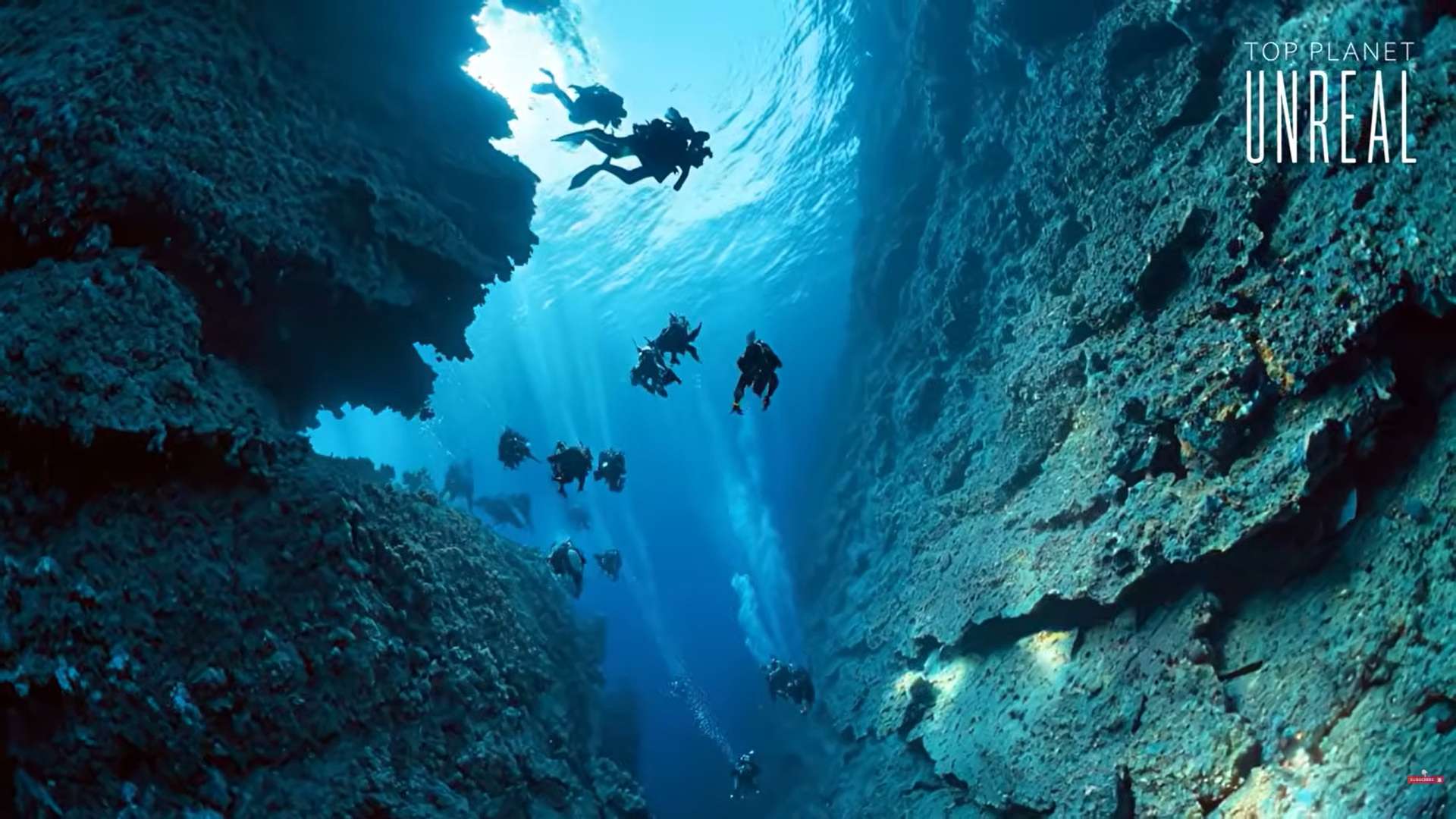
At its heart, the Challenger Deep plunges more than 11 kilometers down. To stand at the bottom would be the equivalent of having the weight of 50 jumbo jets piled onto a single human body, with a pressure of 1,086 bars.
In this absolute, ancient darkness, vision is nearly useless, replaced by senses attuned to movement, vibration, and chemical signals. Life here survives on “marine snow”—a rain of organic debris—and the “chemical cocktails” of hydrothermal vents and mud volcanoes.
Creatures like the gelatinous snailfish and giant single-celled foraminifera have remained unchanged for millions of years, thriving in a Hadel zone that challenges our very definition of biology.
These organisms suggest that life may exist in the dark, pressurized oceans of distant stars.
“If Mount Everest were placed here, its peak would still be submerged by more than a mile of water.”
4. Antarctica’s Invisible Killers: Catabatic Winds and Hidden Crevasses
The waters surrounding Antarctica form a wilderness shaped by cold silence and relentless danger. At the land-sea interface, the environment is dominated by catabatic winds, born from cold air sliding down high glaciers and gaining lethal speed as they fall.
When combined with blizzards, they create “whiteouts” that erase the horizon and turn familiar ground into a disorienting maze in seconds.
The danger extends to the Southern Ocean, where the sea is littered with icebergs—the massive, silent “shadows of the sea.”
Beneath the explorers’ feet, glaciers groan and crack with deep thunderous echoes, hiding narrow crevasses that fall hundreds of meters into the ice. Despite these threats, Antarctica possesses a strange magnetic allure.
Its silence and emptiness invite profound questions about the ancient history of our planet, standing as a world that keeps its secrets close.
5. The Atlantic’s Growing Fury: A Modern Warning
The North Atlantic is nature’s most unforgiving arena, a stage for endless disasters where cold and warm currents collide.
These are the unpredictable waters that claimed the Titanic and continue to conceal countless wrecks beneath an icy veil. Further south, the Mid-Atlantic Ridge acts as the “heartbeat of the planet,” a place of hidden volcanoes and shifting plates that can trigger tsunamis across thousands of kilometers.
Today, the Atlantic is providing a modern warning. As climate change warms its waters, hurricanes are forming faster and reaching monstrous intensity in record time, with winds screaming at more than 250 km/h.
Mariners must contend with “fog thicker than death” and “lightning like veins of fire” as the ocean’s mood becomes more violent with every passing year. The Atlantic is not merely an ocean; it is a living entity breathing in waves and whispering in storms.
“The Atlantic is a living entity, reminding us again and again that Earth’s greatest power lies not in what we can see, but in what waits beneath the surface.”
Conclusion: The Last Word Belongs to the Sea
The ocean remains the ultimate frontier, a realm where nature does not merely exist but reigns supreme.
From the storm-lashed rocks of Cape Horn to the crushing silence of the Mariana Trench, these extreme seas remind us that discovery has always demanded facing the forces that challenge us most.
As we continue to push the boundaries of exploration, we are left with a haunting question: Are the answers to our place in the universe hidden in the silence and weight 11 kilometers below? Or are we fundamentally unprepared for an ocean that is becoming more violent and unpredictable with every passing year? In the end, the sea still holds the last word.
Source: