








MARITIMEPOSTS.COM – As the world’s population continues to grow and wild fish stocks face increasing pressure, aquaculture has emerged as one of the most critical sectors in global food production.
No longer a secondary industry, fish farming now supplies more than half of the seafood consumed worldwide.
At the center of this transformation are a group of countries that have mastered the balance between scale, technology, and market access—becoming the true powerhouses of global aquaculture.
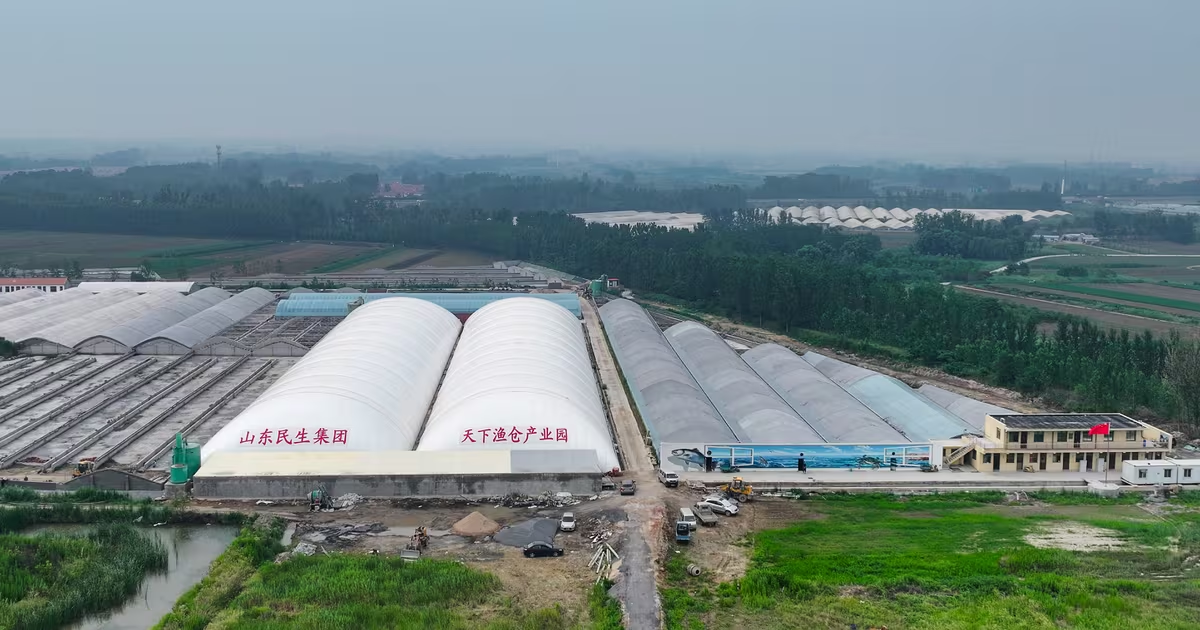
At the forefront stands China, the undisputed giant of aquaculture. Producing more than half of the world’s farmed seafood, China’s dominance is built on massive scale, diversified species cultivation, and strong state support. From freshwater carp to seaweed and shellfish, China has turned aquaculture into a cornerstone of its food security and export economy.
Following behind is India, whose rapid growth has been driven largely by its booming shrimp industry. With strong export ties to Western markets, India has successfully transformed aquaculture into a major source of rural income and foreign exchange.
Similarly, Indonesia has emerged as a global leader, particularly in shrimp, seaweed, and tropical fish farming.
Blessed with vast coastlines and rich marine ecosystems, Indonesia holds immense potential to further expand its influence in the sector.
In Southeast Asia, Vietnam has carved out a powerful niche as a leading exporter of pangasius and shrimp. Its highly export-oriented industry, combined with increasing technological adoption, has made Vietnam a formidable competitor in global seafood markets. Meanwhile, Thailand, once a dominant shrimp exporter, continues to play a significant role despite facing challenges from disease outbreaks and rising competition.
Beyond Asia, aquaculture power takes on a more technology-driven form. Norway stands as a global benchmark for high-tech, sustainable aquaculture, particularly in Atlantic salmon farming.
With advanced monitoring systems, strict regulations, and a focus on environmental sustainability, Norway has set global standards for quality and traceability. In the Southern Hemisphere, Chile mirrors this success as one of the world’s largest salmon exporters, supplying key markets across North America, Europe, and Asia.
Elsewhere, aquaculture plays a vital role in food security. Bangladesh has developed a robust freshwater aquaculture sector centered on carp and tilapia, supporting millions of small-scale farmers. Similarly, Egypt has become Africa’s largest aquaculture producer, relying heavily on tilapia farming to meet domestic demand.
Meanwhile, Ecuador has rapidly risen as a global shrimp powerhouse, known for its efficiency and strong export growth, particularly to Asian markets.
What distinguishes these countries is not merely their production volume, but their strategic positioning within the global seafood system.
Some, like China and Indonesia, rely on scale and natural resources. Others, like Norway, lead through innovation and sustainability. Meanwhile, export-driven nations such as Vietnam and Ecuador thrive on efficiency and global market integration.
For Indonesia, the future holds significant promise. With its vast maritime territory and favorable climate, Indonesia has all the ingredients to become one of the world’s top aquaculture producers.
However, unlocking this potential will require continued investment in infrastructure, technology, and governance to ensure both productivity and sustainability.
In the decades ahead, aquaculture will play an increasingly central role in feeding the world. As these leading nations continue to innovate and expand, the competition for dominance in this sector will intensify. Yet one thing remains clear: the future of global food security will not only be grown on land—but cultivated beneath the surface of the sea.
Editorial Team