







“The land, waters, and natural resources contained therein are controlled by the state and utilized for the greatest prosperity of the people.”
(Article 33 Paragraph 3 of the 1945 Constitution)
MARITIMEPOSTS.COM – To realize the vision of the ocean as the nation’s future, the issue of Illegal, Unreported, and Unregulated (IUU) fishing must be seen as a shared responsibility. It must be addressed by rebuilding Indonesia’s marine and fisheries sector based on the principles of sovereignty, sustainability, and prosperity.
These three principles are the pillars of Indonesia’s marine and fisheries development and are interconnected—they cannot stand alone.
As envisioned by all stakeholders, the pillar of prosperity—currently being constructed by the government through the Ministry of Marine Affairs and Fisheries—can be understood as an effort to develop the marine and fisheries sector as a response to the state’s objective as mandated in the fourth paragraph of the Preamble to the 1945 Constitution, namely “to promote the general welfare.”
The prosperity of the Indonesian nation can only be achieved when sovereignty is upheld and sustainability is maintained.
When Indonesia fully exercises sovereignty over its marine resources and ensures their availability, the nation can optimally utilize the ocean “for the greatest prosperity of the people.”
For 70 years since independence, Indonesia’s development has largely focused on land-based natural resources. Yet nearly 70 percent of Indonesia’s territory is ocean, rich in potential. Efforts to achieve prosperity must also reflect the principle of “social justice for all Indonesians.”
Therefore, development in the marine and fisheries sector must improve the welfare of all Indonesians, particularly small-scale fishermen, who make up the majority of capture fisheries actors.
Prosperity is not merely about increasing income; it also encompasses improvements in all aspects of fishermen’s lives, including “human security,” which covers a healthy environment, adequate healthcare, proper education, and protection from human rights violations. The government, through the Ministry of Marine Affairs and Fisheries (KKP), continues to work collaboratively to improve fishermen’s welfare through pro-people programs in synergy with other ministries, institutions, and the banking sector.
Policy Programs Supporting the Protection and Welfare of Small-Scale Fishermen
Licensing Process
Simplification of complex licensing procedures for small-scale fishermen with vessels under 10 GT. They are allowed to operate freely by simply registering and regularly reporting their catch.
Fishing Vessel Assistance
Annual provision of fishing vessels and equipment. In 2016, the government targeted distributing 1,719 vessels, with 754 units realized through fishermen’s cooperatives, along with training programs. In 2017, assistance was projected at 1,068 vessels.
Fishing Gear Assistance
In 2016, the Ministry distributed 2,738 fishing gear units to 170 cooperatives across 85 districts/cities. The gear types were environmentally friendly and adapted to fish resource potential, including hand lines, pole-and-line, gillnets, traps, and longlines. Replacement gear for cantrang was provided only for vessels under 10 GT. In 2017, assistance was projected at 2,990 units.
Insurance
Implementation of a fishermen’s insurance program. In 2016, 600,000 fishermen were targeted. The program prioritizes fishermen with vessels under 5 GT. Compensation includes:
- Death (fishing activity): IDR 200 million
- Permanent disability: IDR 100 million
- Medical expenses: up to IDR 20 million
- Non-fishing death compensation: IDR 160 million
Access to Capital
Collaboration with the Financial Services Authority (OJK) through the “Jaring” program and expansion of microcredit (KUR) since 2015. By September 2016, credit distribution reached IDR 23.2 trillion with a low non-performing loan ratio of 2.2%.
Strengthening Fisheries Extension Workers
Enhancing the role of extension workers as consultants and facilitators to improve productivity, quality, and efficiency in fisheries businesses.
Integrated Maritime Village Program (Sekaya Maritim)
A program targeting 1,000 fishing villages across Indonesia to alleviate poverty through integrated support, including sanitation, housing, and economic development.
Fisher Card / Fuel Card
A digital system developed with Bank BRI to manage subsidized fuel distribution transparently and prevent misuse.
Capture Fisheries for Indonesians
Foreign ownership is allowed in processing industries but 0% in capture fisheries, ensuring that fishing activities are reserved exclusively for Indonesian fishermen.
Welfare Indicators of Coastal Communities
Production
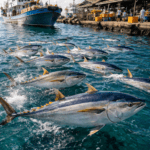
Total fisheries production reached 23.5 million tons in 2016, with aquaculture contributing 16.68 million tons and capture fisheries 6.48 million tons. The fisheries sector GDP grew from IDR 189 trillion (2014) to IDR 214.52 trillion (2016).
Consumption
Fish consumption increased from 35.21 kg per capita (2013) to 41.11 kg (2015), with a 2017 target of 47.12 kg per capita. Eastern Indonesia shows higher consumption compared to Java and Bali.
Exports and Imports
Fisheries exports reached USD 4.17 million in 2016. Indonesia became the largest fisheries exporter in ASEAN by 2016 and ranked sixth globally.
Fishermen’s Welfare
The Fishermen’s Terms of Trade (NTN) reached 111 in June 2017, indicating improved welfare. The Fishermen’s Business Exchange Value (NTUN) rose to 124, showing increased profitability.
State Revenue
Non-tax state revenue (PNBP) from fisheries reached IDR 462 billion in 2016—the highest ever recorded.
Developing Coastal MSMEs
Product Certification
Encouraging MSMEs to obtain certifications such as SKP, SNI, PIRT, and BPOM approval to ensure product safety and quality.
Business Management Assistance
Fisheries extension workers assist MSMEs in improving business management, accessing financing, and expanding partnerships. In 2016, 200 assistant extension workers were deployed to support 20,000 businesses.
Inclusive and Fair Fisheries Business
The government launched the National Fisheries Industry Acceleration Program (Presidential Instruction No. 7/2017), focusing on:
- Processing industry development
- Sustainable aquaculture
- Regulatory reform
- Financing and institutional strengthening
- Spatial planning
- Sustainable capture fisheries
In 2017, three key initiatives were introduced:
- Integrated Marine and Fisheries Centers (SKPT) in outer islands
- Fisheries modernization centers
- Supporting infrastructure such as ports and cold storage
Overall, these efforts aim to create a self-reliant, competitive, and sustainable fisheries sector, ensuring improved income and welfare for coastal communities across Indonesia.
Editor: K. Azis
Source: Laut Masa Depan Bangsa (2018)