






“The mission of prosperity will not be achieved if sovereignty and sustainability are ignored.”
— Susi Pudjiastuti
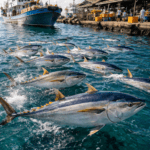
MARITIMEPOSTS.COM – Indonesia’s capture fisheries industry has grown rapidly since the 1970s. Along with this growth, the number of fishing vessels has continued to increase, eventually exceeding the environmental carrying capacity.
As a result, fish resources have steadily declined. The greater the number of fishing fleets, the higher the competition and the faster the rate of fish resource extraction. Ultimately, this has led to declining fish catch production.
Indonesia’s strategic role as one of the world’s largest suppliers of fishery products is increasingly threatened by widespread Illegal, Unreported, and Unregulated (IUU) fishing, as well as environmentally destructive fishing practices that have significantly reduced fish populations in Indonesian waters.
It is therefore time to manage marine and fisheries resources in a sustainable and responsible manner. The Government of Indonesia, through the Ministry of Marine Affairs and Fisheries (KKP), has established sustainable marine and fisheries governance policies through several ministerial regulations. KKP began combating illegal fishing through the moratorium policy on ex-foreign vessels and the prohibition of transshipment at sea.
The fight against IUU fishing is not unique to Indonesia. Countries such as the United States and Somalia have previously declared strong opposition to IUU fishing. In Indonesia, these efforts have received support from the European Union, ambassadors of partner countries, international organizations, the navy, and the police. KKP even categorizes illegal fishing as a national disaster due to the significant economic, ecological, and social damage it causes.
Most illegal fishing activities in Indonesia’s Fisheries Management Areas (WPP-NRI) are carried out by foreign-flagged fishing vessels or former foreign vessels with capacities exceeding 30 gross tons (GT). These vessels account for approximately 20 percent of all vessels above 30 GT operating in Indonesian waters, totaling around 1,605 ex-foreign vessels. The actual number may be even higher, as one vessel permit can reportedly be duplicated up to five times.
Indonesia’s anti-IUU fishing policies are estimated to reduce fishing pressure by 35 percent and increase long-term fish catches, provided domestic fishing efforts are well managed. If anti-IUU policies are implemented consistently alongside fisheries reforms, fish production could increase by up to 25 percent. Based on this rationale, KKP remains committed to eradicating illegal fishing and implementing comprehensive marine and fisheries reforms.
According to Law No. 45 of 2009 on Fisheries, fisheries development in Indonesia has dual objectives: improving the welfare of fishing communities while preserving fish resources. In other words, fisheries development must balance economic growth with equitable distribution and sustainability. This is the mission that KKP seeks to implement earnestly.
Under the sustainability paradigm, fish resource assessments are no longer based solely on economic indicators. Instead, sustainability evaluations incorporate multiple dimensions, including:
- ecological aspects
- economic aspects
- social aspects
- technological aspects
- ethical considerations
- institutional frameworks
These six aspects collectively determine whether fishing activities in a given region are sustainable.
Cantrang: A Challenge for National Fisheries
Environmental degradation in fisheries—including damage to mangrove ecosystems, coral reefs, and open marine ecosystems—is common in developing countries, particularly in Southeast Asia, including Indonesia and Thailand. This situation is often caused by weak governance and oversight of fishing practices, compounded by relatively high poverty levels in coastal communities.
In response, the Indonesian government has issued various regulations aimed at preserving fish resources and prohibiting destructive fishing practices.
One of the earliest measures was Presidential Decree No. 39 of 1980, which mandated the gradual elimination of trawl nets. The policy aimed to reduce the number of trawl vessels operating in Indonesian waters and protect small-scale fishers while minimizing ecosystem damage.
However, many fishers adapted by modifying fishing technologies, often creating locally named gear that functions similarly to trawls, even if not officially categorized as such.
Therefore, Ministerial Regulation No. 2 of 2015, which prohibits the use of trawls and seine nets in Indonesian fisheries management areas, was essentially a continuation of earlier policies.
Examples of Relevant Regulations
- Presidential Decree No. 39/1980 – Gradual elimination of trawl nets.
- Law No. 31/2004 on Fisheries – Regulation of catch limits and fishing gear.
- Law No. 45/2009 – Revision to adapt to technological and legal developments.
- Government Regulation No. 60/2007 – Conservation of fish resources.
- Ministerial Regulation No. 57/2014 – Regulation of capture fisheries operations.
- Ministerial Regulation No. 2/2015 – Ban on trawls and seine nets.
Cantrang Fishing Gear
Cantrang is a variant of trawl gear consisting of a bag-shaped net with two panels, without a mouth-opening device. It is widely used along the northern coast of Java, where approximately 97.8 percent of Indonesia’s cantrang vessels operate in the Java Sea.
The average mesh size of cantrang nets is about 1.5 inches, smaller than the minimum 2-inch mesh size required by regulations. Such small mesh sizes capture juvenile fish that have not yet reproduced, threatening fish population sustainability.
Cantrang also causes serious social and ecological impacts:
- Non-selective catch – capturing fish, shrimp, crabs, and other marine organisms of all sizes.
- Discarded bycatch – distorts fisheries data and reduces stock assessment accuracy.
- Habitat destruction – dredges seabed spawning areas and damages coral ecosystems.
- Resource depletion – forces fishers to travel farther, increasing operational costs.
Studies indicate that fish production declined 45 percent between 2002 and 2007 due to cantrang use.
Conflicts among fishers have also occurred due to cantrang operations, including incidents in East Kalimantan, Asahan, Nagan Raya, and Jakarta waters, where vessels were burned or protests erupted over declining fish stocks and unfair competition.
Controlling Lobster, Crab, and Blue Swimming Crab
Many fishers capture juvenile lobsters, crabs, and egg-bearing individuals because they command higher market prices. However, this practice threatens population sustainability.
In some Indonesian waters, lobster populations have declined dramatically. Two decades ago, fish markets in Pangandaran, Cilacap, Banyuwangi, and Pacitan could collect up to 2 tons of lobster per day. Today, lobster availability has dropped by around 90 percent.
To address this issue, KKP issued Ministerial Regulation No. 1 of 2015, which regulates the capture of:
- Lobster (Panulirus spp.)
- Mud crab (Scylla spp.)
- Blue swimming crab (Portunus pelagicus)
The regulation prohibits capturing egg-bearing individuals and juveniles.
Minimum size requirements:
- Lobster: 8 cm carapace length
- Crab: 15 cm carapace width
- Blue swimming crab: 10 cm carapace width
Allowing these species to grow and reproduce ensures long-term sustainability and greater economic benefits for fishers.
Why Are Reef Fish Regulated?
Regulatory reform in fisheries management is a major focus of KKP. Fisheries licensing must support responsible and sustainable resource management.
Special attention is also given to live fish export mechanisms, which previously allowed manipulation through transshipment at sea, mixing legally farmed fish with illegally caught fish.
To address this issue, KKP issued Ministerial Regulation No. 15/2016 on Live Fish Carrier Vessels, later amended by Regulation No. 32/2016.
The regulation establishes clear rules regarding:
- vessel permits (SIKPI)
- port requirements
- vessel size limits (maximum 500 GT)
- restrictions on foreign-flagged vessels
These rules aim to strengthen fisheries governance and protect Indonesia’s maritime sovereignty.
The Future of Aquaculture
Indonesia has approximately 12 million hectares of potential marine aquaculture areas, yet only about 285,527 hectares (2.36 percent) are currently utilized.
By the end of 2016, aquaculture production reached 11.76 million tons, representing a 4 percent increase from the previous year.
One of KKP’s priority programs is the development of offshore floating cage aquaculture (KJA offshore), inspired by technology used in Norway and recommended by FAO.
Pilot projects are planned in:
- Karimunjawa Islands
- Pangandaran
- Sabang
The selected species is barramundi (Asian seabass) due to strong export demand.
Feed Independence Program
Fish feed represents more than 70 percent of aquaculture production costs, making it a critical issue.
Indonesia’s GERPARI (Independent Feed Movement) program promotes locally produced fish feed. Between 2015 and 2016, independent feed production increased from 16,800 tons to 62,100 tons, a 300 percent increase.
The program also reduced fish feed raw material imports by 27 percent.
The initiative is supported by the Food and Agriculture Organization (FAO), which has allocated funding for technical cooperation projects aimed at strengthening Indonesia’s independent feed production capacity.
Conclusion
Through integrated policies—ranging from combating illegal fishing to promoting sustainable aquaculture—Indonesia aims to ensure that marine and fisheries resources are managed responsibly, sustainably, and for the long-term welfare of its people.