





MARITIMEPOSTS.COM – The massive scale of fish theft by foreign vessels, combined with fishing practices that use environmentally unfriendly and often destructive gear, has pushed much of Indonesia’s waters into a critical condition.
Several Indonesian Fisheries Management Areas (WPP) have entered the “red” category for various fish species and other marine biota. This indicates that overfishing is occurring in those areas.
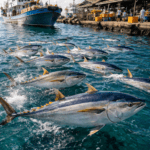
In regions such as the Aru Sea, Arafura Sea, and Eastern Seas, excessive exploitation has affected tuna, skipjack, mackerel tuna, Indian mackerel, squid, shrimp, lobster, crab, and blue swimming crab.
Similar conditions are also found in the Java Sea, where tuna, lobster, and squid are becoming increasingly scarce. According to studies by UCSB and the Marine and Fisheries Research Agency, if overexploitation continues, fish biomass in Indonesian waters could decline by up to 81 percent by 2035.
In recent years, some Indonesian children have shown signs of malnutrition due to a lack of fish consumption, despite fish being a major source of animal protein—more significant than meat and eggs. Ironically, although surrounded by abundant marine resources, most Indonesian fishermen live in poverty. This is also reflected in the fisheries sector’s contribution to Indonesia’s Gross Domestic Product (GDP), which averages only 3.2 percent—an unusually low figure for a maritime nation.
President Joko Widodo introduced a new maritime vision, placing the ocean at the center of the nation’s future, encapsulated in the spirit of Nawa Cita. The goal is strategic and noble: to establish Indonesia as a Global Maritime Axis. “For too long, we have turned our backs on the oceans, seas, straits, and bays.
Starting today, we will restore the glory of our ancestors as brave seafarers, facing storms and waves aboard a ship called the Republic of Indonesia,” Jokowi stated in his first state address after being sworn in as President for the 2014–2019 term on October 20, 2014.
This vision is manifested in the nine pillars of Nawa Cita, with the first emphasizing the return of the state to protect all citizens and provide security through an independent and active foreign policy, reliable national security, and integrated tri-service defense development based on national interests, while strengthening Indonesia’s identity as a maritime nation.
What President Jokowi articulated and embedded in the Nawa Cita reflects a crucial new awareness—a starting point of clarity amid global uncertainty. Making the ocean the future of the nation means that Indonesians, across generations, must be able to live from the sea, now and in the future. This requires safeguarding marine and fisheries resources to ensure sustainability and abundance—not only for Indonesia but also to help feed the world.
To realize this vision, Indonesia’s marine and fisheries sector must become independent, advanced, strong, and grounded in national interests. This is the vision of the Ministry of Marine Affairs and Fisheries (KKP) under Minister Susi Pudjiastuti, structured around three mission pillars: sovereignty, sustainability, and prosperity.
Sovereignty refers to independence in managing and utilizing marine and fisheries resources, supported by strong national capacity for law enforcement at sea to achieve economic sovereignty.
Sustainability emphasizes managing and protecting marine and fisheries resources using environmentally friendly principles to preserve their long-term viability.
Prosperity means that the management of marine and fisheries resources must maximize the welfare of the people. In this regard, KKP prioritizes all stakeholders, including fishermen, aquaculture farmers, fish processors and marketers, salt farmers, and coastal communities.
These three pillars are implemented responsibly, grounded in the spirit of mutual cooperation (gotong royong), which reflects the maritime character of the Indonesian people. Moving forward, collaboration and unity as one nation are essential to generate economic, social, and cultural value.
However, foreign and former foreign vessels continue to use destructive fishing gear, damaging ecosystems and threatening fish stocks. Illegal, unreported, and unregulated (IUU) fishing remains widespread, undermining sovereignty and sustainability.
As a result, the sea—once a reliable source of livelihood—can no longer be depended upon by local fishermen. Their catches continue to decline, as they cannot compete with large foreign vessels, while fish populations diminish alongside damaged ecosystems and coral reefs.
According to Statistics Indonesia (BPS), the number of fishing households declined from 1.6 million in 2003 to around 800,000 in 2013. Additionally, 115 national fish processing companies went bankrupt due to a lack of supply, as illegally caught fish were transported directly overseas.
To address this, KKP introduced comprehensive reforms, beginning with a moratorium on licenses for former foreign vessels under Ministerial Regulation No. 56/2014. Evaluation of 1,605 such vessels revealed widespread violations, including illegal fishing, tax evasion, human trafficking, and smuggling.
KKP also banned transshipment at sea under Regulation No. 57/2014, preventing fish from being transferred directly abroad without reporting. This policy significantly reduced fish supply to foreign processing industries, confirming that much of it originated from illegal fishing in Indonesian waters.
Domestically, strict enforcement was implemented, including the establishment of Task Force 115 through Presidential Regulation No. 115/2015. This multi-agency task force—comprising the Navy, Police, Maritime Security Agency, and Attorney General’s Office—enhances coordination and enforcement to combat illegal fishing.
Further measures included banning foreign investment in capture fisheries under Presidential Regulation No. 44/2016, ensuring that fishing businesses are fully domestically owned, while still allowing foreign investment in fish processing.
These policies have yielded results. Sustainable fish stock levels (Maximum Sustainable Yield/MSY) increased significantly, and illegal fishing has declined sharply since 2015. Hundreds of illegal vessels have been seized and sunk, many from countries such as Vietnam, the Philippines, Malaysia, Thailand, and China.
At the same time, the crackdown has impacted foreign industries that previously relied on illegally sourced fish from Indonesia. Companies in Thailand, China, and the Philippines experienced significant declines due to reduced supply.
Globally, overfishing remains a major concern. The FAO reported that by 2013, around 90 percent of global fishing areas were fully exploited or overfished, up from 60 percent in 1974. This underscores the urgency of sustainable fisheries management.
In Indonesia, IUU fishing is not only an environmental issue but also a multidimensional problem involving economic losses, social impacts, and criminal activities such as human trafficking, forced labor, smuggling, and corruption.
Efforts to combat IUU fishing have also revealed regulatory weaknesses, such as inadequate implementation of the “genuine link” principle under UNCLOS, allowing vessels to operate under false national identities.
Through enforcement, international cooperation, and policy reform, Indonesia continues to strengthen its maritime governance. The ultimate goal is to restore order, protect resources, and ensure that the nation’s vast marine wealth truly benefits its people.
Without decisive action, Indonesia’s oceans risk becoming depleted and degraded. But with strong commitment, law enforcement, and sustainable management, the sea can once again become the foundation of national prosperity and a legacy for future generations.
Sources: MMAF Book: The Transformation of Marine and Fisheries of Indonesia