








MARITIMEPOSTS.COM – In the grand theater of global trade, Southeast Asia offers one of the world’s most compelling maritime contrasts.
On one side of the Malacca Strait stands Indonesia—widely known as the “Maritime Continent”—a vast archipelagic nation blessed with immense natural wealth and strategic geography.
On the other side lies Singapore, a compact city-state that has transformed itself into one of the world’s most powerful global maritime hubs.
Yet, beneath this contrast lies a sobering truth. Indonesia holds the “treasure” in the form of natural resources and geographic scale, while Singapore controls the “map”—the systems, efficiency, and institutions that convert maritime potential into economic power.
While Indonesia’s promise remains largely untapped, Singapore thrives through precision, connectivity, and a highly integrated maritime ecosystem.
Indonesia: Vast Potential, Persistent Paradox
Indonesia’s maritime identity is defined by its extraordinary scale. As the world’s largest archipelagic state, it boasts approximately 108,000 kilometers of coastline—one of the longest in the world—and a maritime territory spanning around 1.9 million square kilometers.
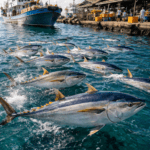
Positioned at the heart of the Coral Triangle, Indonesia is home to roughly 37 percent of the world’s fish species and 76 percent of known coral species.
This abundance translates into enormous economic potential. Estimates suggest Indonesia’s maritime sector could generate between Rp 36,000 trillion and Rp 60,000 trillion annually, with fisheries alone valued at around USD 32 billion and marine biotechnology reaching USD 40 billion.
However, this immense wealth is shadowed by a persistent paradox. Millions of Indonesians who depend on the sea continue to live in poverty.
Around 7.9 million coastal residents—more than a quarter of the nation’s poor—rely directly on marine resources for survival. This disconnect between natural wealth and societal welfare underscores Indonesia’s central challenge: transforming maritime resources into inclusive economic growth.
Singapore: Engineering Maritime Excellence
In stark contrast, Singapore demonstrates how limited natural resources can be overcome through strategic design and institutional excellence. With a land area of just 734 square kilometers and a coastline of roughly 193 kilometers, Singapore has positioned itself as a critical node in the global supply chain.
Its success lies in a deeply integrated maritime ecosystem where shipping, finance, and legal services operate seamlessly. Singapore consistently ranks among the world’s top ports, handling over 39 million TEUs in container throughput and serving as a global transshipment hub.
Beyond physical infrastructure, Singapore has built a powerful ecosystem of maritime services.
It is a global center for shipping finance, maritime insurance, and arbitration, ensuring that economic value is captured not only at the port but across the entire maritime value chain. Investments in advanced infrastructure, such as the Tuas Mega Port, further reinforce its leadership through automation and digital connectivity.
A Stark Comparison
The disparity between Indonesia and Singapore is striking. Indonesia’s vast geography stands in contrast to Singapore’s concentrated efficiency.
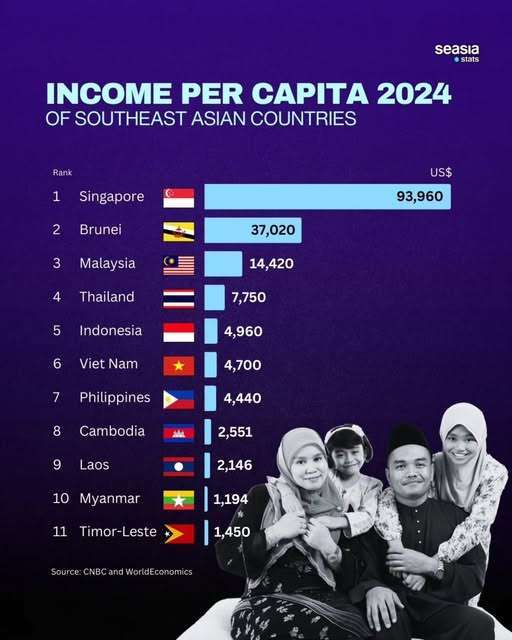
While Indonesia’s GDP per capita remains under USD 5,000, Singapore’s exceeds USD 120,000. Fleet capacity, logistics performance, and ease of doing business all reflect a similar gap.
Even in port performance, the difference is clear. Indonesia’s major port, Tanjung Priok, handles around 17 million TEUs, while Singapore processes more than double that volume.
More importantly, Singapore’s data transparency and global integration further strengthen its competitive edge.
Understanding the Gap
Indonesia’s lag is not a matter of geography, but of systemic challenges. High logistics costs, uneven infrastructure, and limited port connectivity continue to hinder efficiency. Regulatory complexity creates barriers for investors, while dependence on fossil fuels and maritime security concerns add further risks.
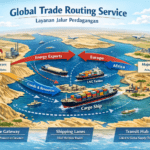
One of the most underutilized assets is Indonesia’s Archipelagic Sea Lanes (ALKI). These strategic maritime corridors serve as global shipping routes, yet Indonesia has not fully captured their economic value. Instead of functioning as revenue-generating arteries, they remain largely passive transit pathways.
Charting a New Course
For Indonesia to emerge as a true maritime power, a fundamental shift in strategy is required. The sea must no longer be seen as a divider, but as a unifying economic engine.
Developing globally competitive hub ports is essential to capture international transshipment traffic. Regulatory reform must simplify business processes and create a more investor-friendly environment.
At the same time, Indonesia must leverage its ALKI corridors by building economic centers along these routes.
Equally critical is the adoption of technology. Investments in port automation and digital logistics systems can significantly reduce costs and improve efficiency. Finally, Indonesia must move beyond resource extraction and develop high-value maritime services, including finance, insurance, and legal expertise.
From Potential to Power
The story of Indonesia and Singapore is not merely a comparison of size, but of strategy. Indonesia possesses the resources—the “treasure”—while Singapore has mastered the systems—the “map.”
For Indonesia, potential alone is not enough. True maritime strength will depend on its ability to combine natural advantages with institutional reform, technological advancement, and economic vision.
Only then can the “Maritime Continent” transform its vast seas into a powerful engine of prosperity—and claim its place as a leading force in the global maritime world.