

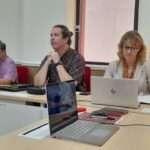


MARITIMEPOSTS.COM – The Halalbihalal gathering held by the Marine Science Alumni Association (ISLA) of Hasanuddin University at Boska Coffee became a moment to explore the experiences and journeys of Marine Science alumni who have made their mark across various “bays” of knowledge exploration.
Behind the hustle and bustle of the oil and gas industry—filled with advanced technology and economic interests—there are individuals who quietly work to maintain environmental balance. One of them is Irma Sabriany.
“I’m Irma, a Marine Science graduate of Unhas, class of 2004—though my friends often call me ‘Cendol’,” she said.
“Currently, I work in the oil and gas sector, specifically in the LNG industry in Papua. My journey to this point has certainly not been instant. I started my career in mining construction projects at Antam, then moved into broader construction work. Along the way, I decided to pursue a master’s degree in environmental science at Institut Teknologi Bandung, which strengthened both my interest and competence in environmental issues,” she explained.
Irma spent about two years working with an NGO from 2015 to 2017 before returning to the industrial sector.
“I was involved in projects in Halmahera, then joined WIKA. Initially, I was assigned to handle safety aspects,” she said.
“From there, I continued developing myself, attending various trainings and eventually obtaining certifications in mining safety and environmental management,” she added.
She admitted that her career has never been far from environmental and waste-related issues.
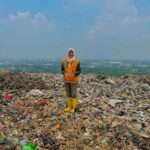
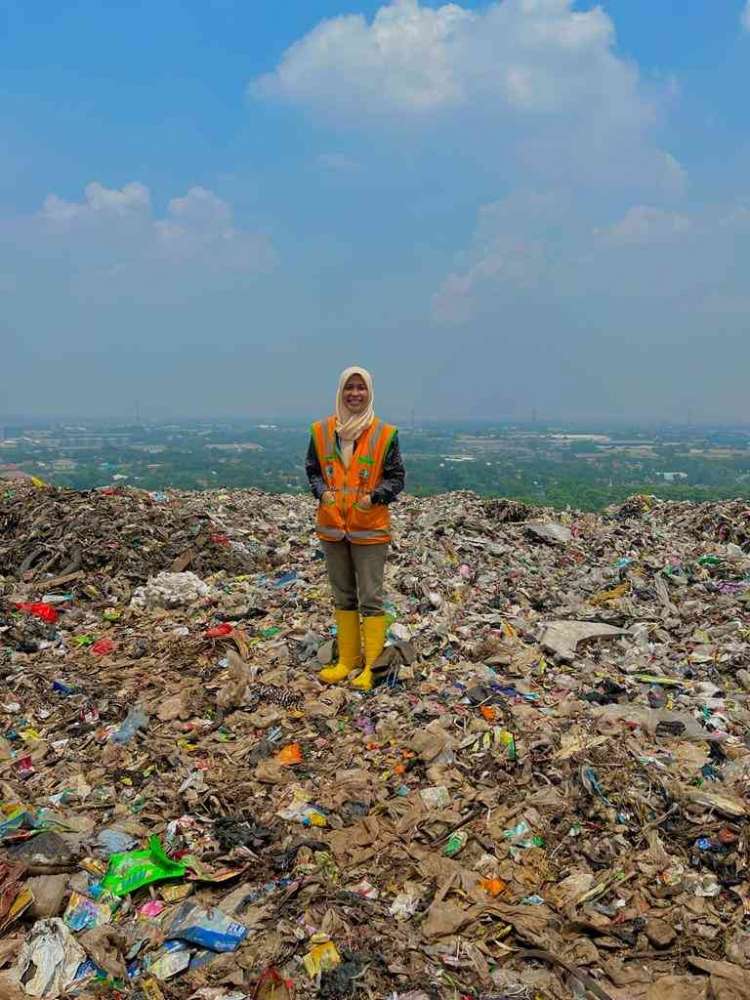
“I was once involved in waste management at Bantargebang Landfill, which gave me valuable experience in understanding the complexity of urban waste. From there, I transitioned into the LNG sector, and now I focus as a specialist handling environmental aspects, particularly waste management,” she noted.
On Competence and Alumni Identity
When asked whether her academic background relates to her current job, Irma affirmed that it does—though not always directly.
“For example, during my master’s, I researched sanitation in coastal areas. That knowledge often comes up in discussions about waste management in coastal project sites where I now work,” she said.
“Working on large-scale projects like this also means competing with graduates from top universities. Of course, there’s a sense of insecurity at first. But over time, I learned that as long as we have competence and a willingness to keep learning, we can compete,” she added.
She also highlighted the challenging nature of fieldwork.
“The location is a remote area, with a roster system—around nine weeks on duty, followed by three weeks off. It’s not just about technical skills, but also mental resilience and adaptability,” she explained.
According to Irma, her journey proves that marine science graduates can thrive in various sectors, including the energy industry. The key is to keep learning, adapting, and daring to seize opportunities.
For Marine Science alumni of Unhas, it almost feels incomplete if they have never experienced the salty breeze of Barrang Lompo Island or conducted research at the university’s Marine Station—symbols of their formative years.
Irma’s career path is not just about profession, but about consistently upholding a principle: that resource exploitation must always go hand in hand with ecological responsibility.
Her background in marine science gave her a strong foundation in understanding coastal and marine ecosystems. But she did not stop there.
“I continued my master’s studies at Institut Teknologi Bandung in environmental science—a step that broadened my perspective from understanding the sea to seeing the environment as an interconnected system,” she said during a conversation at Boska Coffee on Monday, March 31, 2026.
Now, in her role at LNG operations in Bintuni, Papua, Irma—who has traveled across nearly all provinces in Indonesia—stands at the forefront as a guardian of environmental quality.
Her responsibilities are far from simple. Every day, she ensures that operational activities—from production to waste treatment—do not exceed environmental standards.
She is involved in monitoring seawater, air, and soil quality, while also ensuring that hazardous waste is managed according to strict regulations. Beyond technical work, her role demands strong social awareness—bridging corporate interests with the concerns of local communities.
In this context, Irma herself has become an inspiring figure in environmental work. She represents not only ecological awareness but also how science must be practiced with empathy and a commitment to society.
“Environment is not just about data and numbers—it’s also about the people who live within it,” is a principle she holds firmly.
In emergency situations, such as potential oil spills, Irma becomes part of rapid response teams—developing contingency plans, conducting simulations, and taking direct action when incidents occur. Precision and speed are critical, as delays can lead to broader ecological damage.
Her experience at Bantargebang also gave her a unique perspective. She sees a common thread between environmental issues in urban areas and in the energy industry: how humans manage the byproducts of their activities. Whether domestic waste or industrial residue, all require systematic approaches, appropriate technology, and long-term commitment.
From classrooms in Tamalanrea, laboratory experiences in Bandung, to the operational fields of the oil and gas industry, Irma proves one thing: marine science is not just about the sea—it is about understanding and caring for the Earth as a whole.
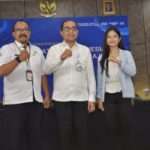
Dean of the Faculty of Marine Science and Fisheries (FIKP) Unhas, Mahatma Lanuru, who attended the event, praised alumni like Irma. He described them as proof that FIKP Unhas graduates are resilient, strong, and able to compete with graduates from any university in Indonesia.
Written by Denun