
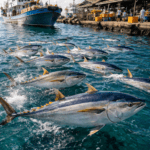









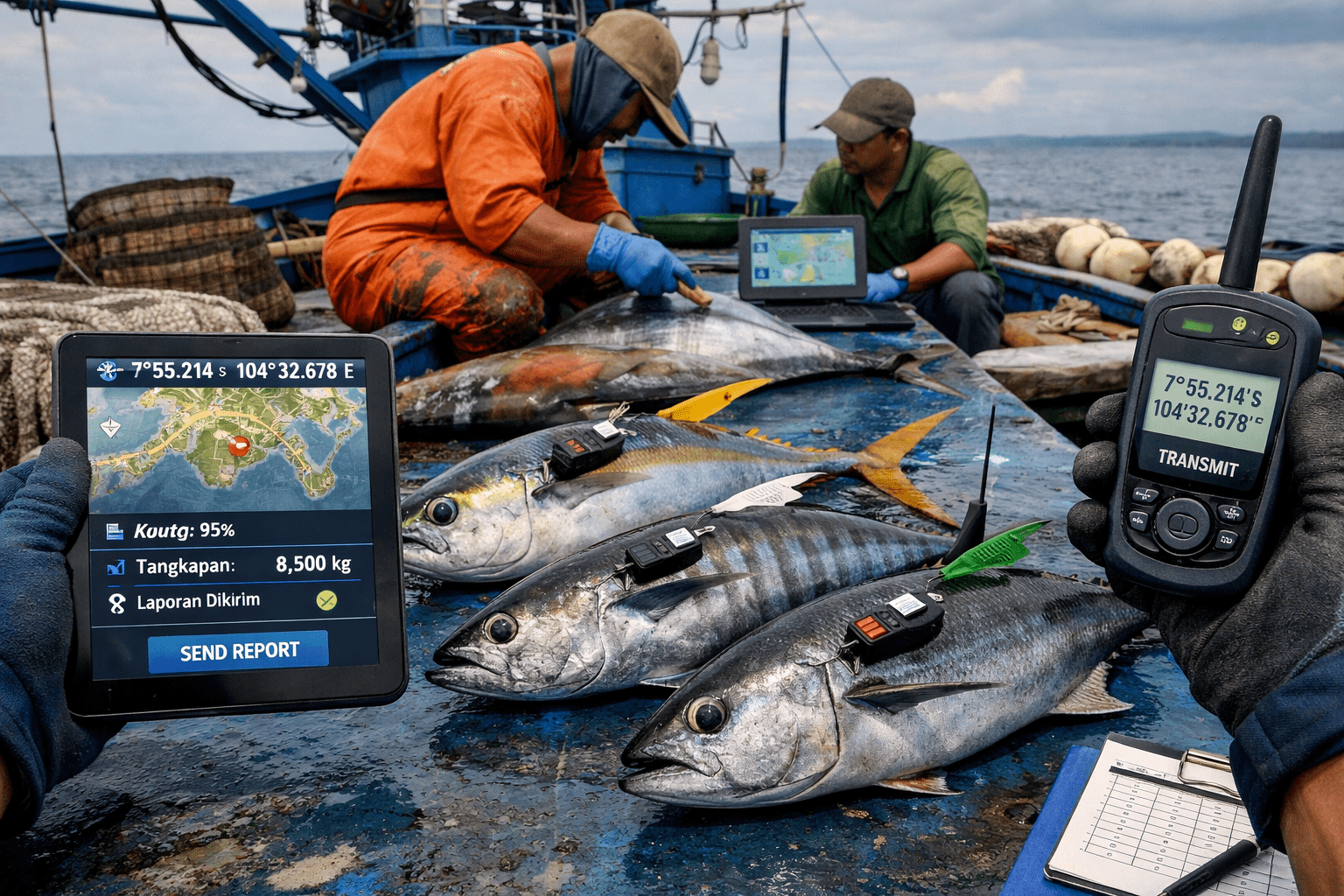
MARITIMEPOSTS.COM – The latest evaluation by the Kementerian Kelautan dan Perikanan sends a clear and urgent signal: Indonesia’s marine resources are under mounting pressure. Of 99 fishery resource groups assessed in 2024, 50 groups (50.51 percent) have already exceeded 100 percent of their allowable catch (JTB)—a direct indication that exploitation has surpassed sustainable limits.
This is not a marginal issue; it is a structural warning that the current model of fisheries utilization is pushing ecosystems beyond their capacity to recover.
A closer look at WPPNRI 712 reinforces the severity of the situation. Key fish stocks such as small pelagic, large pelagic, and demersal fish are being harvested at 166 percent to 230 percent above sustainable thresholds in 2024, following even higher levels in 2023.
Demersal fish, for instance, reached nearly three times (297 percent) the allowable catch just a year earlier. Other commercially important species—including reef fish, crab, blue swimming crab (rajungan), and squid—show similarly excessive exploitation rates.
While a few commodities like lobster and penaeid shrimp remain within or below safe limits, the broader pattern is unmistakable: Indonesia is systematically overfishing its most valuable stocks.
This is precisely why Measured Fishing Policy (Penangkapan Ikan Terukur / PIT) is no longer a policy option—it is an ecological and economic necessity.
Without firm quotas, fishing effort expands unchecked, driven by short-term gains but resulting in long-term depletion.
Overfishing does not only reduce fish populations; it disrupts marine ecosystems, diminishes catch quality, increases operational costs for fishers, and ultimately erodes national fisheries revenue. In other words, the absence of control today guarantees scarcity tomorrow.
PIT offers a science-based solution by aligning catch limits with the biological capacity of fish stocks.
Through quota allocation, spatial zoning, and stricter monitoring, PIT transforms fisheries management from open-access exploitation into controlled, sustainable use.
This is critical not only to restore declining stocks but also to ensure fairness—so that future generations of fishers are not deprived of the same resources that are being exhausted today.
The urgency is undeniable. If current trends persist, sustainability will remain rhetoric rather than reality. But with decisive implementation of PIT—gradually, strategically, and consistently—Indonesia has a real opportunity to reverse overfishing, protect its marine wealth, and secure the long-term viability of its fisheries sector.
___
Editorial Team