







The Big Picture: Why Our Oceans Need a Plan
MARITIMEPOSTS.COM – Indonesia’s vast marine territory is a source of immense pride and a vital resource for our nation’s food security. However, we must recognize that this resource is finite.
For decades, many of our waters operated under an “open-access” system—a model where a lack of strict limits encouraged a “take what you can” mentality. This approach has pushed our marine ecosystems to a precarious breaking point.
To protect the biodiversity of our seas, Indonesia is transitioning from this unregulated model to a “measured” capture system. This shift is about moving from the chaos of over-extraction toward a professionalized, scientific management of our “Blue Economy.”
The Challenge: The Reality of Overfishing
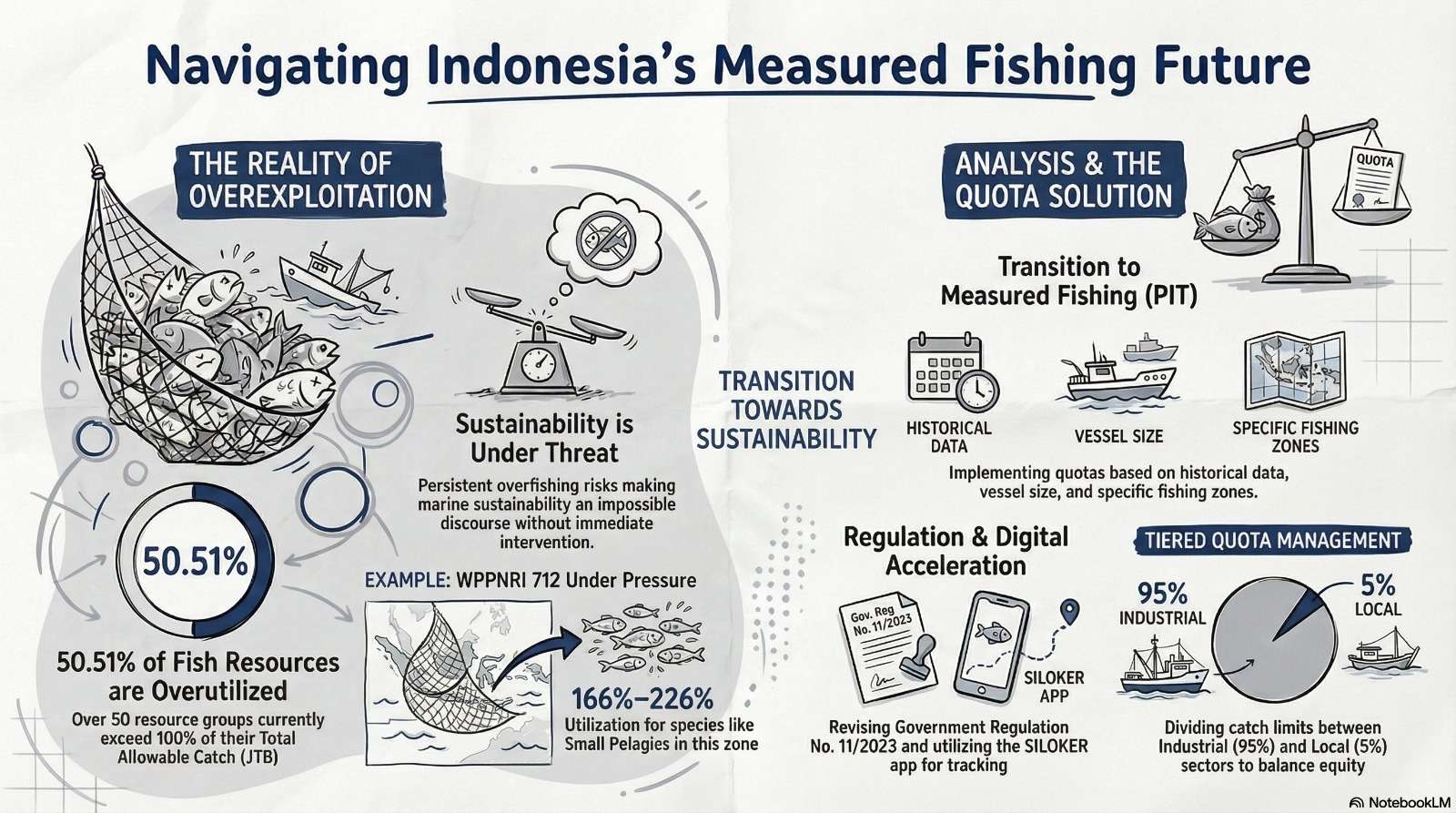
Data from the 2024 fishery resource evaluation reveals a stark reality: 50.51% of fishery resource groups have reached a utilization rate of over 100%. This means we are harvesting fish significantly faster than they can reproduce. Without intervention, the “overfished” status currently affecting half of our stocks will move from a warning to a permanent ecological disaster.
To address this, we need more than just hope; we need a clear map and a set of rigorous, enforceable rules.
Understanding the Map: What is WPPNRI?
To manage 5.8 million square kilometers of water, the government uses a system called WPPNRI (Wilayah Pengelolaan Perikanan Negara Republik Indonesia). Think of these as the “blue provinces” of the sea. Rather than viewing the ocean as one giant, uniform space, WPPNRI allows us to treat different regions as distinct “management units,” each with its own health report and specific ecological needs.
Key zones highlighted in current management include:
- WPPNRI 712 (Java Sea): A region facing intense pressure, where nearly all major species groups are currently over-utilized.
- WPPNRI 714 (Tolo Bay and Banda Sea): A critical management unit for tuna species, including Yellowfin and Bigeye Tuna.
- WPPNRI 718 (Arafura Sea): A vital industrial zone managed specifically for high-value commodities like Penaeid shrimp and squid.
By defining these boundaries, we can set specific catch limits for each area based on exactly what that specific ecosystem can afford to lose without collapsing.
Setting the Limit: The Concept of Allowable Catch (JTB)
The foundation of this new system is the JTB (Jumlah Tangkapan yang Diperbolehkan), or Total Allowable Catch. This is a scientific “red line”—the maximum amount of fish that can be harvested in a year while still allowing the population to recover.
When production exceeds the JTB, we are effectively stealing from the future. The following data from WPPNRI 712 demonstrates why the transition to measured capture is so urgent:
Comparison: Catch Limits vs. Actual Production (2024 Data)
| Species Group | JTB (Limit in Tons) | Actual Production (Tons) | Utilization Rate |
| Small Pelagic Fish | 247,937 | 412,713 | 166% ⚠️ |
| Large Pelagic Fish | 72,932 | 121,034 | 166% ⚠️ |
| Lobster, Crab, & Shellfish | 5,152 | 11,996 | 233% ⚠️ |
| Squid | 16,456 | 28,828 | 175% ⚠️ |
Knowing the limit is only the first step. Human nature often pushes us to ignore these limits for short-term gain, which is why we must move from simply “knowing the number” to a system that enforces it: the PIT system.
The Solution: Measured Fish Capture (PIT) and the Quota System
Penangkapan Ikan Terukur (PIT), or Measured Fish Capture, is the rational solution to the crisis of overfishing. This policy replaces the “first-come, first-served” model with a sophisticated Quota System. Under PIT, the total allowable catch (JTB) is divided into three distinct categories:
- Industrial Quotas: Assigned to large-scale commercial fishing entities.
- Local Fisherman Quotas: Reserved for small-scale fishers operating within 12 nautical miles of the coast, ensuring local communities aren’t displaced by industrial fleets.
- Non-commercial Quotas (Litbangjirat): A dedicated 0.01% of the catch reserved for Education, Research, Development, and Tourism. This ensures the ocean serves our students and scientists, not just the industry.
The 3 Most Important Benefits of PIT
- Ecological Survival: By strictly adhering to the JTB, we ensure fish stocks remain at levels where they can naturally replenish.
- Fair Resource Distribution: Dedicated local quotas guarantee that coastal communities have a protected share of the resources in their own waters.
- Long-term Economic Stability: By avoiding “boom and bust” cycles, we create a predictable industry that can support Indonesian families for generations.
5. Learning from the Field: Case Studies in Quota Management
The quota system is currently being optimized through learning programs for high-value species like Southern Bluefin Tuna (SBT) and Benih Bening Lobster (BBL) or Clear Lobster Seeds. These programs prove that management is about more than just numbers; it is about active monitoring and accountability.
A vital lesson from the SBT fishery is the “Payback” Mechanism. Nature does not reset its clock every January 1st; if a fisher over-harvests their quota this year, that amount is automatically deducted from their quota the following year. Furthermore, the system uses strict Notification Levels to prevent overages:
- 70–80% Usage: Fishers receive a system notification to adjust operations.
- 80–100% Usage: Operations are restricted to specific coordinates, hook depths must be adjusted, and observers must be placed on board.
- >100% Usage: All transshipment of catch is banned, and the Payback penalty is triggered.
Responsibilities of a Modern Fisher
Under the PIT system, fishers are professional stewards of the sea. Their duties include:
- [ ] Obtaining a Quota: Applying via national systems or the SILOKER app (specifically for BBL).
- [ ] Reporting via PIPP: Validating all landings with the Port Authority through the PIPP integrated application.
- [ ] Filling the CDS: Maintaining a Catch Documentation Scheme (CDS) to record exactly what was caught and where.
- [ ] Adhering to the SKA: Ensuring every lobster seed from the wild is accompanied by a Surat Keterangan Asal (SKA) to track its origin and legality.
6. Conclusion: The Student’s Role in a Sustainable Future
The transition to Measured Fish Capture (PIT) represents a fundamental shift in Indonesia’s maritime identity. We are moving away from being a nation that merely “takes” from the sea to one that “harvests” with wisdom and restraint.
For students and future marine professionals, understanding these tools—the WPPNRI maps, the JTB limits, and the SILOKER/PIPP reporting systems—is the first step toward becoming the stewards our oceans need. By combining science with technology, we ensure that Indonesia’s “Blue Future” is not just a dream, but a lasting reality.
“The implementation of measured, quota-based fishing is the only rational path forward. If we respect the limits of the ocean today, its resources will be available to feed and support Indonesia forever.”